

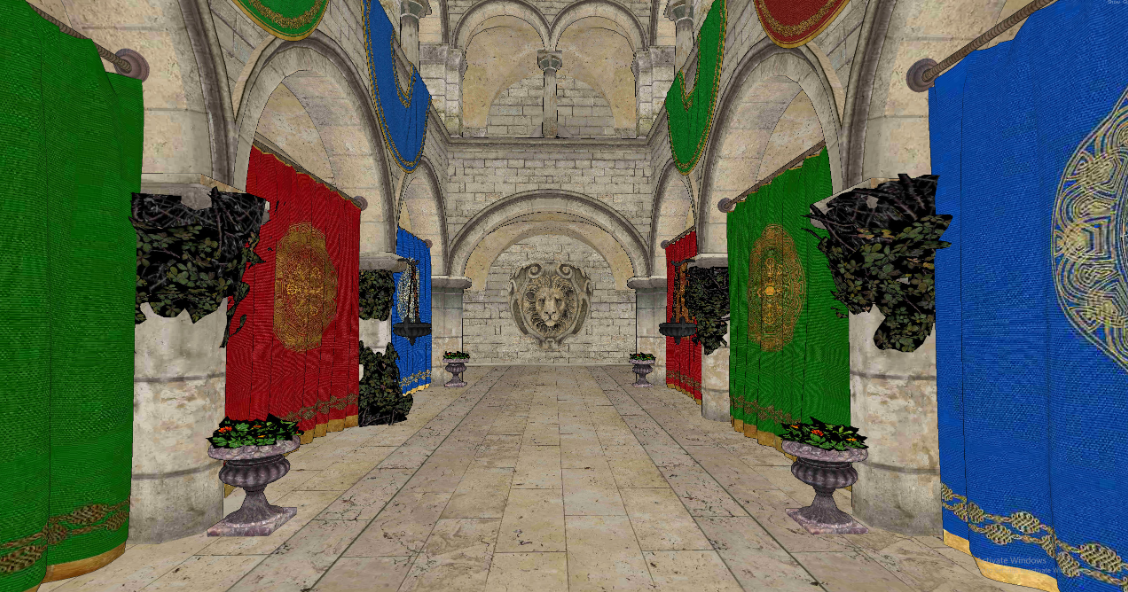
Elias Kristmann , Michael Wimmer, Markus Schütz
Variable‐Rate Texture Compression: Real‐Time Rendering with JPEG
Computer Graphics Forum, 45(2):e70338, May 2026. [ paper]
Information
- Publication Type: Journal Paper with Conference Talk
- Workgroup(s)/Project(s):
- Date: May 2026
- Journal: Computer Graphics Forum
- Volume: 45
- Open Access: yes
- Number: 2
- Location: Aachen, Germany
- Lecturer: Elias Kristmann
- Article Number: e70338
- ISSN: 1467-8659
- Event: Eurographics 2026
- DOI: 10.1111/cgf.70338
- Pages: 13
- Publisher: WILEY
- Conference date: 4. May 2026 – 8. May 2026
- Keywords: CCS Concepts, Image compression, Computing methodologies, real-time rendering, texture compression
Abstract
Although variable-rate compressed image formats such as JPEG are widely used to efficiently encode images, they have not found their way into real-time rendering due to special requirements such as random access to individual texels. In this paper, we investigate the feasibility of variable-rate texture compression on modern GPUs using the JPEG format, and how it compares to the GPU-friendly fixed-rate compression approaches BC1 and ASTC. Using a deferred rendering pipeline, we are able to identify the subset of blocks that are needed for a given frame, decode these, and colorize the framebuffer's pixels. Despite the additional ∼0.17 bit per pixel that we require for our approach, JPEG maintains significantly better quality and compression rates compared to BC1, and depending on the type of image, outperforms or competes with ASTC. The JPEG rendering pipeline increases rendering duration by less than 0.3 ms on an NVIDIA RTX 4090, demonstrating that sophisticated variable-rate compression schemes are feasible on modern GPUs, even in VR. Source code and data sets are available at: https://github.com/elias1518693/jpeg_textures.Additional Files and Images

Weblinks
BibTeX
@article{kristmann-2026-vtc,
  title =      "Variable‐Rate Texture Compression: Real‐Time Rendering
               with JPEG",
  author =     "Elias Kristmann and Michael Wimmer and Markus Sch\"{u}tz",
  year =       "2026",
  abstract =   "Although variable-rate compressed image formats such as JPEG
               are widely used to efficiently encode images, they have not
               found their way into real-time rendering due to special
               requirements such as random access to individual texels. In
               this paper, we investigate the feasibility of variable-rate
               texture compression on modern GPUs using the JPEG format,
               and how it compares to the GPU-friendly fixed-rate
               compression approaches BC1 and ASTC. Using a deferred
               rendering pipeline, we are able to identify the subset of
               blocks that are needed for a given frame, decode these, and
               colorize the framebuffer's pixels. Despite the additional
               ∼0.17 bit per pixel that we require for our approach, JPEG
               maintains significantly better quality and compression rates
               compared to BC1, and depending on the type of image,
               outperforms or competes with ASTC. The JPEG rendering
               pipeline increases rendering duration by less than 0.3 ms on
               an NVIDIA RTX 4090, demonstrating that sophisticated
               variable-rate compression schemes are feasible on modern
               GPUs, even in VR. Source code and data sets are available
               at: https://github.com/elias1518693/jpeg_textures.",
  month =      may,
  journal =    "Computer Graphics Forum",
  volume =     "45",
  number =     "2",
  articleno =  "e70338",
  issn =       "1467-8659",
  doi =        "10.1111/cgf.70338",
  pages =      "13",
  publisher =  "WILEY",
  keywords =   "CCS Concepts, Image compression, Computing methodologies,
               real-time rendering, texture compression",
  URL =        "https://www.cg.tuwien.ac.at/research/publications/2026/kristmann-2026-vtc/",
}