

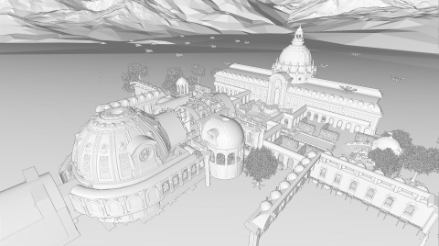
Markus Schütz , Lukas Lipp, Elias Kristmann, Michael Wimmer
CuRast: Cuda-Based Software Rasterization for Billions of Triangles
Computer Graphics Forum, 45(4):e70538, July 2026. [ paper]
Information
- Publication Type: Journal Paper with Conference Talk
- Workgroup(s)/Project(s):
- Date: July 2026
- Journal: Computer Graphics Forum
- Volume: 45
- Number: 4
- Location: Bordeaux, France
- Lecturer: Markus Schütz
- Article Number: e70538
- ISSN: 1467-8659
- Event: Eurographics Symposium on Rendering 2026
- DOI: 10.1111/cgf.70538
- Conference date: 1. July 2026 – 3. July 2026
- Keywords: real-time rendering, software rasterization
Abstract
This paper presents a CUDA-based software rasterizer capable of rendering up to a billion unique triangles, or up to 4 billion instanced triangles, in real time at 60 fps on an RTX 5090. By specifically targeting dense, opaque meshes, our approach is able to outperform the native GPU rasterization pipeline in these scenarios. The resulting performance enables rapid loading and visualization of massive triangle datasets without requiring precomputed spatial acceleration or level-of-detail structures, and supports applications such as efficient editing of large-scale geometry. While the method is primarily designed for dense meshes that generate pixel-sized triangles, we additionally introduce a three-stage pipeline to handle larger primitives. The source code is available at: https://github.com/m-schuetz/CuRastAdditional Files and Images

Weblinks
- DOI: 10.1111/cgf.70538
BibTeX
@article{SCHUETZ-2026-CURAST,
  title =      "CuRast: Cuda-Based Software Rasterization for Billions of
               Triangles",
  author =     "Markus Sch\"{u}tz and Lukas Lipp and Elias Kristmann and
               Michael Wimmer",
  year =       "2026",
  abstract =   "This paper presents a CUDA-based software rasterizer capable
               of rendering up to a billion unique triangles, or up to 4
               billion instanced triangles, in real time at 60 fps on an
               RTX 5090. By specifically targeting dense, opaque meshes,
               our approach is able to outperform the native GPU
               rasterization pipeline in these scenarios. The resulting
               performance enables rapid loading and visualization of
               massive triangle datasets without requiring precomputed
               spatial acceleration or level-of-detail structures, and
               supports applications such as efficient editing of
               large-scale geometry. While the method is primarily designed
               for dense meshes that generate pixel-sized triangles, we
               additionally introduce a three-stage pipeline to handle
               larger primitives. The source code is available at:
               https://github.com/m-schuetz/CuRast",
  month =      jul,
  journal =    "Computer Graphics Forum",
  volume =     "45",
  number =     "4",
  articleno =  "e70538",
  issn =       "1467-8659",
  doi =        "10.1111/cgf.70538",
  keywords =   "real-time rendering, software rasterization",
  URL =        "https://www.cg.tuwien.ac.at/research/publications/2026/SCHUETZ-2026-CURAST/",
}