

Tobias Klein, Ivan Viola , Eduard Gröller, Peter Mindek
Multi-Scale Procedural Animations of Microtubule Dynamics Based on Measured Data
IEEE Transactions on Visualization and Computer Graphics, 26(1):622-632, August 2019. [ paper]
Information
- Publication Type: Journal Paper with Conference Talk
- Workgroup(s)/Project(s):
- Date: August 2019
- Journal: IEEE Transactions on Visualization and Computer Graphics
- Volume: 26
- Number: 1
- Lecturer: Tobias Klein
- Event: IEEE VIS 2019
- DOI: 10.1109/TVCG.2019.2934612
- Call for Papers: Call for Paper
- Conference date: 2019
- Pages: 622 – 632
Abstract
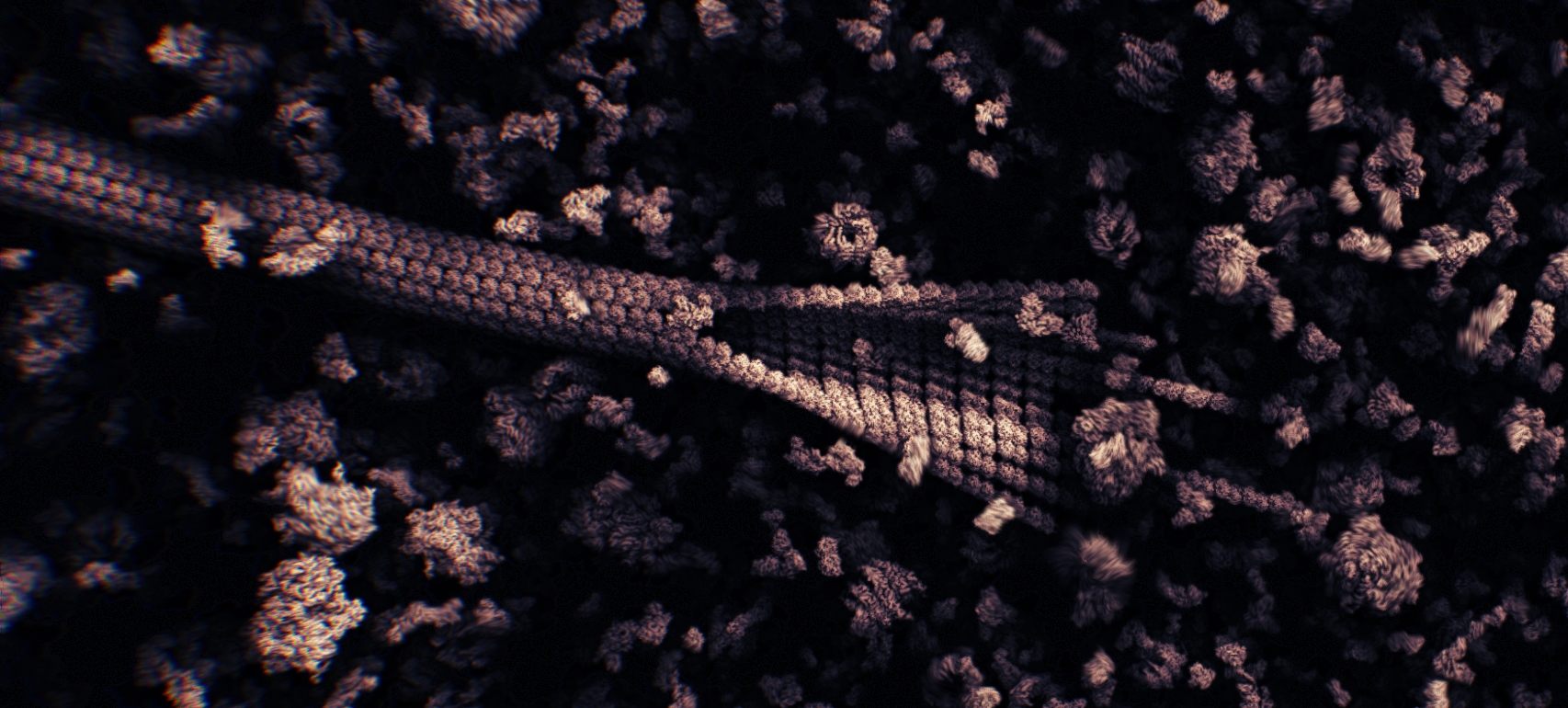
Biologists often use computer graphics to visualize structures, which due to physical limitations are not possible to imagewith a microscope. One example for such structures are microtubules, which are present in every eukaryotic cell. They are part ofthe cytoskeleton maintaining the shape of the cell and playing a key role in the cell division. In this paper, we propose a scientifically-accurate multi-scale procedural model of microtubule dynamics as a novel application scenario for procedural animation, which cangenerate visualizations of their overall shape, molecular structure, as well as animations of the dynamic behaviour of their growth anddisassembly. The model is spanning from tens of micrometers down to atomic resolution. All the aspects of the model are driven byscientific data. The advantage over a traditional, manual animation approach is that when the underlying data change, for instance dueto new evidence, the model can be recreated immediately. The procedural animation concept is presented in its generic form, withseveral novel extensions, facilitating an easy translation to other domains with emergent multi-scale behavior.Additional Files and Images


Weblinks
BibTeX
@article{klein_2019_PMP,
  title =      "Multi-Scale Procedural Animations of Microtubule Dynamics
               Based on Measured Data",
  author =     "Tobias Klein and Ivan Viola and Eduard Gr\"{o}ller and Peter
               Mindek",
  year =       "2019",
  abstract =   "Biologists often use computer graphics to visualize
               structures, which due to physical limitations are not
               possible to imagewith a microscope. One example for such
               structures are microtubules, which are present in every
               eukaryotic cell. They are part ofthe cytoskeleton
               maintaining the shape of the cell and playing a key role in
               the cell division. In this paper, we propose a
               scientifically-accurate multi-scale procedural model of
               microtubule dynamics as a novel application scenario for
               procedural animation, which cangenerate visualizations of
               their overall shape, molecular structure, as well as
               animations of the dynamic behaviour of their growth
               anddisassembly. The model is spanning from tens of
               micrometers down to atomic resolution. All the aspects of
               the model are driven byscientific data. The advantage over a
               traditional, manual animation approach is that when the
               underlying data change, for instance dueto new evidence, the
               model can be recreated immediately. The procedural animation
               concept is presented in its generic form, withseveral novel
               extensions, facilitating an easy translation to other
               domains with emergent multi-scale behavior.",
  month =      aug,
  journal =    "IEEE Transactions on Visualization and Computer Graphics",
  volume =     "26",
  number =     "1",
  doi =        "10.1109/TVCG.2019.2934612",
  pages =      "622--632",
  URL =        "https://www.cg.tuwien.ac.at/research/publications/2019/klein_2019_PMP/",
}