

 Thesis
Information
- Publication Type: PhD-Thesis
- Workgroup(s)/Project(s):
- Date: October 2010
- TU Wien Library:
- Second Supervisor: Peter Wonka

- 1st Reviewer: Michael Wimmer
- 2nd Reviewer: Peter Wonka
- Rigorosum: 16. November 2010
- First Supervisor: Michael Wimmer
- Keywords: Procedural Modeling, Urban Layouts, Interactive Control
Abstract
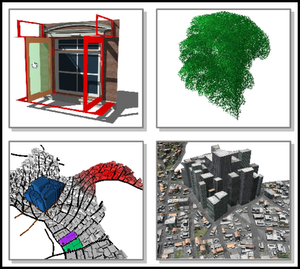
Creating 3D digital assets of urban environments is a challenging task, requiring a significant amount of manual labor. To automate parts of this process, many procedural modeling methods to automatically create buildings, plants or entire cities were introduced. The main advantage of such methods compared to manual methods is the ability to create large amounts of assets using just a few parameters as input data.However, the main disadvantage is the difficulty to control or predict the output of such methods. Direct controllability is especially important for artists enabling them to model the output to their vision or requirements. Therefore, the main goal of this thesis is combining the direct control provided by manual methods with the power of procedural modeling.
To achieve this, several new methods and paradigms bringing direct and visual artist control to procedural generation of urban environments are contributed in this thesis. These include a method enabling a visual design process for building grammars, as well as methods providing direct artist control for architecture generation algorithms. To model whole cities, we introduce a layering system for urban layouts based on graph cut, contributing the ability to perform direct and persistent changes to a procedurally generated city. Additionally, the concept of anchored assignments is introduced, enabling direct control of parameter distributions on cities. Finally, as real-time performance of generation algorithms is paramount if they are to be used in a production setting, we introduce an algorithm able to parallelize the work of L-system generation to thousands of processors.
Additional Files and Images


Weblinks
No further information available.BibTeX
@phdthesis{lipp_markus-2010-DAC,
  title =      "Direct Artist Control for Procedural Content Generation of
               Urban Environments",
  author =     "Markus Lipp",
  year =       "2010",
  abstract =   "Creating 3D digital assets of urban environments is a
               challenging task, requiring a significant amount of manual
               labor. To automate parts of this process, many procedural
               modeling methods to automatically create buildings, plants
               or entire cities were introduced. The main advantage of such
               methods compared to manual methods is the ability to create
               large amounts of assets using just a few parameters as input
               data.   However, the main disadvantage is the difficulty to
               control or predict the output of such methods. Direct
               controllability is especially important for artists enabling
               them to model the output to their vision or requirements.
               Therefore, the main goal of this thesis is combining the
               direct control provided by manual methods with the power of
               procedural modeling.  To achieve this, several new methods
               and paradigms bringing direct and visual artist control to
               procedural generation of urban environments are contributed
               in this thesis. These include a method enabling a visual
               design process for building grammars, as well as methods
               providing direct artist control for architecture generation
               algorithms. To model whole cities, we introduce a layering
               system for urban layouts based on graph cut, contributing
               the ability to perform direct and persistent changes to a
               procedurally generated city. Additionally, the concept of
               anchored assignments is introduced, enabling direct control
               of parameter distributions on cities. Finally, as real-time
               performance of generation algorithms is paramount if they
               are to be used in a production setting, we introduce an
               algorithm able to parallelize the work of L-system
               generation to thousands of processors.",
  month =      oct,
  address =    "Favoritenstrasse 9-11/E193-02, A-1040 Vienna, Austria",
  school =     "Institute of Computer Graphics and Algorithms, Vienna
               University of Technology ",
  keywords =   "Procedural Modeling, Urban Layouts, Interactive Control",
  URL =        "https://www.cg.tuwien.ac.at/research/publications/2010/lipp_markus-2010-DAC/",
}