

Annalena Ulschmid , M. Ott, J. Macho, Michael Wimmer, Stefan Ohrhallinger
NAADF: Globally Illuminated Voxel Worlds Accelerated with Nested Axis‐Aligned Distance Fields
Computer Graphics Forum, 45(2):53, May 2026. [ paper] [GitHub]
Information
- Publication Type: Journal Paper with Conference Talk
- Workgroup(s)/Project(s):
- Date: May 2026
- Journal: Computer Graphics Forum
- Volume: 45
- Open Access: yes
- Number: 2
- Lecturer: Annalena Ulschmid
- Article Number: 53
- ISSN: 1467-8659
- Event: Eurographics 2026
- DOI: 10.1111/cgf.70413
- Pages: 14
- Publisher: WILEY
- Conference date: May 2026
- Keywords: CCS Concepts, Volumetric models, Computing methodologies → Ray tracing, Voxel Worlds, Rendering, Distance Fields, Global Illumination
Abstract
Achieving realistic rendering of 3D scenes in real time using path tracing is challenging due to the high sample count required, with ray tracing as the bottleneck. Focusing on voxels as a geometry representation offers significant opportunities for optimizations, especially for tracing the rays, but also for computing the samples. We propose a novel multilayered spatial structure augmented with in-cell axis-aligned distance fields (AADF) operating as caches. Our nested cell structure already accelerates ray tracing 3-5x compared to the state-of-the-art dense spatial structures, such as variants of directed acyclic graphs (DAG). Using the AADFs (constructed while rendering) inside the cells, we can double the ray throughput again (total 10x). As an application, exploiting nested AADFs (NAADFs) also allows us to double the speed of global illumination computations while significantly reducing artifacts from camera motion, such as flickering, blurring, ghosting, and aliasing, all of which are especially important in voxel worlds with sharp edges. We achieve this by adapting temporal antialiasing (TAA) to retain the last 32 frames rather than a single history buffer to create the final antialiased image, since the discretized voxel structure requires much less memory to store the quantized positions and normals of ray bounces. The sample accumulation for global illumination is optimized by compressing and separating lit/unlit samples, and we apply 8x8 window spatial resampling based on a reservoir-based spatiotemporal importance resampling (ReSTIR) method. Our proposed NAADFs support editing with quick updates to the acceleration in the background, overlays of non-aligned dynamic geometry, and can be easily extended to support transform-aware compression or to represent huge real-world scans. Retaining many past frames rather than just combining them opens up new opportunities to remove spatial and temporal artifacts in path tracing for global illumination.Additional Files and Images
Additional images and videos
image:
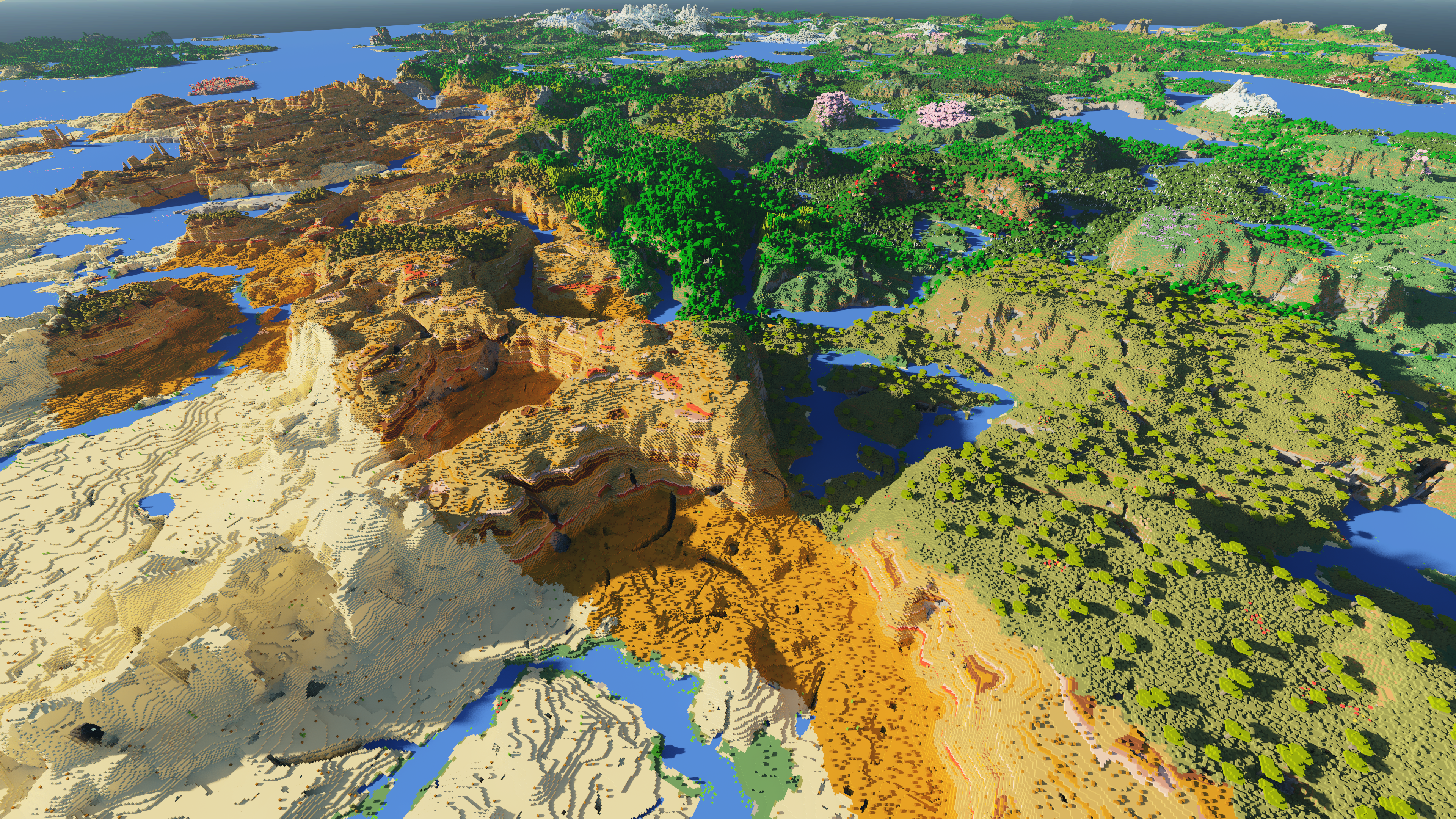
Rendering of a large voxel world
 teaser:
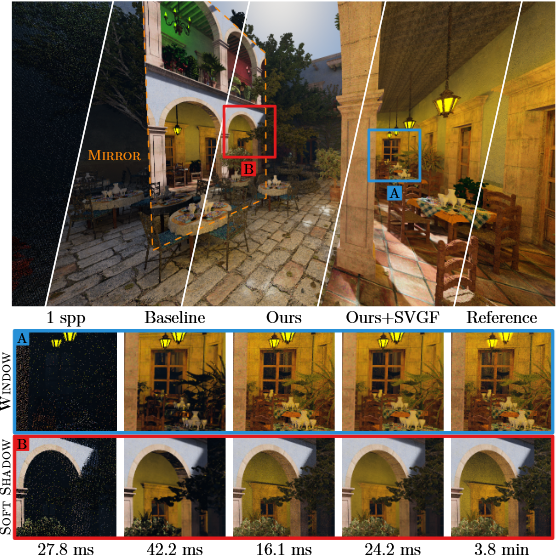
Comparison of ReSTIR and TAA algorithms
teaser:
Comparison of ReSTIR and TAA algorithms
 video 1:
Showcase of NAADFs, entites and editing
video 1:
Showcase of NAADFs, entites and editing
 video 2:
Rendering showcase
video 2:
Rendering showcase
Additional files

Weblinks
BibTeX
@article{ulschmid-2026-naadf,
  title =      "NAADF: Globally Illuminated Voxel Worlds Accelerated with
               Nested Axis‐Aligned Distance Fields",
  author =     "Annalena Ulschmid and M. Ott and J. Macho and Michael Wimmer
               and Stefan Ohrhallinger",
  year =       "2026",
  abstract =   "Achieving realistic rendering of 3D scenes in real time
               using path tracing is challenging due to the high sample
               count required, with ray tracing as the bottleneck. Focusing
               on voxels as a geometry representation offers significant
               opportunities for optimizations, especially for tracing the
               rays, but also for computing the samples. We propose a novel
               multilayered spatial structure augmented with in-cell
               axis-aligned distance fields (AADF) operating as caches. Our
               nested cell structure already accelerates ray tracing 3-5x
               compared to the state-of-the-art dense spatial structures,
               such as variants of directed acyclic graphs (DAG). Using the
               AADFs (constructed while rendering) inside the cells, we can
               double the ray throughput again (total 10x). As an
               application, exploiting nested AADFs (NAADFs) also allows us
               to double the speed of global illumination computations
               while significantly reducing artifacts from camera motion,
               such as flickering, blurring, ghosting, and aliasing, all of
               which are especially important in voxel worlds with sharp
               edges. We achieve this by adapting temporal antialiasing
               (TAA) to retain the last 32 frames rather than a single
               history buffer to create the final antialiased image, since
               the discretized voxel structure requires much less memory to
               store the quantized positions and normals of ray bounces.
               The sample accumulation for global illumination is optimized
               by compressing and separating lit/unlit samples, and we
               apply 8x8 window spatial resampling based on a
               reservoir-based spatiotemporal importance resampling
               (ReSTIR) method. Our proposed NAADFs support editing with
               quick updates to the acceleration in the background,
               overlays of non-aligned dynamic geometry, and can be easily
               extended to support transform-aware compression or to
               represent huge real-world scans. Retaining many past frames
               rather than just combining them opens up new opportunities
               to remove spatial and temporal artifacts in path tracing for
               global illumination.",
  month =      may,
  journal =    "Computer Graphics Forum",
  volume =     "45",
  number =     "2",
  articleno =  "53",
  issn =       "1467-8659",
  doi =        "10.1111/cgf.70413",
  pages =      "14",
  publisher =  "WILEY",
  keywords =   "CCS Concepts, Volumetric models, Computing methodologies →
               Ray tracing, Voxel Worlds, Rendering, Distance Fields,
               Global Illumination",
  URL =        "https://www.cg.tuwien.ac.at/research/publications/2026/ulschmid-2026-naadf/",
}