

Thomas Lutonsky , Viktor Birschitzky, Stefan Jeschke, Andreas Buttinger-Kreuzhuber, Nils Wandel, Daniel Cornel, Viola Haase, Reinhard Klein, Jürgen Waser, Michael Wimmer
Deep learning with upstream-aware terrain representations and rainfall adapter for generalizable pluvial flood prediction
Journal of Hydrology, 680(B), November 2026.
Information
- Publication Type: Journal Paper (without talk)
- Workgroup(s)/Project(s):
- Date: November 2026
- Article Number: 136500
- DOI: 10.1016/j.jhydrol.2026.136500
- ISSN: 1879-2707
- Journal: Journal of Hydrology
- Number: B
- Pages: 14
- Volume: 680
- Publisher: ELSEVIER
- Keywords: Pluvial flooding prediction, Deep learning, Data-driven modeling, Two-stage training
Abstract
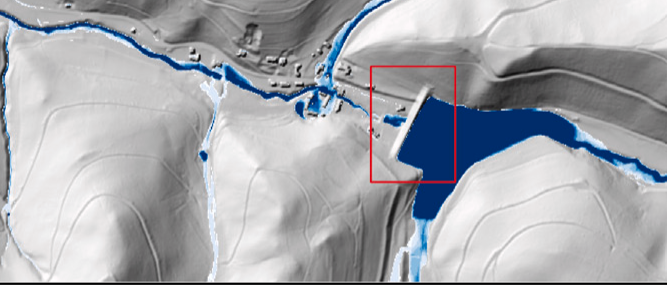
Deep learning-based surrogate models can substantially accelerate pluvial flood simulations. However, most existing approaches struggle to generalize across heterogeneous terrains or modified topographies, limiting their applicability for real-world flood risk assessment unless retrained for each specific terrain. In this work, we investigate how deep learning flood surrogates can be designed to achieve robust spatial generalization across previously unseen terrain configurations without retraining. We train an attention-enhanced U-Net on diverse terrain and introduce upstream-aware input maps that propagate terrain properties into downstream regions, allowing the model to capture long-range spatial dependencies and supporting the learning of generalizable spatial features. In addition, we add architectural design choices to improve the model’s capacity to generalize beyond the training domain. We further propose a two-stage training strategy with an adapter-like rainfall encoder that enables efficient adaptation to previously unseen rainfall intensities while preserving spatial generalizability. The resulting model predicts maximum water depths and is evaluated on unseen catchments in Germany, Austria and Denmark, as well as on artificially modified terrains, such as terrains with added dikes. Our results demonstrate that combining a large training dataset with upstream-aware terrain representations and a generalization-oriented architectural design enables accurate flood predictions across unseen terrains, reaching an RMSE of 0.05m and CSI0.3 of 0.83 over all test domains.Additional Files and Images

Weblinks
BibTeX
@article{lutonsky-2026-dlw,
  title =      "Deep learning with upstream-aware terrain representations
               and rainfall adapter for generalizable pluvial flood
               prediction",
  author =     "Thomas Lutonsky and Viktor Birschitzky and Stefan Jeschke
               and Andreas Buttinger-Kreuzhuber and Nils Wandel and Daniel
               Cornel and Viola Haase and Reinhard Klein and J\"{u}rgen
               Waser and Michael Wimmer",
  year =       "2026",
  abstract =   "Deep learning-based surrogate models can substantially
               accelerate pluvial flood simulations. However, most existing
               approaches struggle to generalize across heterogeneous
               terrains or modified topographies, limiting their
               applicability for real-world flood risk assessment unless
               retrained for each specific terrain. In this work, we
               investigate how deep learning flood surrogates can be
               designed to achieve robust spatial generalization across
               previously unseen terrain configurations without retraining.
               We train an attention-enhanced U-Net on diverse terrain and
               introduce upstream-aware input maps that propagate terrain
               properties into downstream regions, allowing the model to
               capture long-range spatial dependencies and supporting the
               learning of generalizable spatial features. In addition, we
               add architectural design choices to improve the model’s
               capacity to generalize beyond the training domain. We
               further propose a two-stage training strategy with an
               adapter-like rainfall encoder that enables efficient
               adaptation to previously unseen rainfall intensities while
               preserving spatial generalizability. The resulting model
               predicts maximum water depths and is evaluated on unseen
               catchments in Germany, Austria and Denmark, as well as on
               artificially modified terrains, such as terrains with added
               dikes. Our results demonstrate that combining a large
               training dataset with upstream-aware terrain representations
               and a generalization-oriented architectural design enables
               accurate flood predictions across unseen terrains, reaching
               an RMSE of 0.05m and CSI0.3 of 0.83 over all test domains.",
  month =      nov,
  articleno =  "136500",
  doi =        "10.1016/j.jhydrol.2026.136500",
  issn =       "1879-2707",
  journal =    "Journal of Hydrology",
  number =     "B",
  pages =      "14",
  volume =     "680",
  publisher =  "ELSEVIER",
  keywords =   "Pluvial flooding prediction, Deep learning, Data-driven
               modeling, Two-stage training",
  URL =        "https://www.cg.tuwien.ac.at/research/publications/2026/lutonsky-2026-dlw/",
}