

Shervin Rasoulzadeh , Raman Suliman, Arvin Rasoulzadeh, Iva Kovacic, Michael Wimmer
Strokes2Deform: Physics-informed learning of deformation fields on 3D stroke clouds
Computers & Graphics, 138:104629, August 2026. [ paper]
Information
- Publication Type: Journal Paper with Conference Talk
- Workgroup(s)/Project(s):
- Date: August 2026
- Journal: Computers & Graphics
- Volume: 138
- Open Access: yes
- Location: Valencia, Spain
- Lecturer: Shervin Rasoulzadeh
- Article Number: 104629
- ISSN: 1873-7684
- Event: Spanish Conference on Computer Graphics (CEIG 26)
- DOI: 10.1016/j.cag.2026.104629
- Pages: 10
- Publisher: PERGAMON-ELSEVIER SCIENCE LTD
- Conference date: 1. June 2026 – 3. June 2026
- Keywords: Deformable models, Physical AI, Sketch-analysis
Abstract
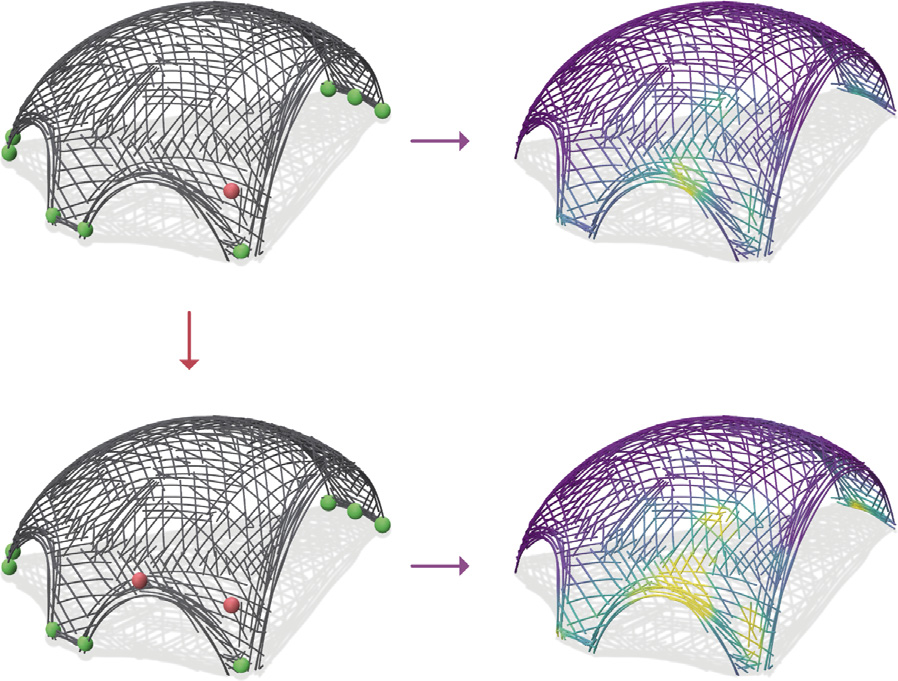
In the 3D architectural design process, deformation analysis of a designed object is a fundamental step. However, such a step is usually inaccessible to designers in the early sketching phase, limiting designers’ ability to reason about the shape’s structural stability. To bridge this gap, we propose Strokes2Deform, an end-to-end learning-based model that enables deformation-aware 3D sketching, requiring neither (surface) reconstruction nor (physical) simulation. Our physics-informed neural network takes as input a 3D sketch stroke cloud and user-specified boundary conditions, and directly predicts the induced deformation field on the 3D stroke cloud. Key to our method is: (i) a synthetic dataset of 40K 3D sketch–deformation pairs of architectural thin-shell structures and their corresponding deformation fields derived from Finite Element (FE) analysis, (ii) the use of fVDB to encode 3D sketch stroke clouds and their per-point features into sparse voxel grids with attributes, and leveraging its differentiable splatting and sampling operators for bidirectional point–voxel mappings, (iii) a dual-head neural network architecture that decouples deformation field prediction into unit-length displacement vectors and scalar displacement magnitudes, and (iv) our physics-informed loss functions derived from thin-shell deformation principles. We validate our method through extensive experiments, demonstrating accurate deformation prediction across sketches of varying complexity and strong agreement with reference deformations derived from FE simulations.Additional Files and Images

Weblinks
BibTeX
@article{RAOULZADEH-2026-STROKES2DEFORM,
  title =      "Strokes2Deform: Physics-informed learning of deformation
               fields on 3D stroke clouds",
  author =     "Shervin Rasoulzadeh and Raman Suliman and Arvin Rasoulzadeh
               and Iva Kovacic and Michael Wimmer",
  year =       "2026",
  abstract =   "In the 3D architectural design process, deformation analysis
               of a designed object is a fundamental step. However, such a
               step is usually inaccessible to designers in the early
               sketching phase, limiting designers’ ability to reason
               about the shape’s structural stability. To bridge this
               gap, we propose Strokes2Deform, an end-to-end learning-based
               model that enables deformation-aware 3D sketching, requiring
               neither (surface) reconstruction nor (physical) simulation.
               Our physics-informed neural network takes as input a 3D
               sketch stroke cloud and user-specified boundary conditions,
               and directly predicts the induced deformation field on the
               3D stroke cloud. Key to our method is: (i) a synthetic
               dataset of 40K 3D sketch–deformation pairs of
               architectural thin-shell structures and their corresponding
               deformation fields derived from Finite Element (FE)
               analysis, (ii) the use of fVDB to encode 3D sketch stroke
               clouds and their per-point features into sparse voxel grids
               with attributes, and leveraging its differentiable splatting
               and sampling operators for bidirectional point–voxel
               mappings, (iii) a dual-head neural network architecture that
               decouples deformation field prediction into unit-length
               displacement vectors and scalar displacement magnitudes, and
               (iv) our physics-informed loss functions derived from
               thin-shell deformation principles. We validate our method
               through extensive experiments, demonstrating accurate
               deformation prediction across sketches of varying complexity
               and strong agreement with reference deformations derived
               from FE simulations.",
  month =      aug,
  journal =    "Computers & Graphics",
  volume =     "138",
  articleno =  "104629",
  issn =       "1873-7684",
  doi =        "10.1016/j.cag.2026.104629",
  pages =      "10",
  publisher =  "PERGAMON-ELSEVIER SCIENCE LTD",
  keywords =   "Deformable models, Physical AI, Sketch-analysis",
  URL =        "https://www.cg.tuwien.ac.at/research/publications/2026/RAOULZADEH-2026-STROKES2DEFORM/",
}