

Tazzio Ludwig Weydemann
Non-uniform offsetting of surfaces
[ thesis]
Information
- Publication Type: Master Thesis
- Workgroup(s)/Project(s):
- Date: November 2025
- Date (Start): 11. August 2016
- Date (End): 24. November 2025
- TU Wien Library: AC17720179
- Diploma Examination: 24. November 2025
- Open Access: yes
- First Supervisor: Michael Wimmer

- Pages: 92
- Keywords: Offset Surfaces, Non-Uniform Offset, Volumetric Method, Octree, Dual Contouring, Radial Basis Function, Per-Vertex Control, k-d Tree, Signed Distance Field, Computer Graphics
Abstract
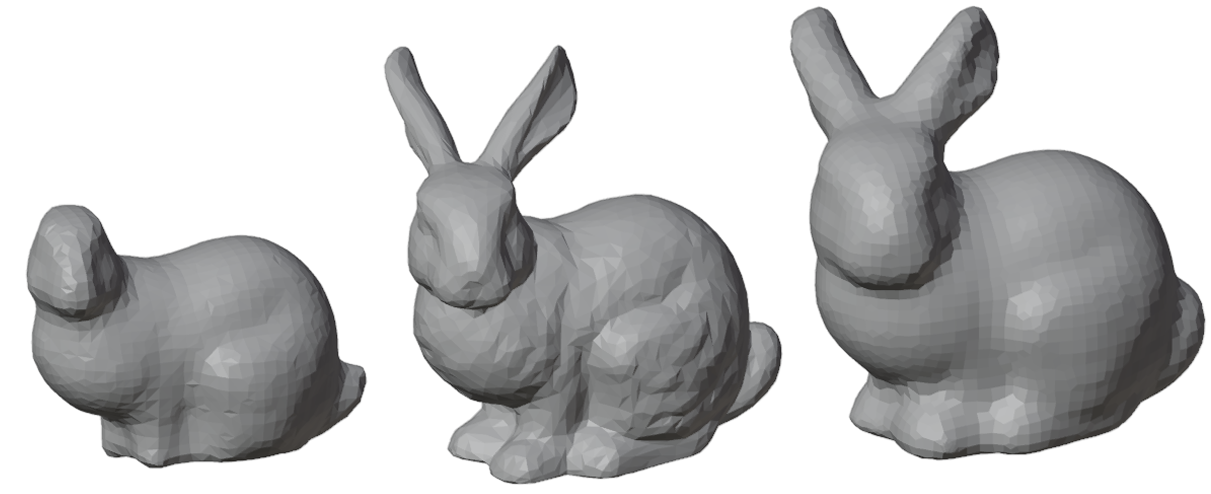
Offset surfaces are fundamental in computer graphics applications, such as computer-aided design or tool-path generation. However, generating them while preserving geometric details and handling self-intersections remains challenging, particularly for surfaces with sharp features. This thesis presents a robust method for non-uniform offset surface generation, extending volumetric, feature-preserving uniform offset approaches to allow per-vertex control over offset distances. This enables greater flexibility in handling complex geometries and user-defined specifications.To achieve a smooth distribution of offsets across the input mesh, the method introduces a Radial Basis Function interpolation combined with Dijkstra-based distance propagation. The method supports the extraction of both inner and outer offset components through an octree data structure and a modified Dual Contouring algorithm adapted for non-uniform distances, ensuring accurate and manifold surface generation. This approach's adaptability and robustness are demonstrated across diverse input models with varying offset assignments. They showcase successful extraction of inner and outer components and the ability to capture localized asymmetries while preserving geometric integrity.Additional Files and Images

Weblinks
- Entry in reposiTUm (TU Wien Publication Database)
- CatalogPlus (TU Wien Library)
- DOI: 10.34726/hss.2025.40588
BibTeX
@mastersthesis{weydemann-2025-noo,
  title =      "Non-uniform offsetting of surfaces",
  author =     "Tazzio Ludwig Weydemann",
  year =       "2025",
  abstract =   "Offset surfaces are fundamental in computer graphics
               applications, such as computer-aided design or tool-path
               generation. However, generating them while preserving
               geometric details and handling self-intersections remains
               challenging, particularly for surfaces with sharp features.
               This thesis presents a robust method for non-uniform offset
               surface generation, extending volumetric, feature-preserving
               uniform offset approaches to allow per-vertex control over
               offset distances. This enables greater flexibility in
               handling complex geometries and user-defined
               specifications.To achieve a smooth distribution of offsets
               across the input mesh, the method introduces a Radial Basis
               Function interpolation combined with Dijkstra-based distance
               propagation. The method supports the extraction of both
               inner and outer offset components through an octree data
               structure and a modified Dual Contouring algorithm adapted
               for non-uniform distances, ensuring accurate and manifold
               surface generation. This approach's adaptability and
               robustness are demonstrated across diverse input models with
               varying offset assignments. They showcase successful
               extraction of inner and outer components and the ability to
               capture localized asymmetries while preserving geometric
               integrity.",
  month =      nov,
  pages =      "92",
  address =    "Favoritenstrasse 9-11/E193-02, A-1040 Vienna, Austria",
  school =     "Research Unit of Computer Graphics, Institute of Visual
               Computing and Human-Centered Technology, Faculty of
               Informatics, TU Wien",
  keywords =   "Offset Surfaces, Non-Uniform Offset, Volumetric Method,
               Octree, Dual Contouring, Radial Basis Function, Per-Vertex
               Control, k-d Tree, Signed Distance Field, Computer Graphics",
  URL =        "https://www.cg.tuwien.ac.at/research/publications/2025/weydemann-2025-noo/",
}