

Hiroyuki Sakai , Karoly Zsolnai-Fehér, Thomas Auzinger, Michael Wimmer
Exploiting A Priori Information for Filtering Monte Carlo Renderings
TR-193-02-2021-1, May 2021 [ tech-report]
Information
- Visibility: hidden
- Publication Type: Technical Report
- Workgroup(s)/Project(s):
- Date: May 2021
- Number: TR-193-02-2021-1
- Open Access: no
- Keywords: Monte Carlo noise filtering, photorealistic rendering
Abstract
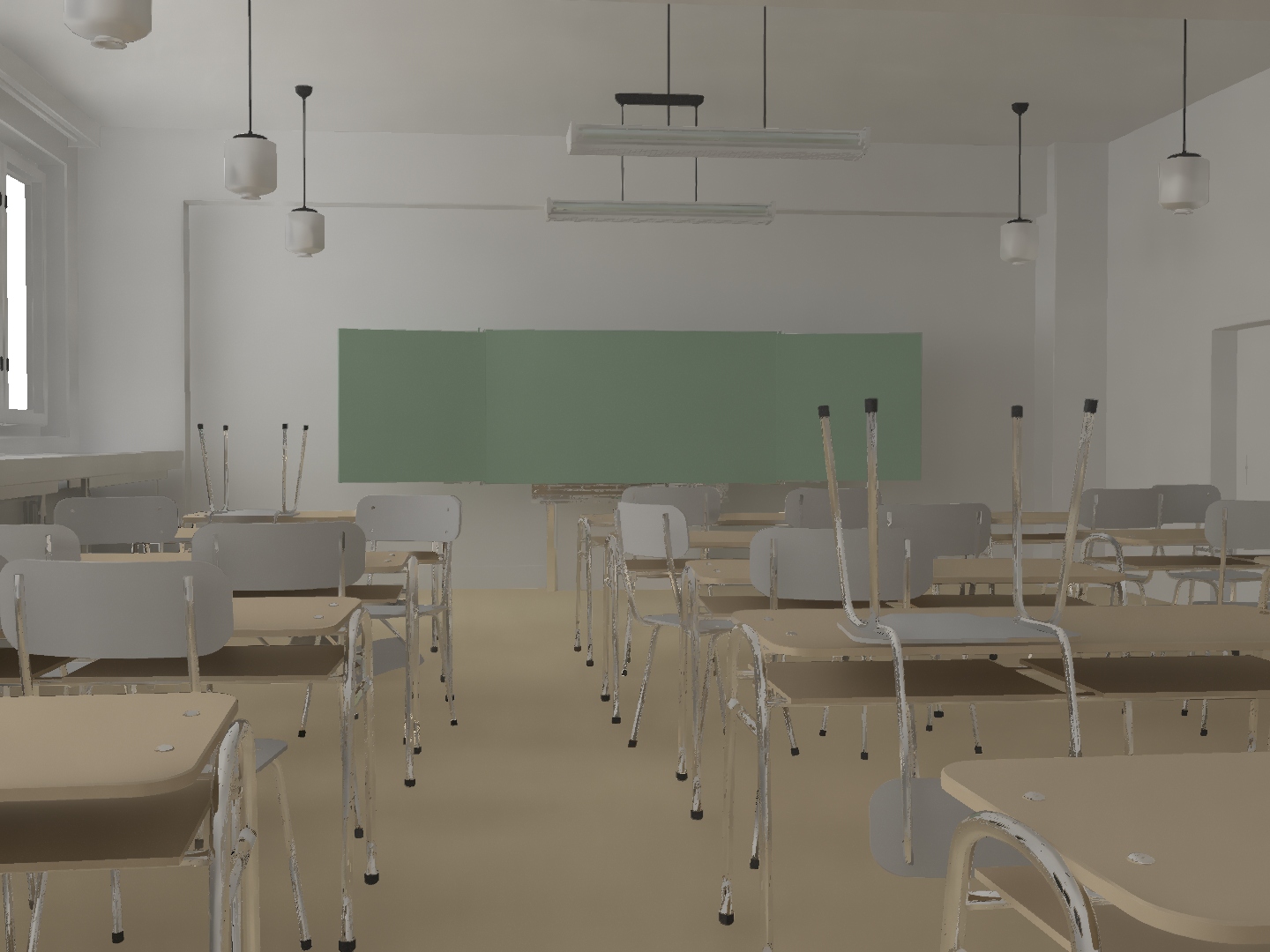
Monte Carlo rendering techniques are capable of rendering photorealistic images by performing exhaustive stochastic sampling for each pixel but suffer from objectionable noise at low sampling rates. A possible way to mitigate this problem is to perform high-dimensional filtering on the rendered image. The effectiveness of this approach is highly dependent on secondary information regarding both the image structure (given as so-called feature buffers) and the recorded noise. Previous approaches commonly use positions and normals as secondary information, and determine the local noise empirically based on the obtained samples. In this work, we propose to take a priori information in the form of scene material descriptions into consideration. We introduce a noise-estimation technique and a novel feature buffer, based on surface albedos to assist the noise filtering process based on this a priori information. We present an implementation of our method as an extension of the adaptive manifold filter and demonstrate the capabilities of our system by effectively denoising highly undersampled scenes with multiple refractive and reflective materials as well as high-resolution geometry and textures in only a few seconds.Additional Files and Images

Weblinks
No further information available.BibTeX
@techreport{sakai-2021-eif,
  title =      "Exploiting A Priori Information for Filtering Monte Carlo
               Renderings",
  author =     "Hiroyuki Sakai and Karoly Zsolnai-Feh\'{e}r and Thomas
               Auzinger and Michael Wimmer",
  year =       "2021",
  abstract =   "Monte Carlo rendering techniques are capable of rendering
               photorealistic images by performing exhaustive stochastic
               sampling for each pixel but suffer from objectionable noise
               at low sampling rates. A possible way to mitigate this
               problem is to perform high-dimensional filtering on the
               rendered image. The effectiveness of this approach is highly
               dependent on secondary information regarding both the image
               structure (given as so-called feature buffers) and the
               recorded noise. Previous approaches commonly use positions
               and normals as secondary information, and determine the
               local noise empirically based on the obtained samples. In
               this work, we propose to take a priori information in the
               form of scene material descriptions into consideration. We
               introduce a noise-estimation technique and a novel feature
               buffer, based on surface albedos to assist the noise
               filtering process based on this a priori information. We
               present an implementation of our method as an extension of
               the adaptive manifold filter and demonstrate the
               capabilities of our system by effectively denoising highly
               undersampled scenes with multiple refractive and reflective
               materials as well as high-resolution geometry and textures
               in only a few seconds.",
  month =      may,
  number =     "TR-193-02-2021-1",
  address =    "Favoritenstrasse 9-11/E193-02, A-1040 Vienna, Austria",
  institution = "Research Unit of Computer Graphics, Institute of Visual
               Computing and Human-Centered Technology, Faculty of
               Informatics, TU Wien ",
  note =       "human contact: technical-report@cg.tuwien.ac.at",
  keywords =   "Monte Carlo noise filtering, photorealistic rendering",
  URL =        "https://www.cg.tuwien.ac.at/research/publications/2021/sakai-2021-eif/",
}