

Markus Giegl, Michael Wimmer
Fitted Virtual Shadow Maps
In Proceedings of Graphics Interface 2007, pages 159-168. May 2007.
[ Preprint]
Information
- Publication Type: Conference Paper
- Workgroup(s)/Project(s):
- Date: May 2007
- ISBN: 978-1-56881-337-0
- Publisher: Canadian Human-Computer Communications Society
- Location: Montreal, Canada
- Lecturer: Markus Giegl
- Editor: Christopher G. Healey and Edward Lank
- Booktitle: Proceedings of Graphics Interface 2007
- Conference date: 28. May 2007 – 30. May 2007
- Pages: 159 – 168
- Keywords: real-time shadowing, shadows, shadow maps, large environemnts
Abstract
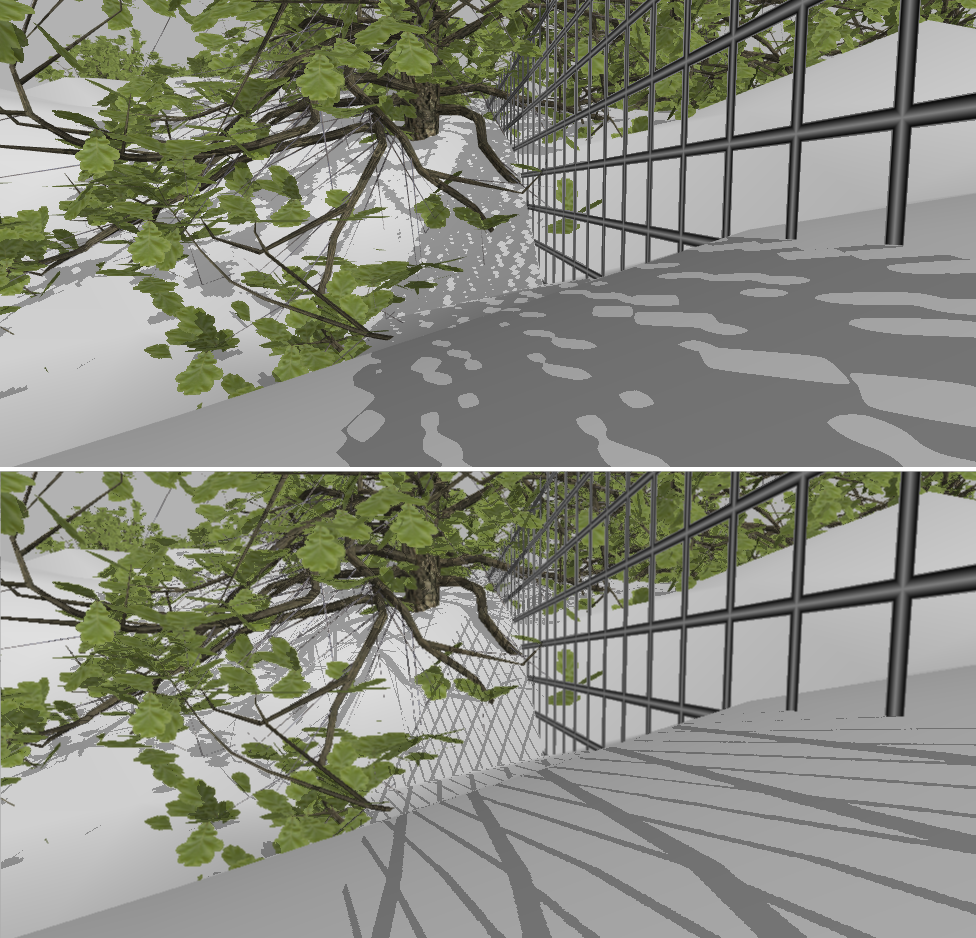
Too little shadow map resolution and resulting undersampling artifacts, perspective and projection aliasing, have long been a fundamental problem of shadowing scenes with shadow mapping.We present a new smart, real-time shadow mapping algorithm that virtually increases the resolution of the shadow map beyond the GPU hardware limit where needed. We first sample the scene from the eye-point on the GPU to get the needed shadow map resolution in different parts of the scene. We then process the resulting data on the CPU and finally arrive at a hierarchical grid structure, which we traverse in kd-tree fashion, shadowing the scene with shadow map tiles where needed.
Shadow quality can be traded for speed through an intuitive parameter, with a homogeneous quality reduction in the whole scene, down to normal shadow mapping. This allows the algorithm to be used on a wide range of hardware.
Additional Files and Images

Weblinks
No further information available.BibTeX
@inproceedings{GIEGL-2007-FVS,
  title =      "Fitted Virtual Shadow Maps",
  author =     "Markus Giegl and Michael Wimmer",
  year =       "2007",
  abstract =   "Too little shadow map resolution and resulting undersampling
               artifacts, perspective and projection aliasing, have long
               been a fundamental problem of shadowing scenes with shadow
               mapping.  We present a new smart, real-time shadow mapping
               algorithm that virtually increases the resolution of the
               shadow map beyond the GPU hardware limit where needed. We
               first sample the scene from the eye-point on the GPU to get
               the needed shadow map resolution in different parts of the
               scene. We then process the resulting data on the CPU and
               finally arrive at a hierarchical grid structure, which we
               traverse in kd-tree fashion, shadowing the scene with shadow
               map tiles where needed.  Shadow quality can be traded for
               speed through an intuitive parameter, with a homogeneous
               quality reduction in the whole scene, down to normal shadow
               mapping. This allows the algorithm to be used on a wide
               range of hardware.",
  month =      may,
  isbn =       "978-1-56881-337-0",
  publisher =  "Canadian Human-Computer Communications Society",
  location =   "Montreal, Canada",
  editor =     "Christopher G. Healey and Edward Lank",
  booktitle =  "Proceedings of Graphics Interface 2007",
  pages =      "159--168",
  keywords =   "real-time shadowing, shadows, shadow maps, large
               environemnts",
  URL =        "https://www.cg.tuwien.ac.at/research/publications/2007/GIEGL-2007-FVS/",
}