

Acceleration structure competition (San Miguel scene, time in seconds)
| Student | Build [s] | Render [s] | Sum [s] |
|---|---|---|---|
| 🥇 Ott Marvin | 6.5 | 106.4 | 112.9 |
| Last Year’s Winner | 6.1 | 132.5 | 138.6 |
| 🥈 Grisenti Emanuele | 8.9 | 142.0 | 150.9 |
| Winner From Two Years Ago | 12.4 | 164.9 | 177.3 |
| 🥉Elagabani Munir Yousif | 13.3 | 184.6 | 197.9 |
| Seczer Tobias | 29.5 | 244.4 | 273.9 |
| Muth Wendelin | 11.4 | 263.3 | 274.8 |
| Zechmann Manuel | 17.9 | 305.6 | 323.5 |
| Preissegger Leo | 17.1 | 372.3 | 389.4 |
| Komon Patrick | 133.8 | 289.8 | 423.6 |
| Miedler Michael | 43.3 | 430.4 | 473.7 |
| Meier Moritz | 6.3 | 531.3 | 537.6 |
| EPFL reference | 10.2 | 621.3 | 631.6 |
| Tuncer Kerem | 1.6 | 668.4 | 670.1 |
| Shakirov Ruslan | 4.0 | 766.7 | 770.7 |
| Kovács Balázs | 4.4 | 783.9 | 788.3 |
| Tadic Staša | 6.4 | 871.0 | 877.4 |
| Liopas Evangelos Ioannis | 1.3 | 1402.9 | 1404.2 |
| Kömürcü Ali | 29.3 | 1413.1 | 1442.4 |
| Amstler Nikolaus | 8.3 | 1439.8 | 1448.1 |
| Lalov Robert | 9.5 | 1548.7 | 1558.2 |
| Arbesser-Rastburg Niclas | 83.8 | 1612.5 | 1696.3 |
| Bauer David | 1.8 | 2346.2 | 2348.0 |
| Derflinger Simon | 24.5 | 2507.6 | 2532.1 |
| Füricht Elias | 9.6 | 2985.7 | 2995.3 |
| Scheiber Maximilian | 11.0 | 3942.5 | 3953.5 |
| Median Split reference | 9.4 | 4363.5 | 4372.9 |
Scene competition
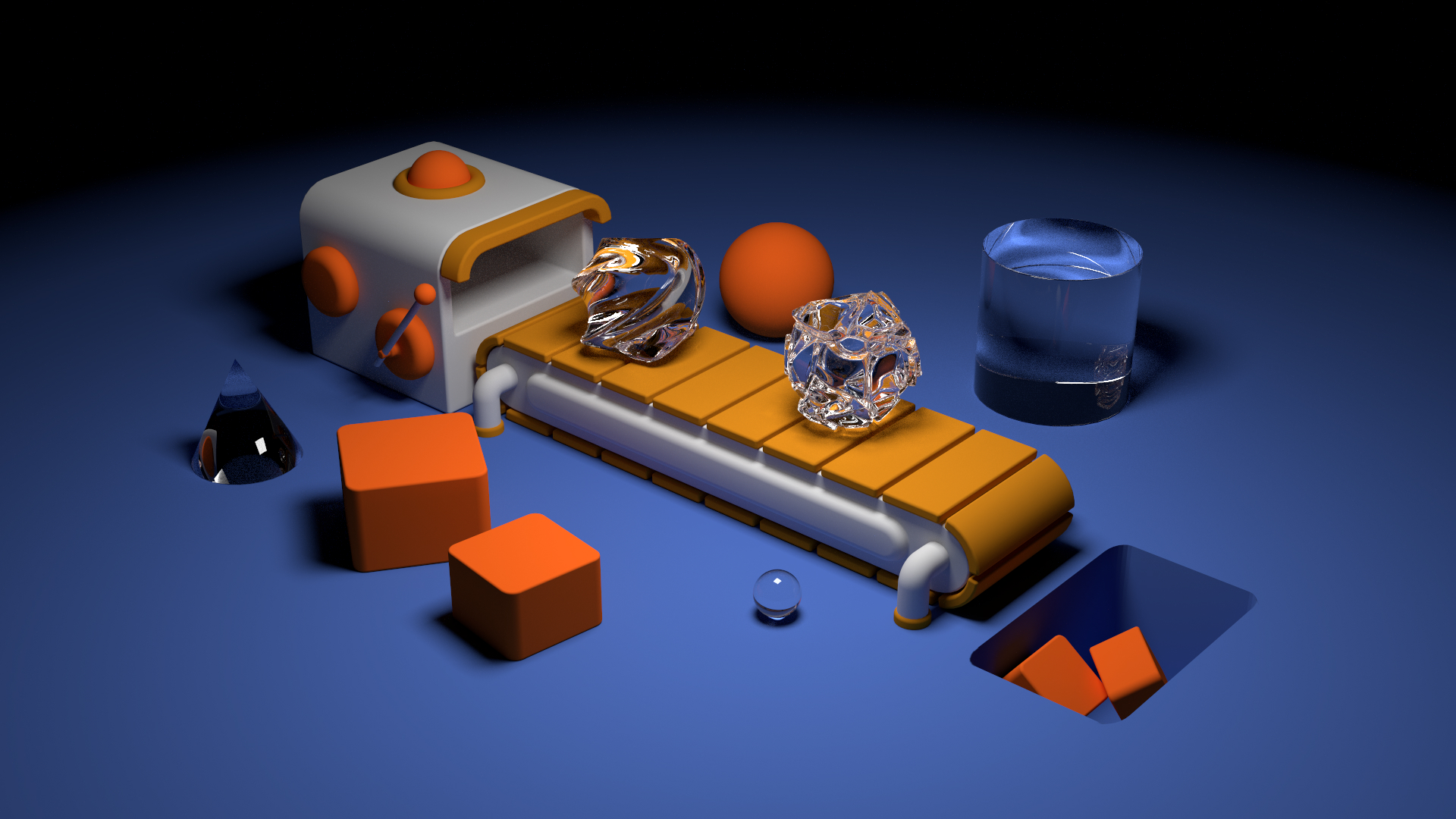
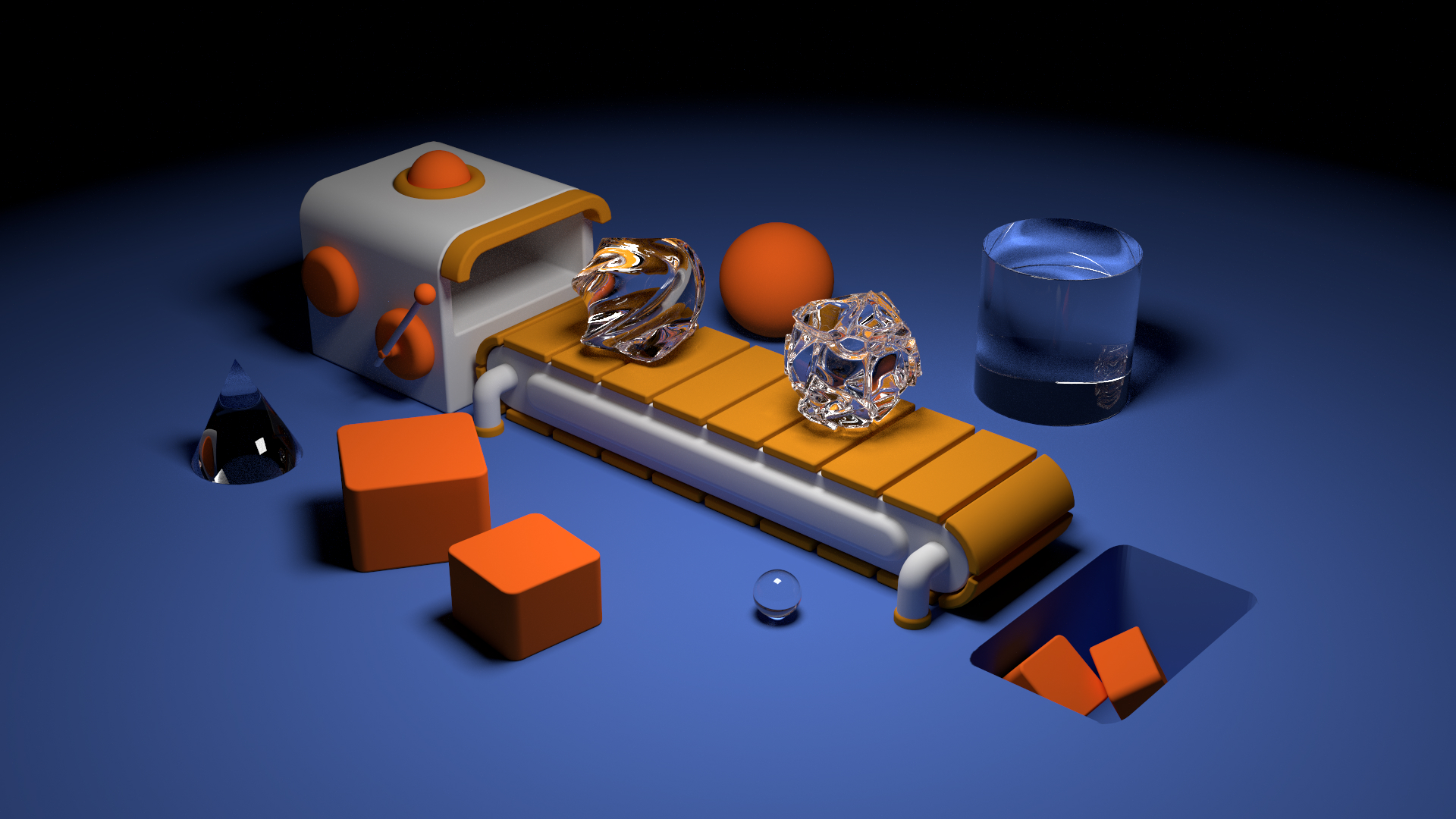
Glass Factory
This scene was created with the help of two tutorials: https://www.youtube.com/watch?v=Jwl48psPrxU, https://www.youtube.com/watch?v=OhzcCsR_EO0.
I combined the factory scene from the second tutorial link with some glass displacements from the first tutorial.
The scene was rendered on the GPU with a path tracing implementation that uses CUDA.
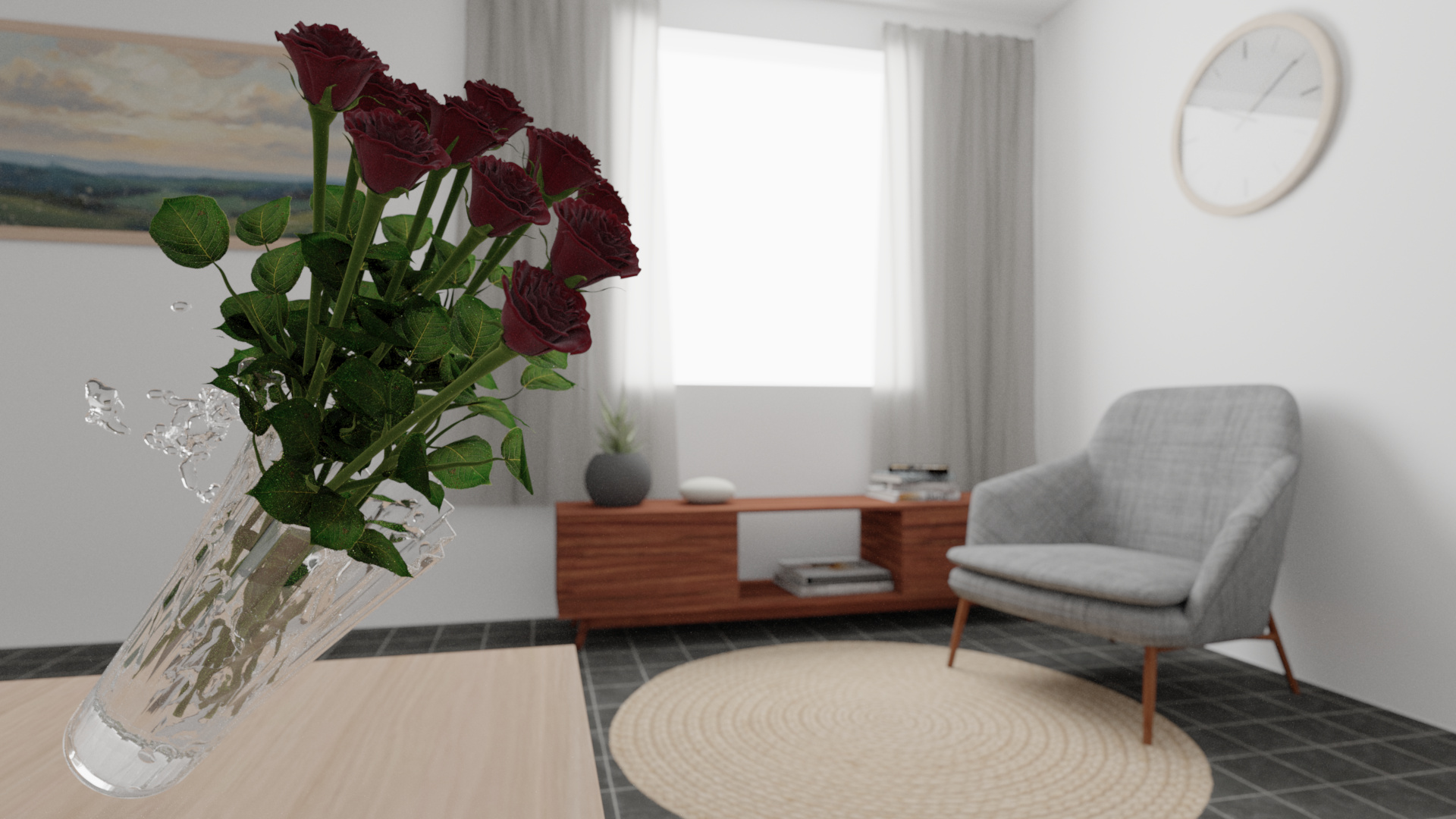
A dramatic moment
The scene captures a dramatic moment as a glass vase tips over on a wooden table. A dozen vibrant red roses are visible inside the vase as water splashes out. The action takes place in a bright, modern living room, with natural light pouring in through a large window covered by sheer curtains. The room is decorated with a simple gray armchair and a low wooden media console.
I modeled most of the scene by hand in Blender. The curtains were created using cloth simulation, and the water using a fluid simulation. I tried to make it pretty photo realistic by color grading the image using the AgX tone mapping operator, giving it a slightly washed-out, professional look.
The chair, books and aloe vera plant models are from sketchfab.
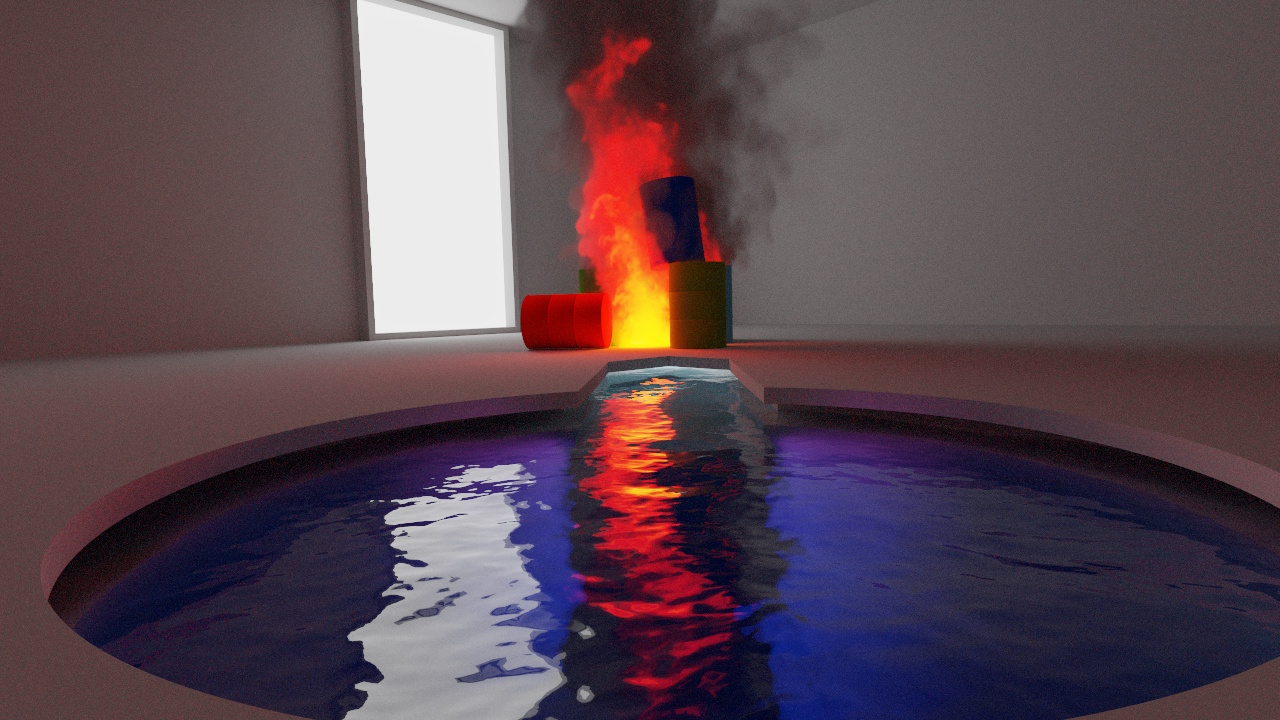
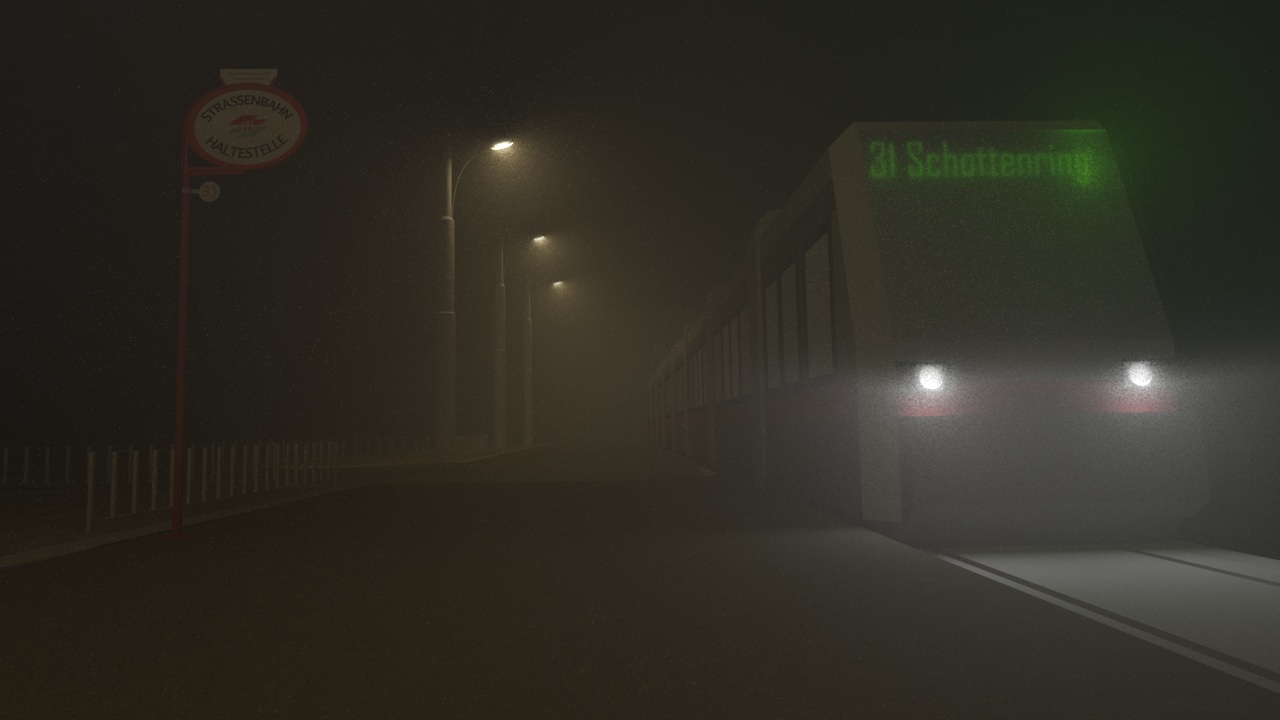
Tram Station
The whole scene has been modeled and textured in Blender. The tram model uses diffuse and dielectric (windows) BSDF components, whereas all other models only use the diffuse BSDF.
A heterogeneous media covers the scene which creates the foggy appearance. There are 9 lights in total, of which 6 are visible (lanterns, tram-lights, text on tram) and 3 invisible (one inside the tram, two behind the camera).
Antialiasing and mitchell filtering techniques are applied.
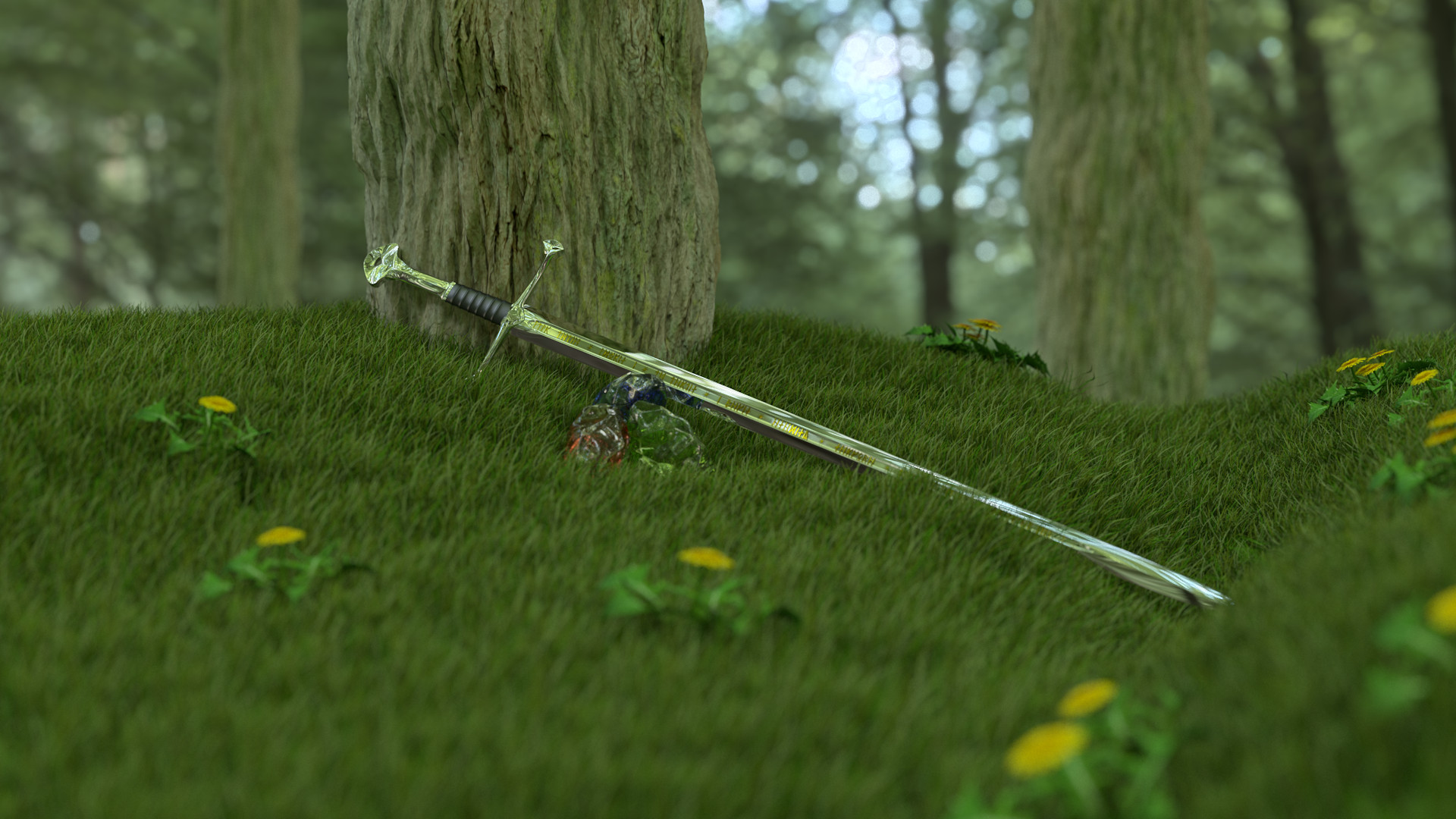
Andúril
Everything in the scene was hand-modelled in Blender. The sword handle uses a microfacet BSDF, while the rest of it uses a mirror BSDF, including the runes, which are also coloured. For nice reflections in the sword and for the background, an environment map is used. The crystals use a dielectric BSDF which supports the Beer-Lambert law for light absorption. For the final output, antialiasing, DOF, and local Reinhard tone-mapping are also used.
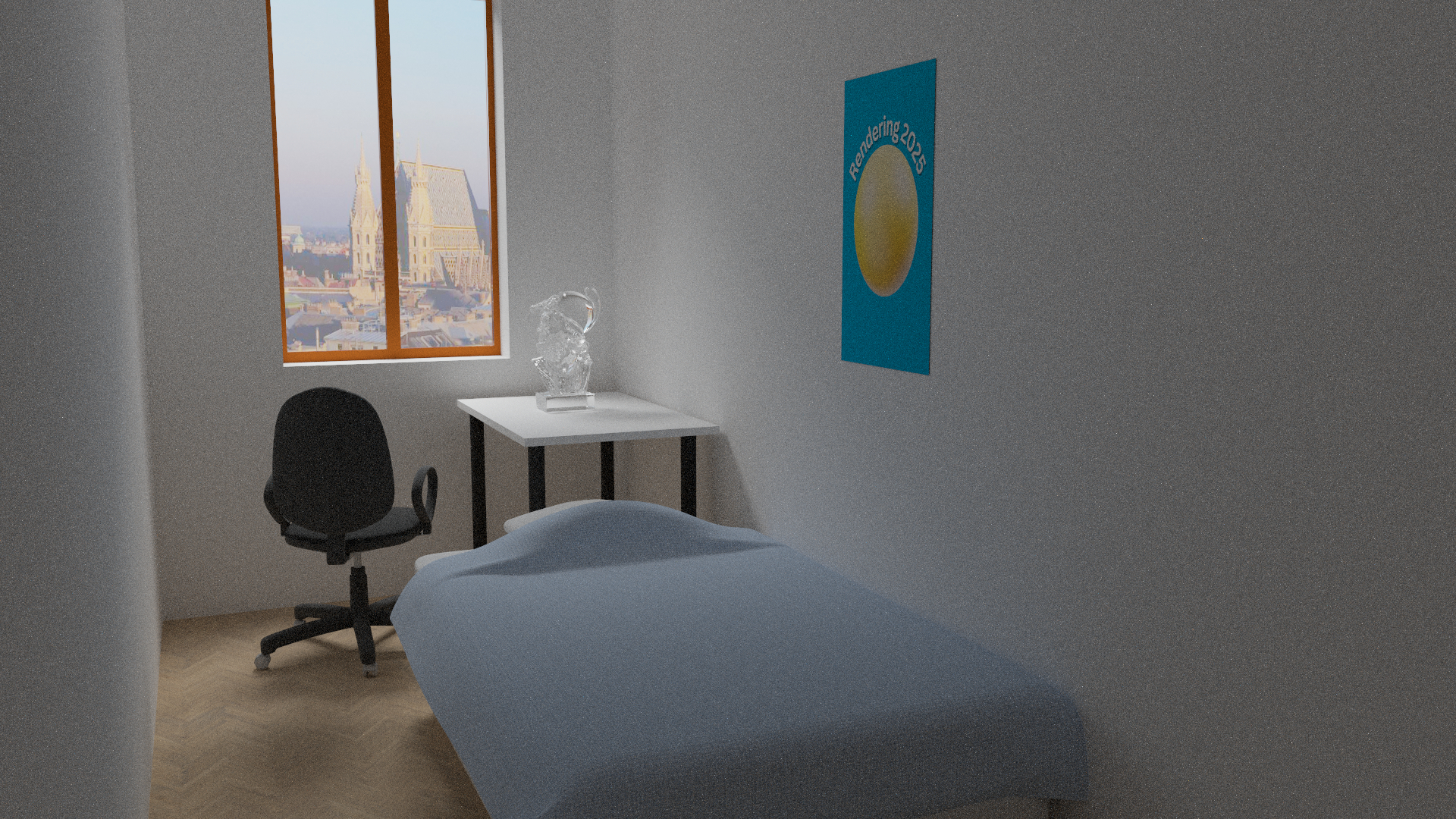
Room
This scene showcases all the techniques implemented throughout the rendering course.
It features a basic room with textured elements like the floor, poster and background. It is all rendered using multiple importance sampling (MIS) and next event estimation (NEE).
Tone mapping is also applied to the final image.
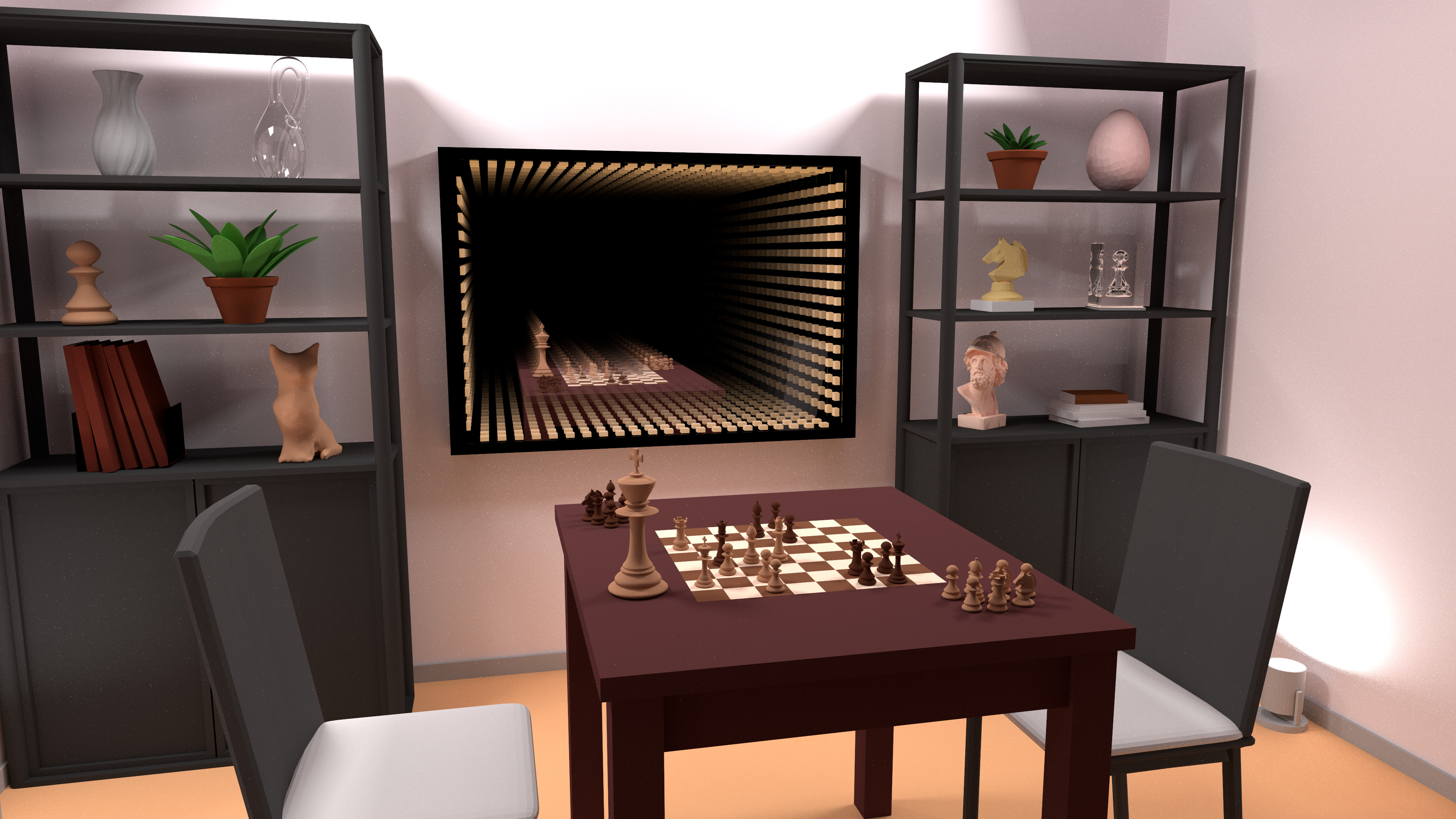
Chess Room
This scene features a decorated chess room. Centrally placed on the wall is an infinity mirror, which utilizes both dielectric and mirror materials to create this depth effect. The Klein bottle and glass block with the cut-out pawn also use a dielectric material for the glass effect. Next event estimation and Halton Sampling with Owen scrambling are used to reduce image noise.
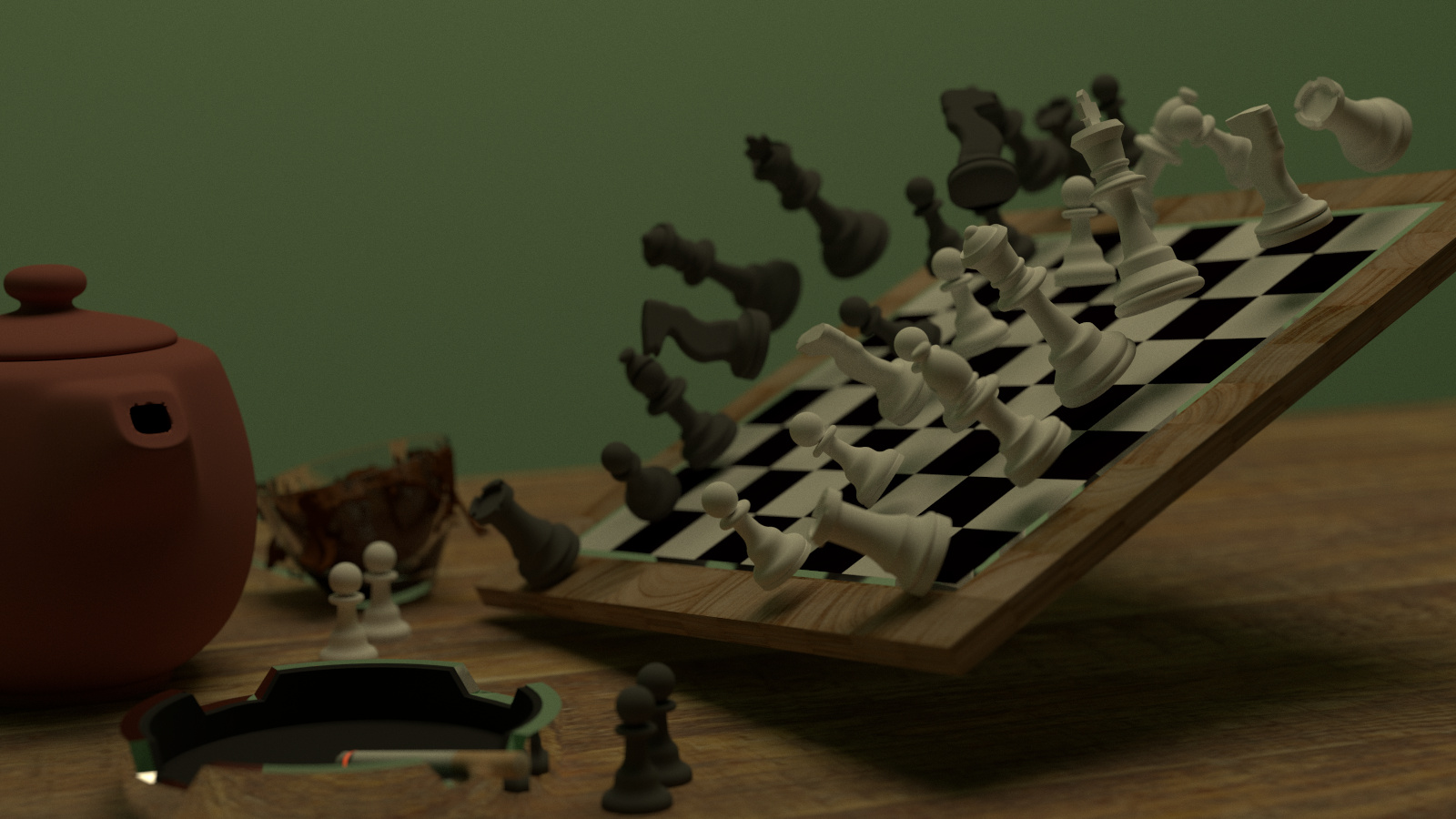
Flipping the board
A chessboard is flipped over, sending the pieces flying. A cup tips over in the background. A lit cigarette is resting in an ashtray. The camera focuses on the white queen with a low depth-of-field. The objects use mostly diffuse materials while the board, the ashtray, the cigeratte and the table have textures. Parts of the ashtray and board use mirror materials, while the cup uses a dielectric. The fluid in the cup is a mesh created from a fluid simulation in Blender.
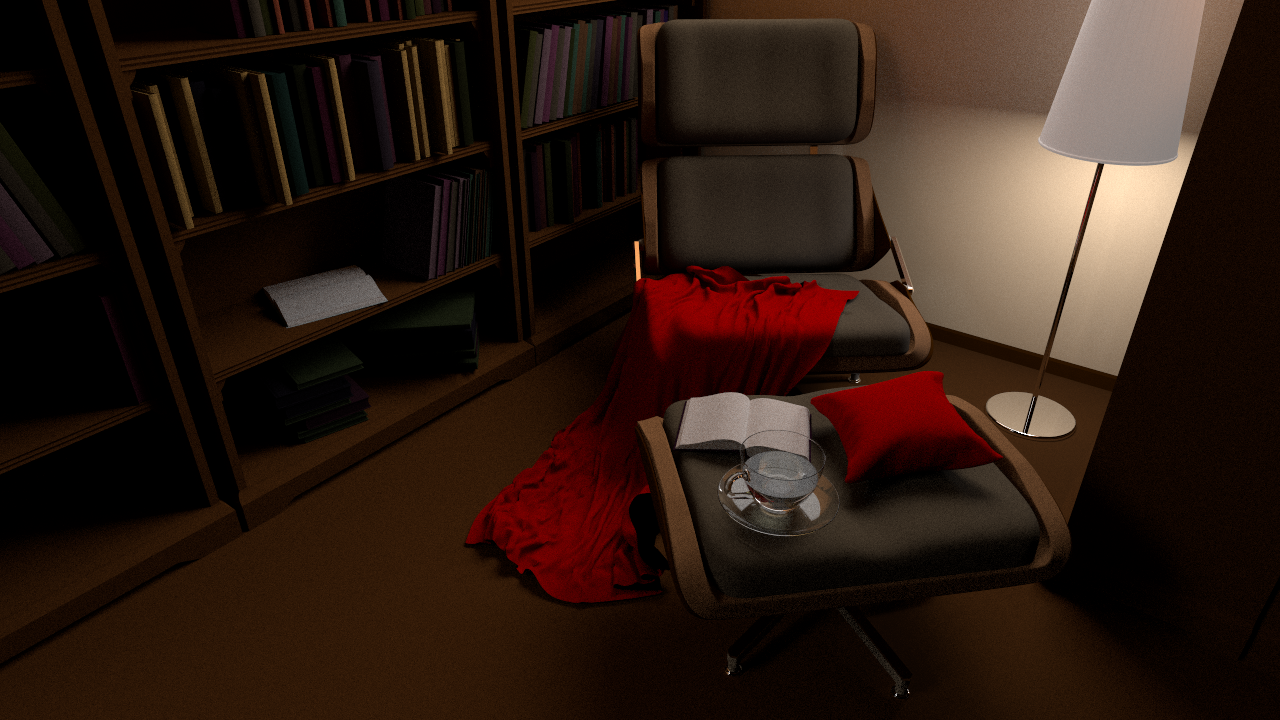
Cozyplace
A cozy place fully modeled and simulated using Cinema4D. The scene is lit by two area lights placed inside the lamp, creating a soft atmosphere. Diffuse materials were used for the fabrics, furniture and books, dielectric for the glass teacup placed on the footrest and mirror materials for metallic and reflective elements in the scene like the lamp stand, and the chair's feet. Rendered using NEE and a samplecount of 4096.
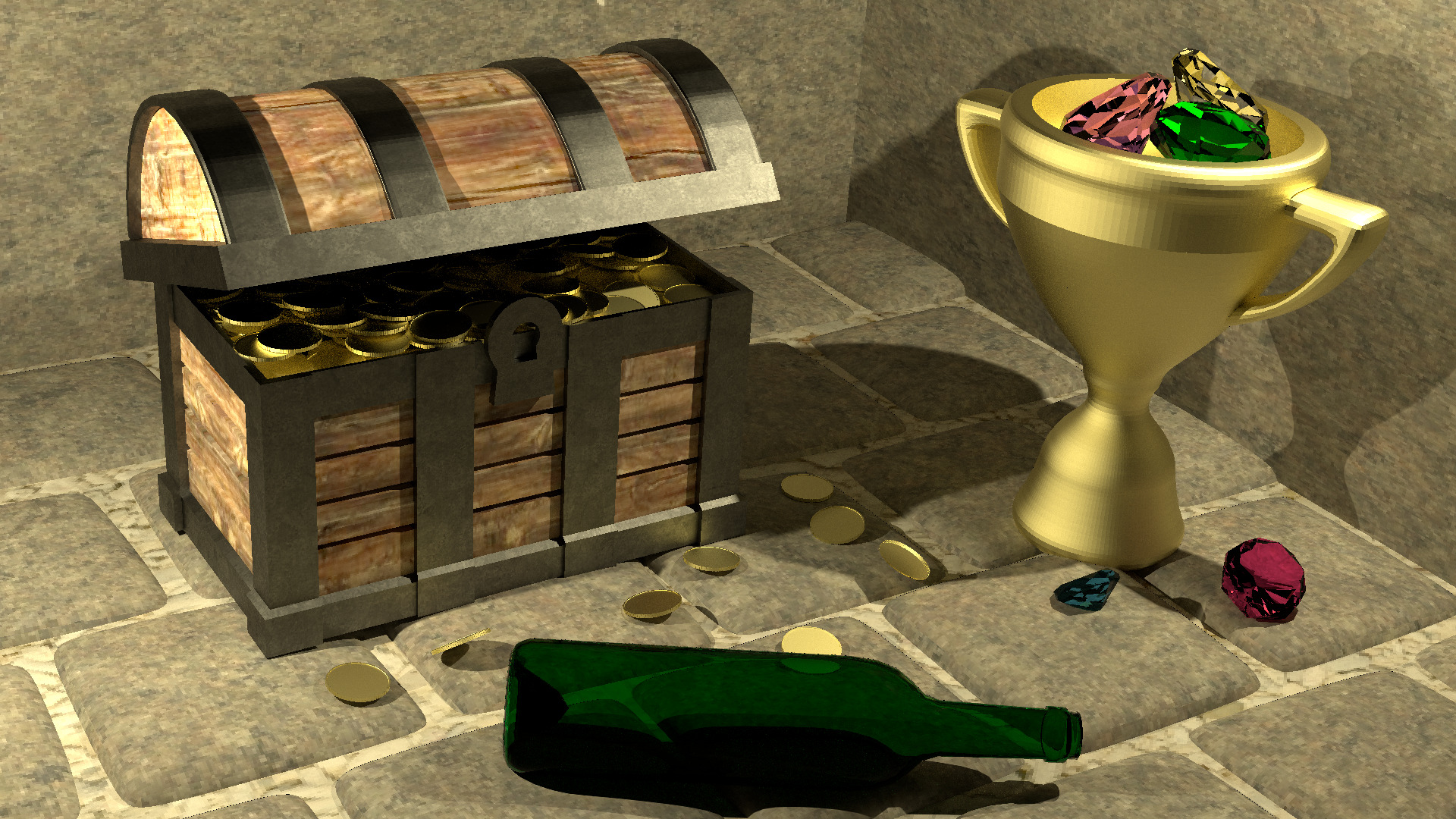
Pirate Treasure
This scene shows a pirate’s hoard with a chest full of coins, scattered gems, and a golden chalice. All elements were modeled in Blender, with physics simulations used to let the coins fall and settle in a natural way. Textures were incorporated to give more detail to the surfaces, and the gold uses a microfacet model with Fresnel reflections and roughness to make it appear more like real metal.
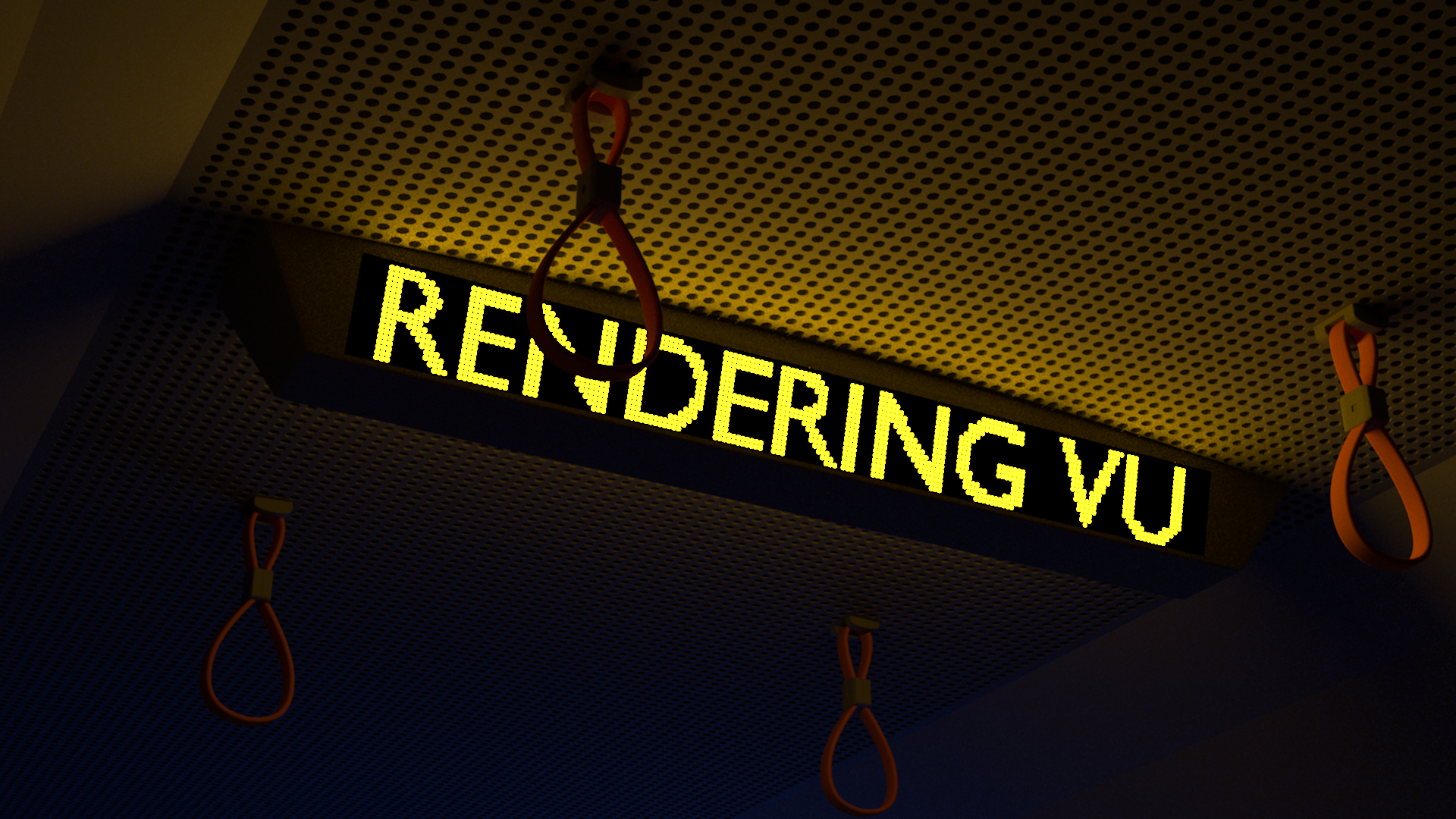
Subway Nights
This scene was modeled and arranged using Blender and portrays the perspective of someone sitting in a subway looking up, with the LED panel as a mesh emitter and the moon shining in from outside being the only source of light inside. With countless small features and sharp edges, a Mitchell–Netravali filter helps to smooth out aliasing.
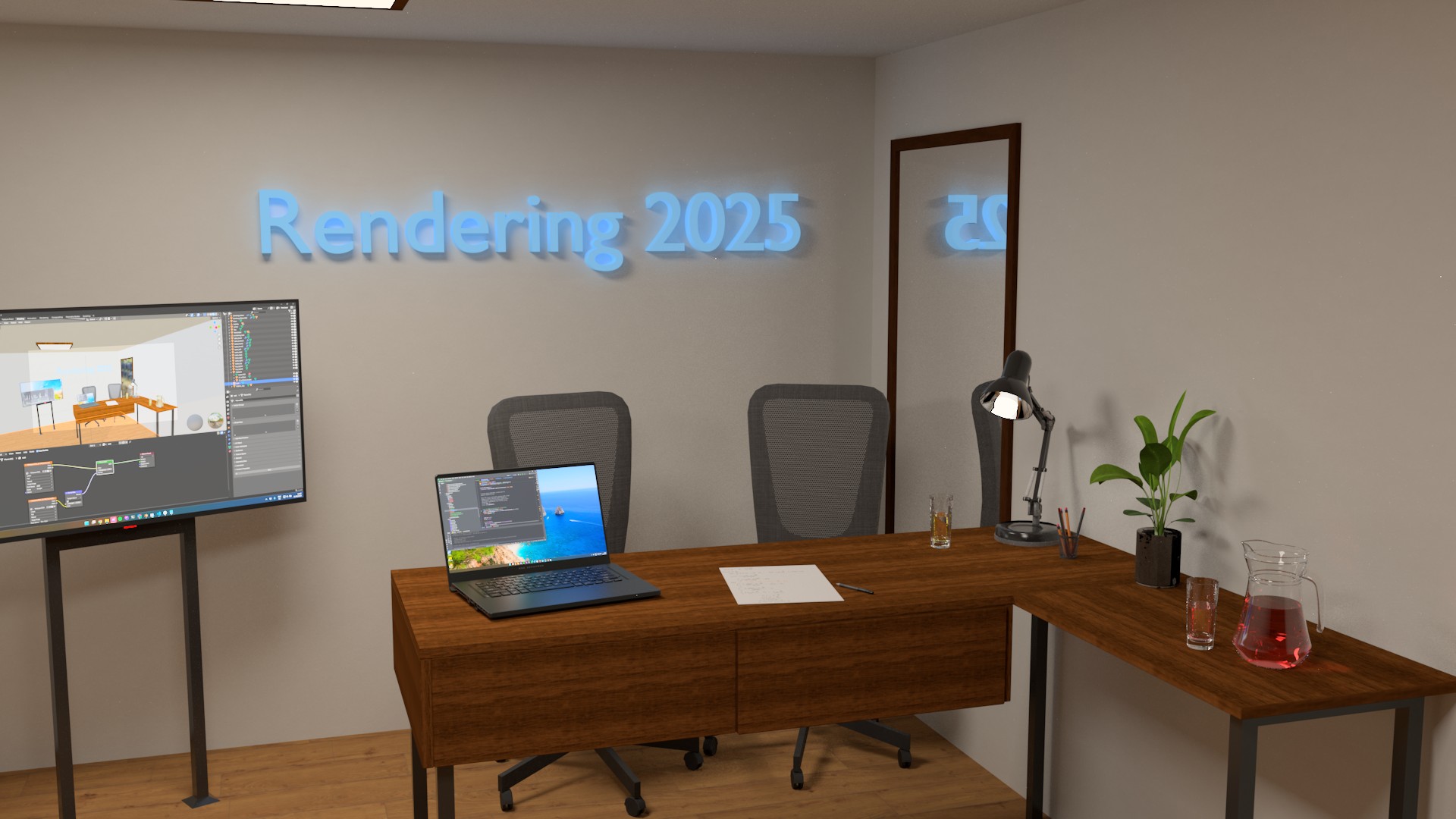
Desk in an Office
The scene features colored dielectric materials, seen in the glasses on the desk. They are colored by absorption using the Beer-Lambert law.
The two screens in the scene are emissive, with a texture applied to simulate a computer display.
The scene also makes use of the microfacet material model in many places, such as the laptop, the desk stands, the desk lamp and the pens.
The scene was rendered with 5000 samples per pixel, NEE and MIS enabled and RR continuation probability of 0.9.
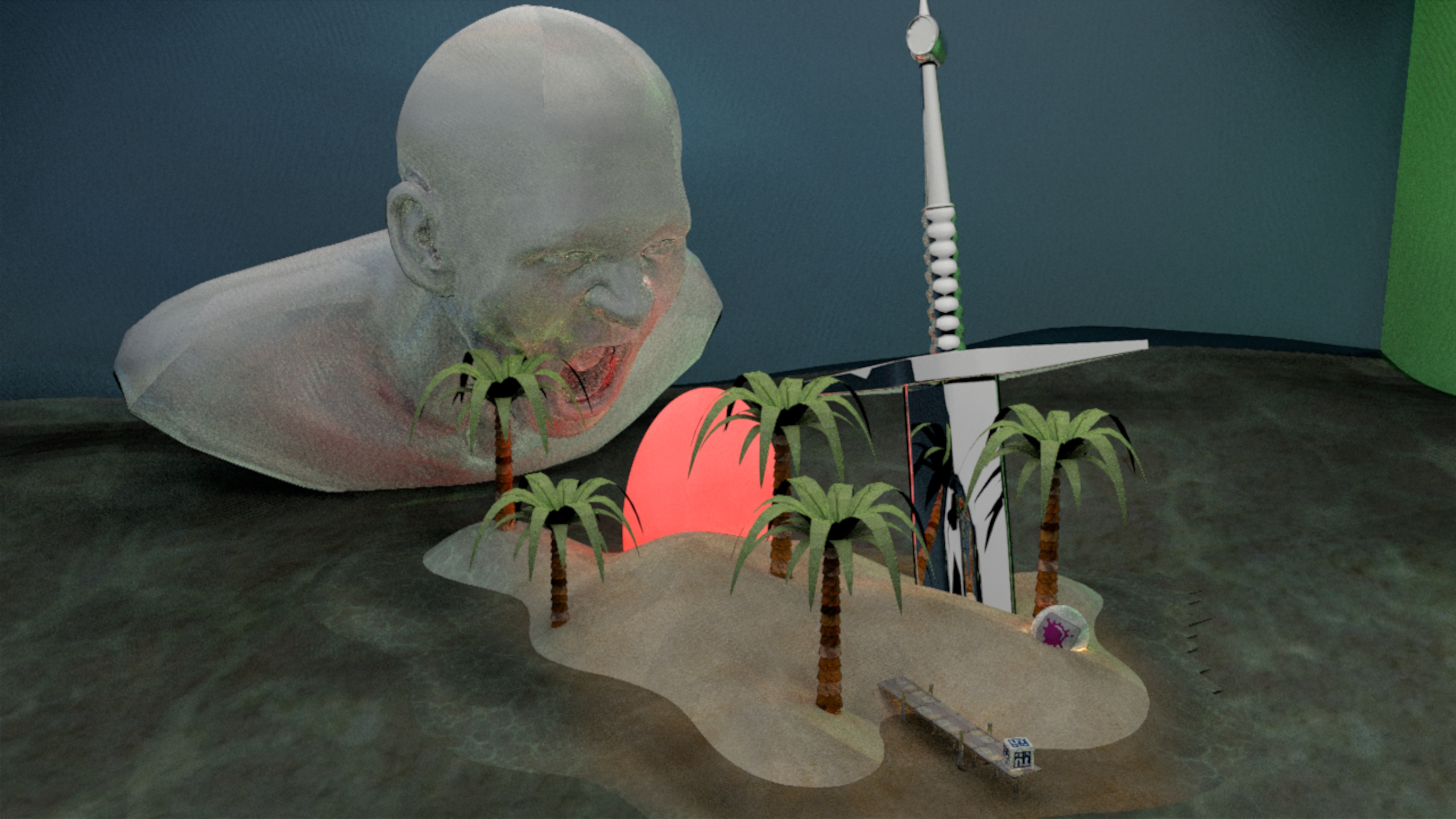
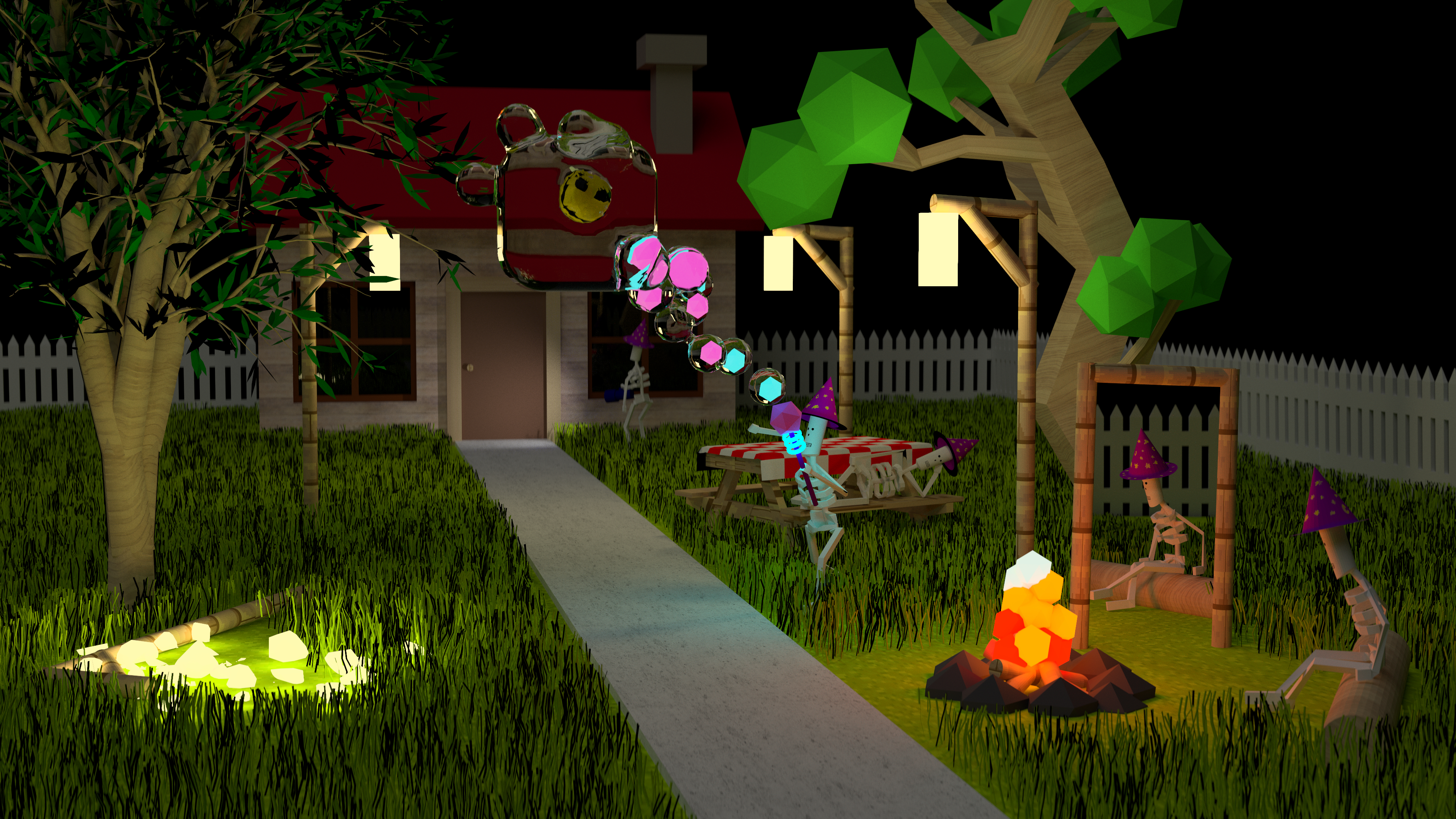
Silly Skeletons
A spooky scene featuring magical skeletons.
Rendered using MIS for all materials.
Texturing for diffuse materials.
Dielectrics for the magic spells (Modeled using metaballs).
For tone-mapping I used the Extended-Reinhard operator to
keep the colors vibrant. I used DOF to add more depth
to the whole scene.
The skeletons also brought their all-knowing mirror of course.
All models are made by me using various modeling
techniques or built-in Blender functionality.
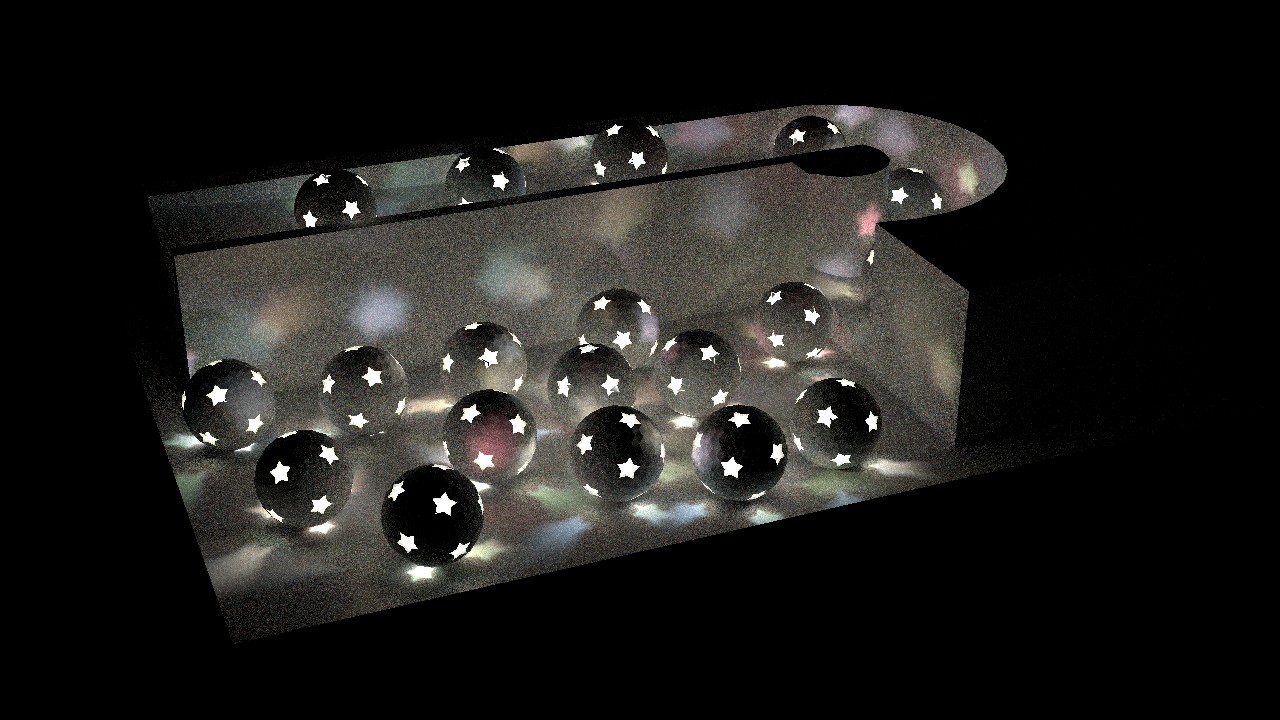
Glowballs
This scene is a tribute to an old Nvidia tech demo.
Made entirely from scratch, it was brought to life using NEE and MIS. Each ball has six tiny area lights inside,
that with nineteen balls sum up to 114 lights. Together they light up the scene, and star-shaped holes give a
cute sparkly vibe.
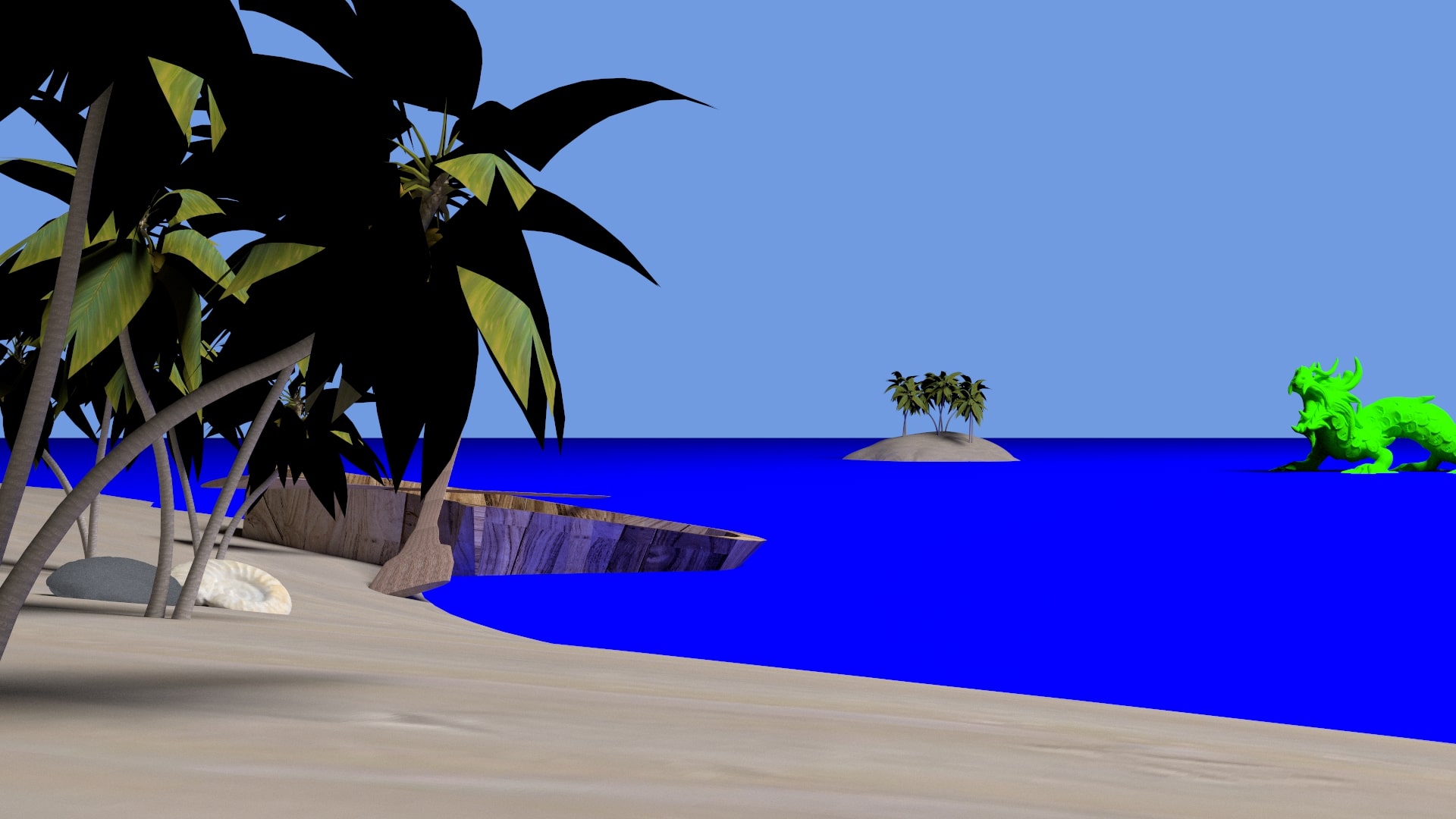
Cozy day at the beach
This scene features a beach with palm trees and an island. Additionally, it contains a self modelled boat, a stanford dragon and ammonites. The ammonites have been created using a Structure from Motion approach using 200 images and one of the ammonites uses subsurface scattering for its color.