



Abstract
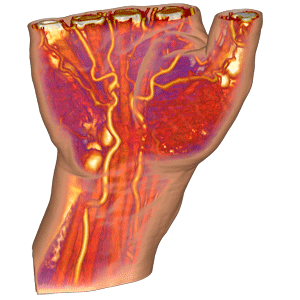
In volume rendering it is very difficult to simultaneously visualize interior and exterior structures while preserving clear shape cues. Very transparent transfer functions produce cluttered images with many overlapping structures, while clipping techniques completely remove possibly important context information. In this paper we present a new model for volume rendering, inspired by techniques from illustration that provides a means of interactively inspecting the interior of a volumetric data set in a feature-driven way which retains context information. The context-preserving volume rendering model uses a function of shading intensity, gradient magnitude, distance to the eye point, and previously accumulated opacity to selectively reduce the opacity in less important data regions. It is controlled by two user-specified parameters. This new method represents an alternative to conventional clipping techniques, shares their easy and intuitive user control, but does not suffer from the drawback of missing context information.Keywords: volume rendering, focus+context techniques, non-photorealistic techniques
Download full paper
Stefan Bruckner, Sören Grimm, Armin Kanitsar, Meister Eduard Gröller, "Illustrative Context-Preserving Volume Rendering", in Proceedings of EuroVis 2005, pp. 69-76.- [PDF] Full paper (4.0 MB)
Supplementary videos
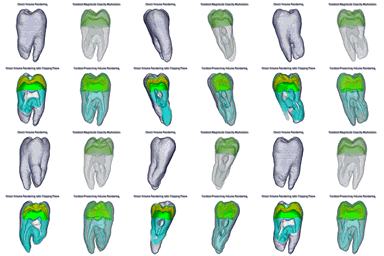 |
Video 1:
Comparing context-preserving volume rendering to conventional direct volume rendering, gradient-magnitude opacity modulation, and direct volume rendering using a clipping plane. The same transfer function is used for all four methods. |
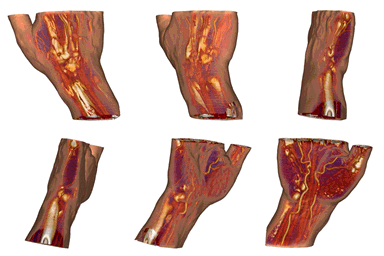 |
Video 2:
Context-preserving volume rendering of a human hand CT data set. |
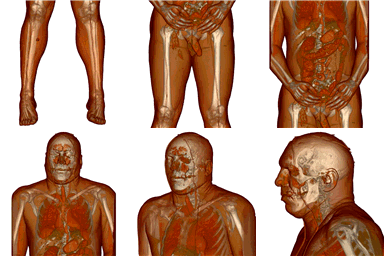 |
Video 3:
Context-preserving volume rendering of the visible human male CT data set. |
 |
Video 4:
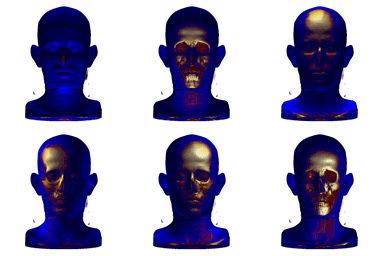
Context-preserving volume rendering of a human head CT data set using a modulation function for the model parameters which makes the bone impenetrable. |
BibTeX Entry
@inproceedings{bruckner-2005-ICV,
  title =      "Illustrative Context-Preserving Volume Rendering",
  author =     "Stefan Bruckner and S{\"o}ren Grimm and Armin Kanitsar and
               Meister Eduard Gr{\"o}ller",
  year =       "2005",
  abstract =   "In volume rendering it is very difficult to simultaneously
               visualize interior and exterior structures while preserving
               clear shape cues. Very transparent transfer functions
               produce cluttered images with many overlapping structures,
               while clipping techniques completely remove possibly
               important context information. In this paper we present a
               new model for volume rendering, inspired by techniques from
               illustration that provides a means of interactively
               inspecting the interior of a volumetric data set in a
               feature-driven way which retains context information. The
               context-preserving volume rendering model uses a function of
               shading intensity, gradient magnitude, distance to the eye
               point, and previously accumulated opacity to selectively
               reduce the opacity in less important data regions. It is
               controlled by two user-specified parameters. This new method
               represents an alternative to conventional clipping
               techniques, shares their easy and intuitive user control,
               but does not suffer from the drawback of missing context
               information. ",
  pages =      "69--76",
  month =      "may",
  booktitle =  "Proceedings of EuroVis 2005",
  keywords =   "volume rendering, non-photorealistic techniques,
               focus+context techniques",
  URL =        "http://www.cg.tuwien.ac.at/research/publications/2005/bruckner-2005-ICV/",
}