

Rita Borgo, Johannes Kehrer , David H.S. Chung, Eamonn Maguire, Robert S. Laramee, Helwig Hauser, Matthew Ward, Min Chen
Glyph-based Visualization: Foundations, Design Guidelines, Techniques and Applications
Eurographics State of the Art Reports:39-63, May 2013.
Information
- Publication Type: Journal Paper with Conference Talk
- Workgroup(s)/Project(s):
- Date: May 2013
- Journal: Eurographics State of the Art Reports
- Note: http://diglib.eg.org/EG/DL/conf/EG2013/stars/039-063.pdf
- Location: Girona, Spain
- Lecturer:
- Rita Borgo
- Johannes Kehrer
- David H.S. Chung
- Min Chen
- Publisher: Eurographics Association
- Series: EG STARs
- Conference date: 6. May 2013 – 10. May 2013
- Pages: 39 – 63
Abstract
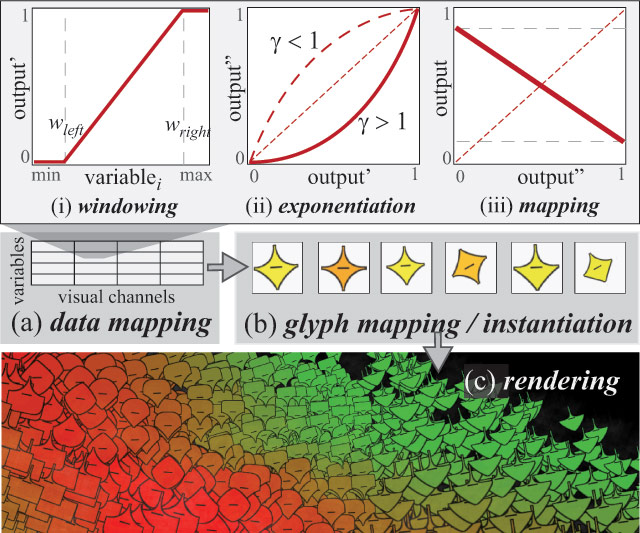
This state of the art report focuses on glyph-based visualization, a common form of visual design where a data set is depicted by a collection of visual objects referred to as glyphs. Its major strength is that patterns of multivariate data involving more than two attribute dimensions can often be more readily perceived in the context of a spatial relationship, whereas many techniques for spatial data such as direct volume rendering find difficult to depict with multivariate or multi-field data, and many techniques for non-spatial data such as parallel coordinates are less able to convey spatial relationships encoded in the data. This report fills several major gaps in the literature, drawing the link between the fundamental concepts in semiotics and the broad spectrum of glyph-based visualization, reviewing existing design guidelines and implementation techniques, and surveying the use of glyph-based visualization in many applications.Additional Files and Images
Additional images and videos
teaser:
teaser image
Additional files
 report:
State-of-the-Art Report
report:
State-of-the-Art Report
 slides Borgo:
presentation by R. Borgo
slides Borgo:
presentation by R. Borgo
 slides Chung:
presentation by D.H.S. Chung
slides Chung:
presentation by D.H.S. Chung
 slides J. Kehrer:
presentation by J. Kehrer
slides J. Kehrer:
presentation by J. Kehrer
Weblinks
No further information available.BibTeX
@article{borgo-2013-gly,
  title =      "Glyph-based Visualization: Foundations, Design Guidelines,
               Techniques and Applications",
  author =     "Rita Borgo and Johannes Kehrer and David H.S. Chung and
               Eamonn Maguire and Robert S. Laramee and Helwig Hauser and
               Matthew Ward and Min Chen",
  year =       "2013",
  abstract =   "This state of the art report focuses on glyph-based
               visualization, a common form of visual design where a data
               set is depicted by a collection of visual objects referred
               to as glyphs. Its major strength is that patterns of
               multivariate data involving more than two attribute
               dimensions can often be more readily perceived in the
               context of a spatial relationship, whereas many techniques
               for spatial data such as direct volume rendering find
               difficult to depict with multivariate or multi-field data,
               and many techniques for non-spatial data such as parallel
               coordinates are less able to convey spatial relationships
               encoded in the data. This report fills several major gaps in
               the literature, drawing the link between the fundamental
               concepts in semiotics and the broad spectrum of glyph-based
               visualization, reviewing existing design guidelines and
               implementation techniques, and surveying the use of
               glyph-based visualization in many applications.",
  month =      may,
  journal =    "Eurographics State of the Art Reports",
  note =       "http://diglib.eg.org/EG/DL/conf/EG2013/stars/039-063.pdf",
  publisher =  "Eurographics Association",
  series =     "EG STARs",
  pages =      "39--63",
  URL =        "https://www.cg.tuwien.ac.at/research/publications/2013/borgo-2013-gly/",
}