

Andrea Weidlich , Alexander Wilkie
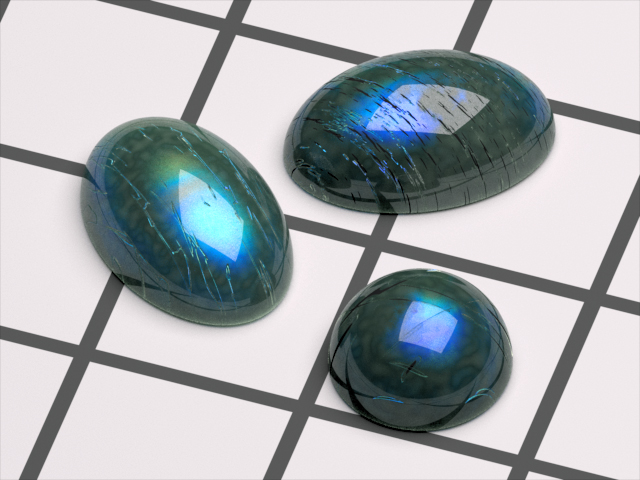
Rendering the Effect of Labradorescence
In Proceedings of Graphics Interface 2009, pages 79-85. May 2009.
[ ]
]
Information
- Publication Type: Conference Paper
- Workgroup(s)/Project(s):
- Date: May 2009
- ISBN: 978-1-56881-470-4
- Publisher: ACM
- Location: Kelowna, British Columbia, Canada
- Lecturer: Andrea Weidlich
- Booktitle: Proceedings of Graphics Interface 2009
- Conference date: 25. May 2009 – 27. May 2009
- Pages: 79 – 85
- Keywords: Predictive Rendering, Surface, Crystals
Abstract
Labradorescence is a complex optical phenomenon that can be found in certain minerals, such as Labradorite or Spectrolite. Because of their unique colour properties these minerals are often used as gemstones and decorative objects. Since the phenomenon is strongly orientation dependent, such minerals need a special cut to make the most of their unique type of colourful sheen, which makes it desirable to be able to predict the final appearance of a given stone prior to the cutting process. Also, the peculiar properties of the effect make a believable replication with an ad-hoc shader dificult even for normal, non-predictive rendering purposes. We provide a reflectance model for labradorescence that is directly derived from the physical characteristics of such materials. Due to its inherent accuracy, it can be used for predictive rendering purposes, but also for generic rendering applications.Additional Files and Images


Weblinks
No further information available.BibTeX
@inproceedings{weidlich_2009_REL,
  title =      "Rendering the Effect of Labradorescence",
  author =     "Andrea Weidlich and Alexander Wilkie",
  year =       "2009",
  abstract =   "Labradorescence is a complex optical phenomenon that can be
               found in certain minerals, such as Labradorite or
               Spectrolite. Because of their unique colour properties these
               minerals are often used  as gemstones and decorative
               objects. Since the phenomenon is strongly orientation
               dependent, such minerals need a special cut to make the most
               of their unique type of colourful sheen, which makes it
               desirable to be able to predict the final appearance of a
               given stone prior to the cutting process. Also, the peculiar
               properties of the effect make a believable replication with
               an ad-hoc shader dificult even for normal, non-predictive
               rendering purposes.  We provide a reflectance model for
               labradorescence that is directly derived from the physical
               characteristics of such materials. Due to its inherent
               accuracy, it can be used for predictive rendering purposes,
               but also for generic rendering applications. ",
  month =      may,
  isbn =       "978-1-56881-470-4",
  publisher =  "ACM",
  location =   "Kelowna, British Columbia, Canada ",
  booktitle =  "Proceedings of Graphics Interface 2009",
  pages =      "79--85",
  keywords =   "Predictive Rendering, Surface, Crystals",
  URL =        "https://www.cg.tuwien.ac.at/research/publications/2009/weidlich_2009_REL/",
}