

Matús Straka, Michal Cervenanský, Alexandra La Cruz , Arnold Köchl, Miloš Šrámek, Eduard Gröller, Dominik Fleischmann
The VesselGlyph: Focus & Context Visualization in CT-Angiography
In IEEE Visualization 2004, pages 392-385. October 2004.
[ ]
]
Information
- Publication Type: Conference Paper
- Workgroup(s)/Project(s):
- Date: October 2004
- Publisher: IEEE
- Organization: Commision for Scientific Visualization, Austrian
- Location: Austin, Texas
- Editor: IEEE
- Booktitle: IEEE Visualization 2004
- Pages: 392 – 385
- Keywords: focus & Context Technique, Direct Volume Rendering, Curved Planar Reformation, Vessel Visualization
Abstract
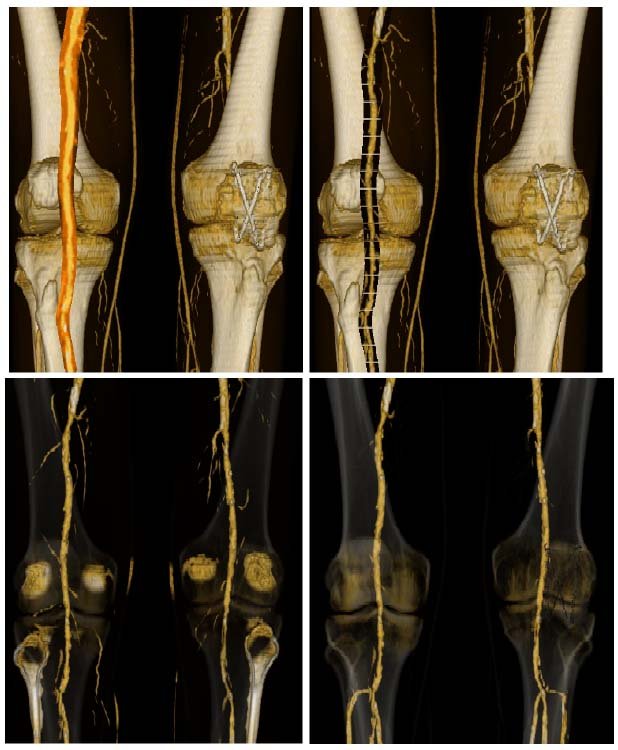
Reliable and complete blood-vessel segmentation is still a challenging problem. This is especially true in the presence of morphologic changes resulting from atherosclerotic diseases. In this paper we take advantage of partially segmented data with approximately identified vessel centerlines to comprehensively visualize the diseased peripheral arterial tree. We introduce the VesselGlyph as an abstract notation for novel focus & context visualization techniques of tubular structures such as contrast-medium enhanced arteries in CT-Angiography (CT-A). The proposed techniques combine direct volume rendering (DVR) and curved planar reformation (CPR) within a single image. The VesselGlyph consists of several regions where different rendering methods are used. Region type, the used visualization method and region parameters depend on the distance from the vessel centerline and on viewing parameters as well. By selecting proper rendering techniques for different regions, vessels are depicted in a naturally looking and undistorted anatomic context. In this paper we furthermore present a way how to implement the proposed techniques in software and by means of modern 3D graphics accelerators.Additional Files and Images

Weblinks
No further information available.BibTeX
@inproceedings{StrakaVis2004,
  title =      "The VesselGlyph: Focus & Context Visualization in
               CT-Angiography",
  author =     "Mat\'{u}s Straka and Michal Cervenansk\'{y} and Alexandra La
               Cruz and Arnold K\"{o}chl and Milo\v{s} \v{S}r\'{a}mek and
               Eduard Gr\"{o}ller and Dominik Fleischmann",
  year =       "2004",
  abstract =   "Reliable and complete blood-vessel segmentation is still a
               challenging problem. This is especially true in the presence
               of morphologic changes resulting from atherosclerotic
               diseases. In this paper we take advantage of partially
               segmented data with approximately identified vessel
               centerlines to comprehensively visualize the diseased
               peripheral arterial tree. We introduce the VesselGlyph as an
               abstract notation for novel focus & context visualization
               techniques of tubular structures such as contrast-medium
               enhanced arteries in CT-Angiography (CT-A). The proposed
               techniques combine direct volume rendering (DVR) and curved
               planar reformation (CPR) within a single image. The
               VesselGlyph consists of several regions where different
               rendering methods are used. Region type, the used
               visualization method and region parameters depend on the
               distance from the vessel centerline and on viewing
               parameters as well. By selecting proper rendering techniques
               for different regions, vessels are depicted in a naturally
               looking and undistorted anatomic context. In this paper we
               furthermore present a way how to implement the proposed
               techniques in software and by means of modern 3D graphics
               accelerators.",
  month =      oct,
  publisher =  "IEEE",
  organization = "Commision for Scientific Visualization, Austrian",
  location =   "Austin, Texas",
  editor =     "IEEE",
  booktitle =  "IEEE Visualization 2004",
  pages =      "392--385",
  keywords =   "focus & Context Technique, Direct Volume Rendering, Curved
               Planar Reformation, Vessel Visualization",
  URL =        "https://www.cg.tuwien.ac.at/research/publications/2004/StrakaVis2004/",
}