

Leon Stempfer
Web-based Animated Avalanche Simulation
[ thesis] [code]
Information
- Publication Type: Bachelor Thesis
- Workgroup(s)/Project(s):
- Date: October 2026
- Date (Start): December 2025
- Date (End): October 2026
- Matrikelnummer: 12222127
- First Supervisor:

Abstract
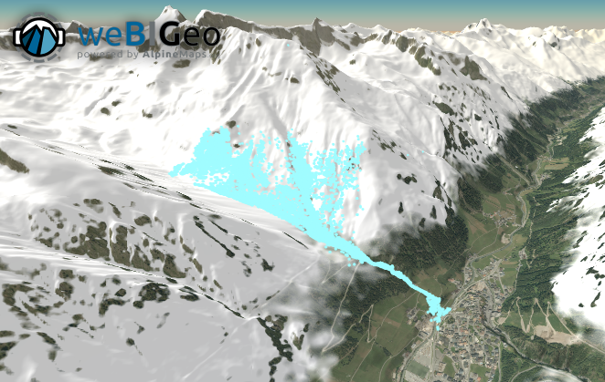
There are many tools for avalanche simulation or animation, but most are focused on academic study or used by professional government agencies and thus not easily accessible for everybody. These expert tools are complex to understand and use correctly, and need computational resources that not everybody has access to. This thesis uses weBIGeo a web-based geographical visualisation platform to make an easily accessible avalanche animation that can be used in a standard web browser.This animation utilises Smoothed Particle Hydrodynamics and Simplified Friction-Limited Model to calculate the movement of particles to emulate the simulation path of an avalanche in real-time. The evaluation is compared against the “AvaFrame: com1DFA model”, an avalanche simulation tool used by the Austrian government, and the output closely resembles the path of the Madlein avalanche. This animation performs at 60 FPS with a GPU pass taking around 0.5ms, simulating around 15,000 active particles.
Additional Files and Images

Weblinks
BibTeX
@bachelorsthesis{stempfer-2026-aas,
  title =      "Web-based Animated Avalanche Simulation",
  author =     "Leon Stempfer",
  year =       "2026",
  abstract =   "There are many tools for avalanche simulation or animation,
               but most are focused on academic study or used by
               professional government agencies and thus not easily
               accessible for everybody. These expert tools are complex to
               understand and use correctly, and need computational
               resources that not everybody has access to. This thesis uses
               weBIGeo a web-based geographical visualisation platform to
               make an easily accessible avalanche animation that can be
               used in a standard web browser.  This animation utilises
               Smoothed Particle Hydrodynamics and Simplified
               Friction-Limited Model to calculate the movement of
               particles to emulate the simulation path of an avalanche in
               real-time. The evaluation is compared against the
               “AvaFrame: com1DFA model”, an avalanche simulation tool
               used by the Austrian government, and the output closely
               resembles the path of the Madlein avalanche. This animation
               performs at 60 FPS with a GPU pass taking around 0.5ms,
               simulating around 15,000 active particles. ",
  month =      oct,
  address =    "Favoritenstrasse 9-11/E193-02, A-1040 Vienna, Austria",
  school =     "Research Unit of Computer Graphics, Institute of Visual
               Computing and Human-Centered Technology, Faculty of
               Informatics, TU Wien ",
  URL =        "https://www.cg.tuwien.ac.at/research/publications/2026/stempfer-2026-aas/",
}