

Pascal Rupp
Zero-Shot Scatterplot Annotation
[ thesis]
Information
- Publication Type: Bachelor Thesis
- Workgroup(s)/Project(s):
- Date: September 2026
- Date (Start): February 2026
- Date (End): August 2026
- Matrikelnummer: 12323804
- First Supervisor: Manuela Waldner

- Keywords: dimensionality reduction, unstructured data, scatterplot annotation
Abstract
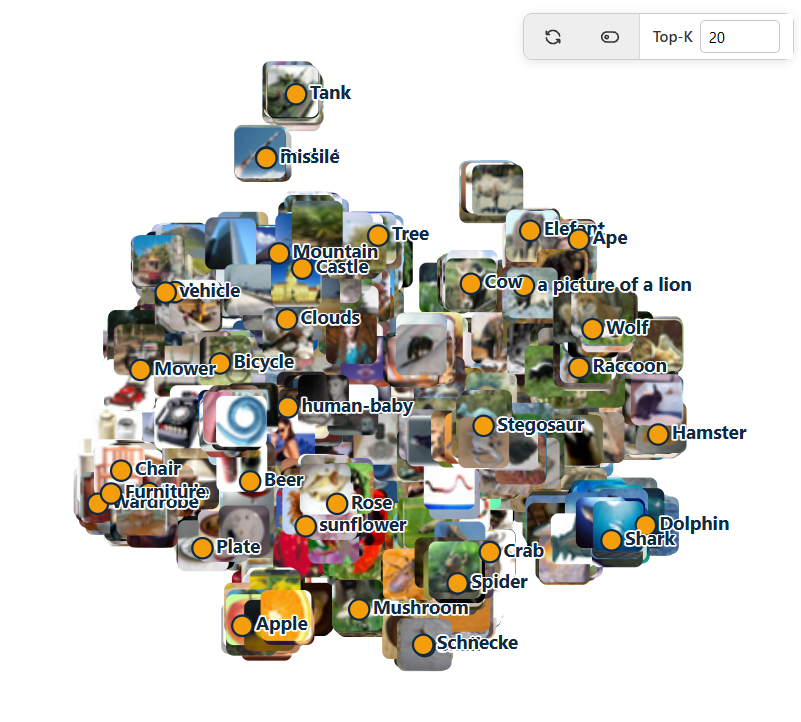
Scatter plots of image embeddings group visually similar images into clusters. To understand what a cluster represents, the individual images must be examined and their commonalities interpreted. This paper investigates whether a user-specified vocabulary of expected concepts can be interactively and automatically placed into an existing scatter plot using a pre-trained vision-language model. The approach utilizes the shared high-dimensional embedding space of Contrastive Language-Image Pretraining (CLIP) for images and text. A text label is encoded in the same way as an image and projected into the existing two-dimensional layout of the image embeddings using the adapted Uniform Manifold Approximation and Projection (UMAP) model. Since both CLIP encoders were trained to share the same high-dimensional space, the position of the label in the resulting scatter plot provides an approximate answer to the question of where to find images that match that word—without any classifier training and without a single labeled example. A simple concept creation interface allows users to define and customize their own annotation vocabulary and immediately place it on the scatter plot. The approach is evaluated on the Canadian Institute for Advanced Research-100 (CIFAR- 100) and Fashion-Modified National Institute of Standards and Technology database (Fashion-MNIST) datasets. Across all 100 CIFAR-100 classes, the projected labels are, on average, about as close to their target cluster as a typical image from that class itself. However, accuracy varies significantly: classes that are clearly distinct visually and semantically are labeled reliably, while classes that overlap in CLIP’s own embedding space—such as several person-related categories—are not reliably recognized. The system also generalizes to vocabulary that was never used to label the dataset, while remaining within the interactive time budget (approximately 21 ms per label after a one-time setup). The results show that projecting user-defined text directly onto an image scatter plot is a fast and practical way to make its clusters interpretable without labeled training data—with reliability limited by the underlying vision-language model rather than by the projection mechanism.Additional Files and Images

Weblinks
No further information available.BibTeX
@bachelorsthesis{rupp-2026-zsa,
  title =      "Zero-Shot Scatterplot Annotation",
  author =     "Pascal Rupp",
  year =       "2026",
  abstract =   "Scatter plots of image embeddings group visually similar
               images into clusters. To understand what a cluster
               represents, the individual images must be examined and their
               commonalities interpreted. This paper investigates whether a
               user-specified vocabulary of expected concepts can be
               interactively and automatically placed into an existing
               scatter plot using a pre-trained vision-language model. The
               approach utilizes the shared high-dimensional embedding
               space of Contrastive Language-Image Pretraining (CLIP) for
               images and text. A text label is encoded in the same way as
               an image and projected into the existing two-dimensional
               layout of the image embeddings using the adapted Uniform
               Manifold Approximation and Projection (UMAP) model. Since
               both CLIP encoders were trained to share the same
               high-dimensional space, the position of the label in the
               resulting scatter plot provides an approximate answer to the
               question of where to find images that match that
               word—without any classifier training and without a single
               labeled example. A simple concept creation interface allows
               users to define and customize their own annotation
               vocabulary and immediately place it on the scatter plot. The
               approach is evaluated on the Canadian Institute for Advanced
               Research-100 (CIFAR- 100) and Fashion-Modified National
               Institute of Standards and Technology database
               (Fashion-MNIST) datasets. Across all 100 CIFAR-100 classes,
               the projected labels are, on average, about as close to
               their target cluster as a typical image from that class
               itself. However, accuracy varies significantly: classes that
               are clearly distinct visually and semantically are labeled
               reliably, while classes that overlap in CLIP’s own
               embedding space—such as several person-related
               categories—are not reliably recognized. The system also
               generalizes to vocabulary that was never used to label the
               dataset, while remaining within the interactive time budget
               (approximately 21 ms per label after a one-time setup). The
               results show that projecting user-defined text directly onto
               an image scatter plot is a fast and practical way to make
               its clusters interpretable without labeled training
               data—with reliability limited by the underlying
               vision-language model rather than by the projection
               mechanism.",
  month =      sep,
  address =    "Favoritenstrasse 9-11/E193-02, A-1040 Vienna, Austria",
  school =     "Research Unit of Computer Graphics, Institute of Visual
               Computing and Human-Centered Technology, Faculty of
               Informatics, TU Wien ",
  keywords =   "dimensionality reduction, unstructured data, scatterplot
               annotation",
  URL =        "https://www.cg.tuwien.ac.at/research/publications/2026/rupp-2026-zsa/",
}