

Runzhou Mao , Hiroyuki Sakai, Christian Freude, Christoph Garth, Petra Gospodnetić, Juraj Fulir
Rendering Synthetic Defects for Learning‐Based Industrial Inspection
Computer Graphics Forum:e70550, August 2026.
Information
- Publication Type: Journal Paper with Conference Talk
- Workgroup(s)/Project(s):
- Date: August 2026
- Journal: Computer Graphics Forum
- Article Number: e70550
- ISSN: 1467-8659
- DOI: 10.1111/cgf.70550
- Pages: 13
- Publisher: WILEY
- Keywords: rendering, visual inspection, synthetic data, feature-space analysis
Abstract
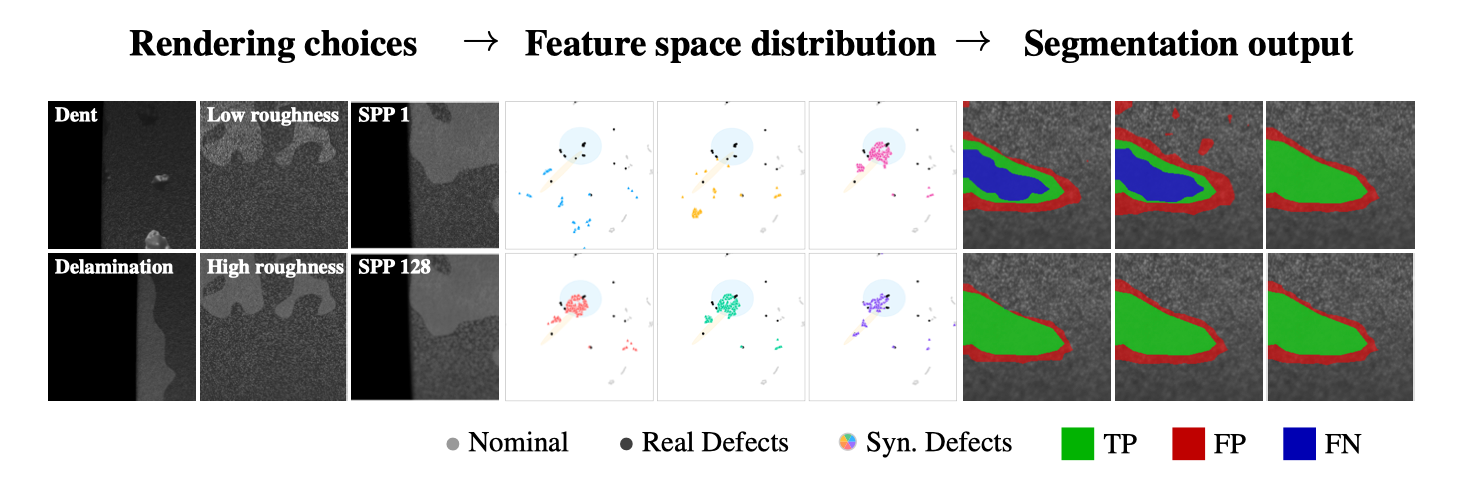
Computer vision increasingly uses synthetic data from physically based rendering to supplement limited real-world datasets. In industrial inspection, defect data is scarce and the rendering pipeline is explicitly controlled, and synthetic defect generation therefore becomes a dataset design problem. In this setting, building a dataset means choosing points in a rendering parameter space: defect shape, material, illumination, viewpoint, and sampling define the training distribution, but their effect on downstream learning is often hard to judge from images alone. We therefore study how these factors change defect features, where their relation to downstream learning is easier to inspect. Our results show that the rendering factors do not matter equally: defect shape, material, illumination, and viewpoint often affect downstream behavior much more than the number of samples per pixel. Synthetic subsets that transfer better downstream tend to stay close to real defect features, cover the observed defect modes, and stay separated from the defect-free (OK) region. Based on these observations, we build a simple feature-space screening heuristic for selecting subsets from large candidate pools. The selected subsets often outperform matched random selection for downstream segmentation on real data.Additional Files and Images
Weblinks
BibTeX
@article{mao-2026-rsd,
  title =      "Rendering Synthetic Defects for Learning‐Based Industrial
               Inspection",
  author =     "Runzhou Mao and Hiroyuki Sakai and Christian Freude and
               Christoph Garth and Petra Gospodneti\'{c} and Juraj Fulir",
  year =       "2026",
  abstract =   "Computer vision increasingly uses synthetic data from
               physically based rendering to supplement limited real-world
               datasets. In industrial inspection, defect data is scarce
               and the rendering pipeline is explicitly controlled, and
               synthetic defect generation therefore becomes a dataset
               design problem. In this setting, building a dataset means
               choosing points in a rendering parameter space: defect
               shape, material, illumination, viewpoint, and sampling
               define the training distribution, but their effect on
               downstream learning is often hard to judge from images
               alone. We therefore study how these factors change defect
               features, where their relation to downstream learning is
               easier to inspect. Our results show that the rendering
               factors do not matter equally: defect shape, material,
               illumination, and viewpoint often affect downstream behavior
               much more than the number of samples per pixel. Synthetic
               subsets that transfer better downstream tend to stay close
               to real defect features, cover the observed defect modes,
               and stay separated from the defect-free (OK) region. Based
               on these observations, we build a simple feature-space
               screening heuristic for selecting subsets from large
               candidate pools. The selected subsets often outperform
               matched random selection for downstream segmentation on real
               data.",
  month =      aug,
  journal =    "Computer Graphics Forum",
  articleno =  "e70550",
  issn =       "1467-8659",
  doi =        "10.1111/cgf.70550",
  pages =      "13",
  publisher =  "WILEY",
  keywords =   "rendering, visual inspection, synthetic data, feature-space
               analysis",
  URL =        "https://www.cg.tuwien.ac.at/research/publications/2026/mao-2026-rsd/",
}