

Marlene Huber , Johannes Eschner, Hannes Kaufmann, Katharina Krösl, Milena Vuckovic
Feedback-Driven Iterative VR Prototype Development for Environmental Data Communication to the General Public
Computers & Graphics, 140, September 2026.
Information
- Publication Type: Journal Paper (without talk)
- Workgroup(s)/Project(s):
- Date: September 2026
- Article Number: 104744
- DOI: 10.1016/j.cag.2026.104744
- ISSN: 1873-7684
- Journal: Computers & Graphics
- Pages: 11
- Volume: 140
- Publisher: PERGAMON-ELSEVIER SCIENCE LTD
- Keywords: Data visualization, Immersive Environments, Environmental data, Science Communication, Virtual Reality
Abstract
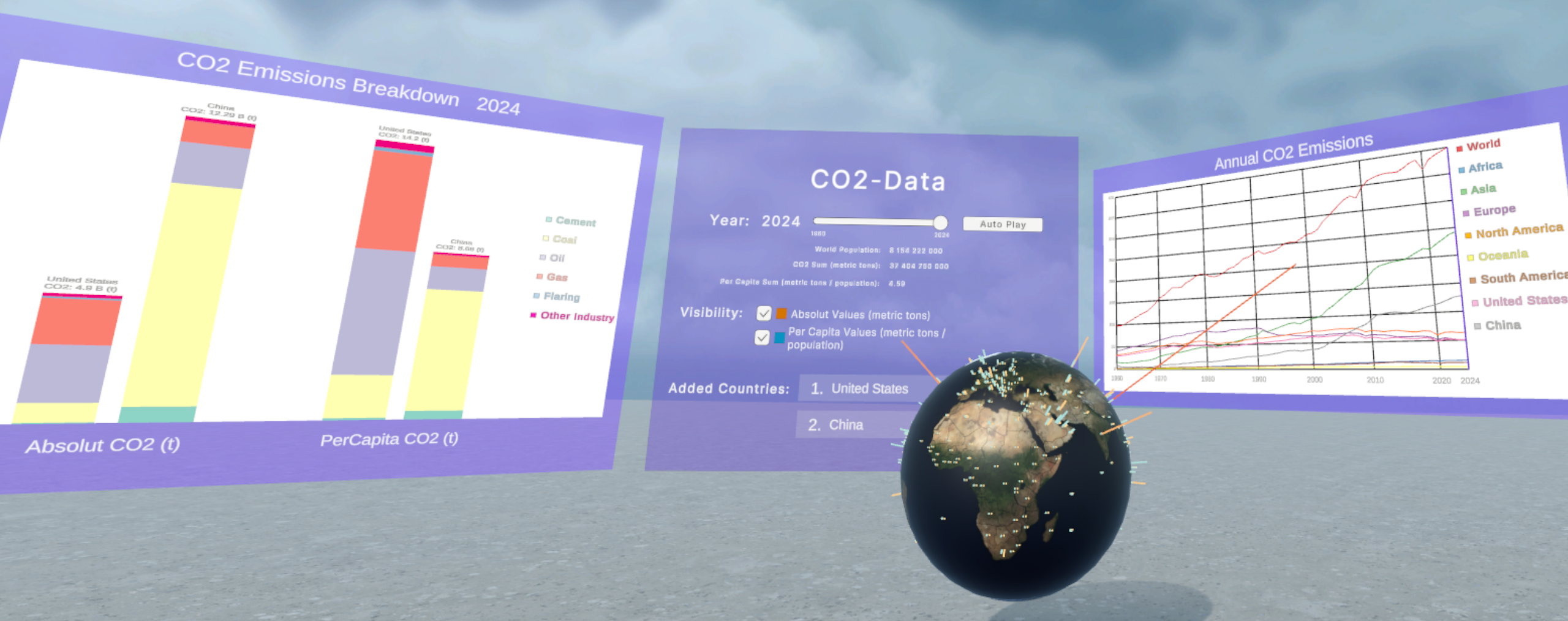
This paper explores how interactive, immersive 3D environments can foster shared understanding of contextually situated data among volunteer-based participants from the general public. For this purpose, we developed a virtual reality (VR) prototype to visualize country-specific CO2 emissions and population dynamics across different spatio-temporal scales, contextually situated on an interactive 3D globe. Building on the first round of user evaluations, documented in our previous work and briefly revisited here, this publication presents the VR prototype’s redesign based on participant feedback and evaluates the impact of these changes. The comparison between the initial and redesigned prototypes empirically assesses whether feedback-driven design recommendations improve users’ interaction with, understanding of, and sensemaking through immersive environmental data visualization, grounded in established iterative design principles. Our findings suggest that the implemented strategies improved understanding and fostered deeper insights into the data, without overwhelming users with complex interactions or visualizations.Additional Files and Images
Weblinks
BibTeX
@article{huber-2026-fiv,
  title =      "Feedback-Driven Iterative VR Prototype Development for
               Environmental Data Communication to the General Public",
  author =     "Marlene Huber and Johannes Eschner and Hannes Kaufmann and
               Katharina Kr\"{o}sl and Milena Vuckovic",
  year =       "2026",
  abstract =   "This paper explores how interactive, immersive 3D
               environments can foster shared understanding of contextually
               situated data among volunteer-based participants from the
               general public. For this purpose, we developed a virtual
               reality (VR) prototype to visualize country-specific CO2
               emissions and population dynamics across different
               spatio-temporal scales, contextually situated on an
               interactive 3D globe. Building on the first round of user
               evaluations, documented in our previous work and briefly
               revisited here, this publication presents the VR
               prototype’s redesign based on participant feedback and
               evaluates the impact of these changes. The comparison
               between the initial and redesigned prototypes empirically
               assesses whether feedback-driven design recommendations
               improve users’ interaction with, understanding of, and
               sensemaking through immersive environmental data
               visualization, grounded in established iterative design
               principles. Our findings suggest that the implemented
               strategies improved understanding and fostered deeper
               insights into the data, without overwhelming users with
               complex interactions or visualizations.",
  month =      sep,
  articleno =  "104744",
  doi =        "10.1016/j.cag.2026.104744",
  issn =       "1873-7684",
  journal =    "Computers & Graphics",
  pages =      "11",
  volume =     "140",
  publisher =  "PERGAMON-ELSEVIER SCIENCE LTD",
  keywords =   "Data visualization, Immersive Environments, Environmental
               data, Science Communication, Virtual Reality",
  URL =        "https://www.cg.tuwien.ac.at/research/publications/2026/huber-2026-fiv/",
}