

Angeliki Grammatikaki , Milena Vuckovic, Manuela Waldner
TreesFormer: Multimodal Grammar-Based 3D Tree Reconstruction from Sparse Geodata
In Computer Graphics & Visual Computing (CGVC) 2026, pages 1-10. April 2026.
[ paper]
Information
- Publication Type: Conference Paper
- Workgroup(s)/Project(s):
- Date: April 2026
- ISBN: 978-3-03868-319-3
- Publisher: The Eurographics Association
- Open Access: yes
- Location: Nottingham
- Lecturer: Angeliki Grammatikaki
- Event: 28th Eurographics Conference on Visualization (EuroVis 2026)
- Editor: Sheng, Yun and Elshehaly, Mai
- DOI: 10.2312/cgvc.20261008
- Booktitle: Computer Graphics & Visual Computing (CGVC) 2026
- Pages: 10
- Conference date: 8. June 2026 – 12. June 2026
- Pages: 1 – 10
- Keywords: Neural networks, Mesh models, Reconstruction
Abstract
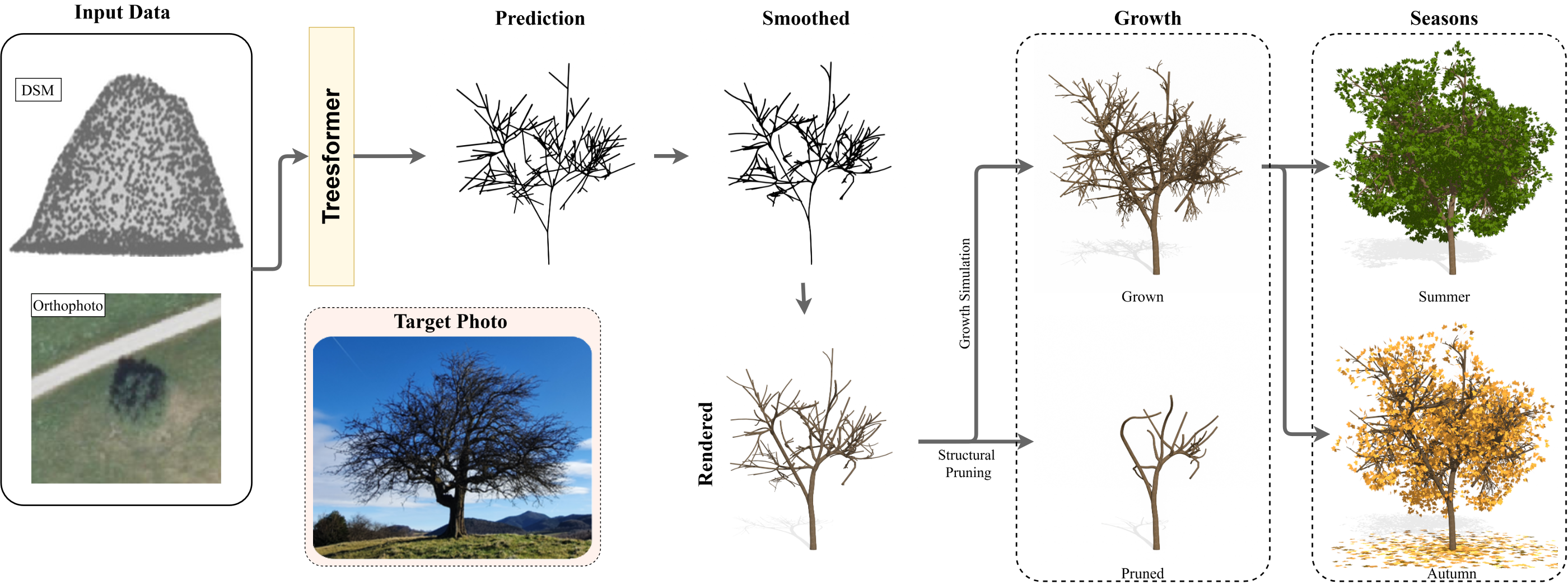
We present TreesFormer, the first grammar-based framework for reconstructing hierarchical 3D tree structures directly from sparse top-down geodata using only a single orthophoto and its corresponding Digital Surface Model (DSM). It employs a multi-modal autoregressive transformer that predicts compact parametric L-system grammars from DSM point clouds and orthophoto features, jointly predicting symbolic structure and geometric parameters while enforcing grammar constraints during decoding. To enable supervision in the absence of real-world grammar annotations, we introduce a synthetic multimodal dataset of procedurally generated trees with aligned aerial inputs and ground-truth L-system labels. Experiments show that DSMs drive overall geometric accuracy and crown shape, while orthophoto conditioning improves structural regularity and branching depth; their combination consistently outperforms either modality alone. The model generalizes to real-world Austrian and French aerial data, producing interpretable branching structures suitable for large-scale rural 3D mapping. The codebase, synthetic dataset, and pretrained model are publicly available at https://angelikigram.github.io/treesformer/.Additional Files and Images

Weblinks
BibTeX
@inproceedings{grammatikaki-2026-treesformer,
  title =      "TreesFormer: Multimodal Grammar-Based 3D Tree Reconstruction
               from Sparse Geodata",
  author =     "Angeliki Grammatikaki and Milena Vuckovic and Manuela
               Waldner",
  year =       "2026",
  abstract =   "We present TreesFormer, the first grammar-based framework
               for reconstructing hierarchical 3D tree structures directly
               from sparse top-down geodata using only a single orthophoto
               and its corresponding Digital Surface Model (DSM). It
               employs a multi-modal autoregressive transformer that
               predicts compact parametric L-system grammars from DSM point
               clouds and orthophoto features, jointly predicting symbolic
               structure and geometric parameters while enforcing grammar
               constraints during decoding. To enable supervision in the
               absence of real-world grammar annotations, we introduce a
               synthetic multimodal dataset of procedurally generated trees
               with aligned aerial inputs and ground-truth L-system labels.
               Experiments show that DSMs drive overall geometric accuracy
               and crown shape, while orthophoto conditioning improves
               structural regularity and branching depth; their combination
               consistently outperforms either modality alone. The model
               generalizes to real-world Austrian and French aerial data,
               producing interpretable branching structures suitable for
               large-scale rural 3D mapping. The codebase, synthetic
               dataset, and pretrained model are publicly available at
               https://angelikigram.github.io/treesformer/.",
  month =      apr,
  isbn =       "978-3-03868-319-3",
  publisher =  "The Eurographics Association",
  location =   "Nottingham",
  event =      "28th Eurographics Conference on Visualization (EuroVis 2026)",
  editor =     "Sheng, Yun and Elshehaly, Mai",
  doi =        "10.2312/cgvc.20261008",
  booktitle =  "Computer Graphics & Visual Computing (CGVC) 2026",
  pages =      "10",
  pages =      "1--10",
  keywords =   "Neural networks, Mesh models, Reconstruction",
  URL =        "https://www.cg.tuwien.ac.at/research/publications/2026/grammatikaki-2026-treesformer/",
}