

 Master thesis
Information
- Publication Type: Master Thesis
- Workgroup(s)/Project(s):
- Date: April 2017
- Date (Start): 1. June 2016
- Date (End): 21. April 2017
- TU Wien Library:
- First Supervisor: Ivan Viola

Abstract
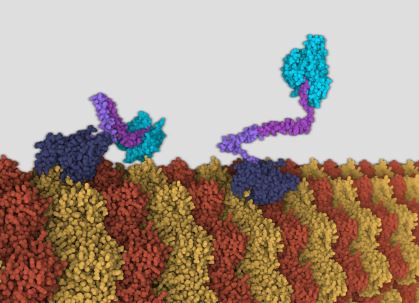
This work proposes an agent-based model for animating molecular machines. Usually molecular machines are visualized using key-frame animation. Creating large molecular assemblies with key-frame animation in standard 3D software can be a tedious task, because hundreds or thousands of molecular particles have to be animated by hand, considering various biological phenomena. To avoid repetitive animation of molecular particles, a prototypic framework is implemented, that employs an agent-based approach. Instead of animating the molecular particles directly, the framework utilizes behavior descriptions for each type of molecular particle. The animation results from the molecular particles interacting with each other as defined by their behavior. Interaction between molecular particles is enabled by an abstract model that is implemented by the framework. The methodology for creating the framework was driven through learning by example. Three molecular machines are visualized using the framework. During this process, the framework was iteratively improved, to meet the requirements for each new molecular machine. The resulted animations demonstrate that agent-based animation is a viable option for molecular machines.Additional Files and Images

Weblinks
No further information available.BibTeX
@mastersthesis{Gehrer-2017,
  title =      "Visualization of molecular machinery using agent-based
               animation",
  author =     "Daniel Gehrer",
  year =       "2017",
  abstract =   "This work proposes an agent-based model for animating
               molecular machines. Usually molecular machines are
               visualized using key-frame animation. Creating large
               molecular assemblies with key-frame animation in standard 3D
               software can be a tedious task, because hundreds or
               thousands of molecular particles have to be animated by
               hand, considering various biological phenomena. To avoid
               repetitive animation of molecular particles, a prototypic
               framework is implemented, that employs an agent-based
               approach. Instead of animating the molecular particles
               directly, the framework utilizes behavior descriptions for
               each type of molecular particle. The animation results from
               the molecular particles interacting with each other as
               defined by their behavior. Interaction between molecular
               particles is enabled by an abstract model that is
               implemented by the framework. The methodology for creating
               the framework was driven through learning by example. Three
               molecular machines are visualized using the framework.
               During this process, the framework was iteratively improved,
               to meet the requirements for each new molecular machine. The
               resulted animations demonstrate that agent-based animation
               is a viable option for molecular machines. ",
  month =      apr,
  address =    "Favoritenstrasse 9-11/E193-02, A-1040 Vienna, Austria",
  school =     "Institute of Computer Graphics and Algorithms, Vienna
               University of Technology ",
  URL =        "https://www.cg.tuwien.ac.at/research/publications/2017/Gehrer-2017/",
}