

Irene Reisner-Kollmann, Stefan Maierhofer
Segmenting Multiple Range Images with Primitive Shapes
In Proceedings of 19th International Conference on Systems, Signals and Image Processing (IWSSIP 2012). April 2012.
Information
- Publication Type: Conference Paper
- Workgroup(s)/Project(s):
- Date: April 2012
- ISBN: 978-3-200-02588-2
- Location: Vienna
- Lecturer: Irene Reisner-Kollmann
- Booktitle: Proceedings of 19th International Conference on Systems, Signals and Image Processing (IWSSIP 2012)
- Conference date: 11. April 2012 – 13. April 2012
- Keywords: surface fitting, range data, segmentation, shape detection
Abstract
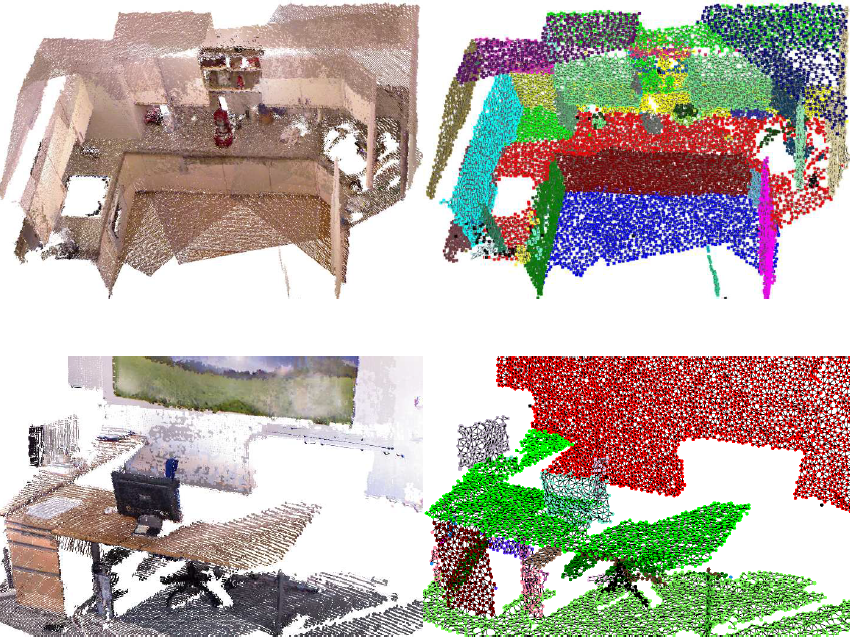
We introduce a novel method for automatically segmenting multiple registered range images by detecting and optimizing geometric primitives. The resulting shapes provide high level information about scanned objects and are a valuable input for surface reconstruction, hole filling, or shape analysis. We begin by generating a global graph of sample points covering all input frames. The graph structure allows to compute a globally consistent segmentation with a memory and time-efficient solution, even for large sets of input images. We iteratively detect shapes with a Ransac-approach, optimize the assignments of graph nodes to shapes, and optimize the shape parameters. Finally, pixel-accurate segmentations can be extracted for each source image individually. By using range images instead of unstructured point clouds as input, we can exploit additional information such as connectivity or varying precision of depth measurements.Additional Files and Images

Weblinks
No further information available.BibTeX
@inproceedings{reisner-2012-iwssip,
  title =      "Segmenting Multiple Range Images with Primitive Shapes",
  author =     "Irene Reisner-Kollmann and Stefan Maierhofer",
  year =       "2012",
  abstract =   "We introduce a novel method for automatically segmenting
               multiple registered range images by detecting and optimizing
               geometric primitives. The resulting shapes provide high
               level information about scanned objects and are a valuable
               input for surface reconstruction, hole filling, or shape
               analysis. We begin by generating a global graph of sample
               points covering all input frames. The graph structure allows
               to compute a globally consistent segmentation with a memory
               and time-efficient solution, even for large sets of input
               images. We iteratively detect shapes with a Ransac-approach,
               optimize the assignments of graph nodes to shapes, and
               optimize the shape parameters. Finally, pixel-accurate
               segmentations can be extracted for each source image
               individually. By using range images instead of unstructured
               point clouds as input, we can exploit additional information
               such as connectivity or varying precision of depth
               measurements.",
  month =      apr,
  isbn =       "978-3-200-02588-2",
  location =   "Vienna",
  booktitle =  "Proceedings of 19th International Conference on Systems,
               Signals and Image Processing (IWSSIP 2012)",
  keywords =   "surface fitting, range data, segmentation, shape detection",
  URL =        "https://www.cg.tuwien.ac.at/research/publications/2012/reisner-2012-iwssip/",
}