

Alexander Wilkie, Andrea Weidlich, Marcus Magnor, A. Chalmers
Predictive Rendering
In SIGGRAPH Asia 2009 Courses. 2009.
Information
- Publication Type: Other Reviewed Publication
- Workgroup(s)/Project(s): not specified
- Date: 2009
- Booktitle: SIGGRAPH Asia 2009 Courses
- Location: Yokohama, Japan
- Conference date: 16. December 2009 – 19. December 2009
Abstract
This course intends to serve two closely related purposes: to provide an accurate definition of the term predictive rendering, the sub-discipline of computer graphics that attempts to provide reliable predictions of object appearance, and to present the technological foundations on which one can currently conduct research in this area.The first goal of the course – a clear definition of what predictive rendering actually is – seems to be necessary due to the extreme prevalence of its antonym, believable rendering. Practically all contemporary production computer graphics, as well as most current graphics research efforts, fall into the latter category. Coupled with the fact that in the collective mindset of the graphics community, the distinction between these areas has, for a variety of reasons, been somewhat blurry so far, a precise clarifying statement appears to be in order.
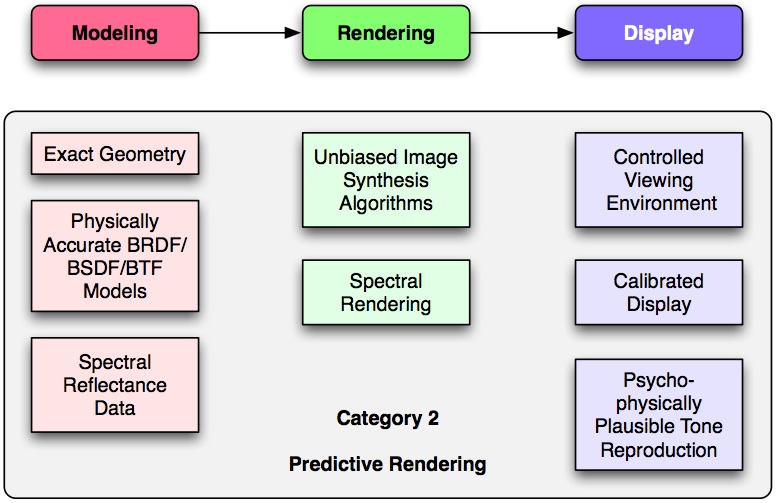
The second, much larger and technical part of the course then presents the foundations of current predictive rendering. Unlike believable rendering, where any technology that delivers visually convincing (as opposed to radiometrically correct) results is acceptable for a given task, a predictive pipeline suffers from the fundamental problem that all components – modeling, rendering, display – have to be of a uniformly high quality to ensure a predictive result. This fact has, over time, no doubt served to deter many researchers from entering this promising and interesting field, in which a large amount of work still lies ahead of us.
In the second part, we cover an entire predictive rendering pipeline, and for each stage present those – in some cases surprisingly few – graphics technologies that can be used in such a context. This course should enable anyone with a solid background in graphics to bootstrap a basic predictive rendering environment, with which further research, or perhaps even specialised production work, can be conducted.
Additional Files and Images
Weblinks
No further information available.BibTeX
@inproceedings{wilkie-209.pr,
  title =      "Predictive Rendering",
  author =     "Alexander Wilkie and Andrea Weidlich and Marcus Magnor and
               A. Chalmers",
  year =       "2009",
  abstract =   "This course intends to serve two closely related purposes:
               to provide an accurate definition of the term predictive
               rendering, the sub-discipline of computer graphics that
               attempts to provide reliable predictions of object
               appearance, and to present the technological foundations on
               which one can currently conduct research in this area.  The
               first goal of the course – a clear definition of what
               predictive rendering actually is – seems to be necessary
               due to the extreme prevalence of its antonym, believable
               rendering. Practically all contemporary production computer
               graphics, as well as most current graphics research efforts,
               fall into the latter category. Coupled with the fact that in
               the collective mindset of the graphics community, the
               distinction between these areas has, for a variety of
               reasons, been somewhat blurry so far, a precise clarifying
               statement appears to be in order.  The second, much larger
               and technical part of the course then presents the
               foundations of current predictive rendering. Unlike
               believable rendering, where any technology that delivers
               visually convincing (as opposed to radiometrically correct)
               results is acceptable for a given task, a predictive
               pipeline suffers from the fundamental problem that all
               components – modeling, rendering, display – have to be
               of a uniformly high quality to ensure a predictive result.
               This fact has, over time, no doubt served to deter many
               researchers from entering this promising and interesting
               field, in which a large amount of work still lies ahead of
               us.  In the second part, we cover an entire predictive
               rendering pipeline, and for each stage present those – in
               some cases surprisingly few – graphics technologies that
               can be used in such a context. This course should enable
               anyone with a solid background in graphics to bootstrap a
               basic predictive rendering environment, with which further
               research, or perhaps even specialised production work, can
               be conducted.",
  booktitle =  "SIGGRAPH Asia 2009 Courses",
  location =   "Yokohama, Japan",
  URL =        "https://www.cg.tuwien.ac.at/research/publications/2009/wilkie-209.pr/",
}