



Abstract
This paper introduces importance-driven volume rendering as a novel technique for automatic focus and context display of volumetric data. It is a generalization of cut-away views, which - depending on the viewpoint - remove or suppress less important parts of a scene to reveal more important underlying information. We automatize and apply this idea to volumetric data.Each part of the volumetric data is assigned an object importance which encodes visibility priority. It determines which structures should be readily discernable and which structures are less important. In those image regions, where an object occludes more important structures it is displayed more sparsely than in those areas where no occlusion occurs. Thus the objects of interest are clearly visible. For each object several representations, i.e., levels of sparseness, are specified. The display of an individual object may incorporate different levels of sparseness. The goal is to emphasize important structures and to maximize the information content in the final image.
This paper also discusses several possible schemes for level of sparseness specification and different ways how object importance can be composited to determine the final appearance of a particular object.
Keywords: view-dependent visualization, volume rendering, focus+context techniques, level-of-detail techniques, non-photorealistic techniques
Download full paper
Ivan Viola, Armin Kanitsar, Meister Eduard Gröller, "Importance-Driven Volume Rendering", in proceedings of IEEE Visualization 2004, pages 139-145. idvr.pdf (2,780 KB).Figures in the paper
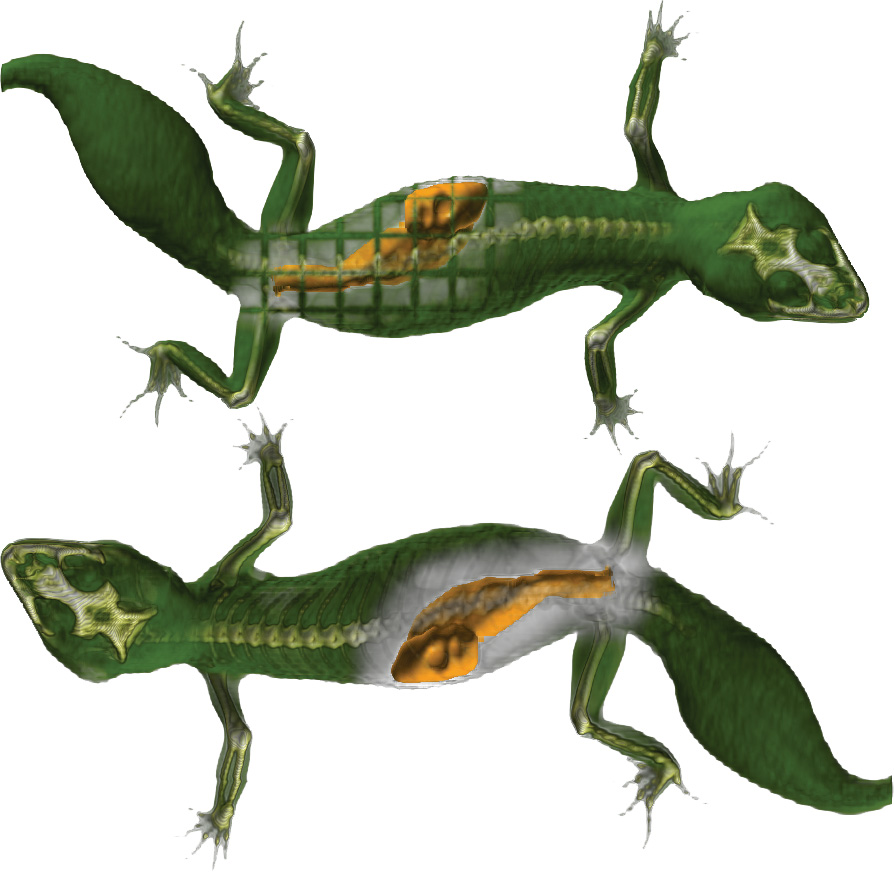 |
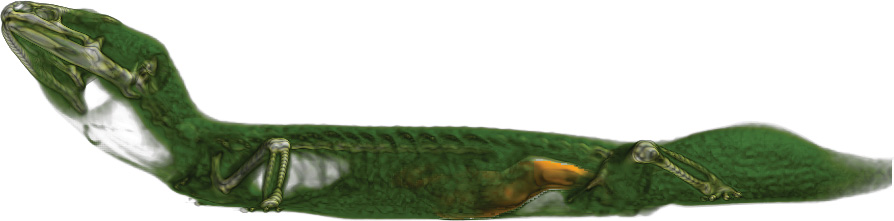
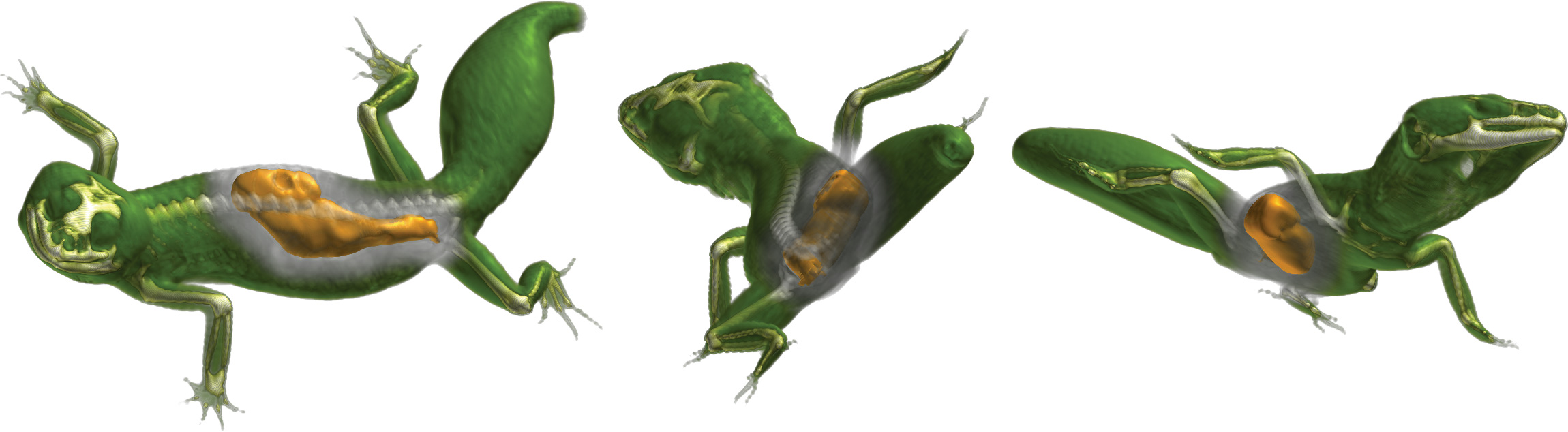
Figure 1:
Teaser: Leopard Gecko dataset: Importance-driven volume rendering of inner structures. |
 (a) (a) 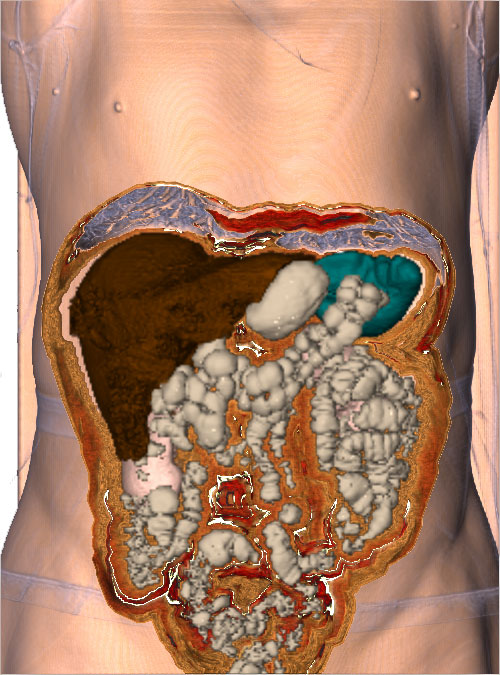 (b) (b)
|
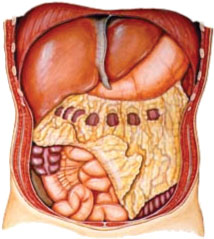
Figure 2:
Comparison between artistic medical illustration of the abdomen (a) and our method (b). Illustration image is courtesy of Howell MediGraphics. |
 (a) (a) 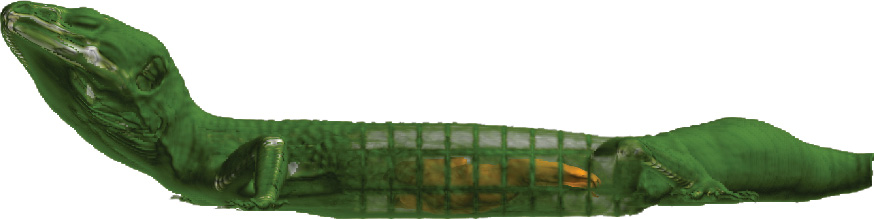 (b) (b)
|
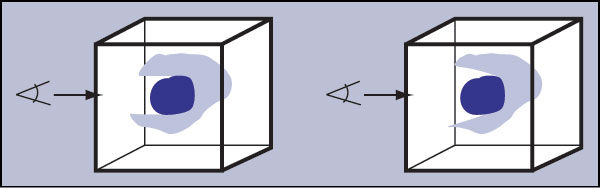
Figure 3:
Comparison between traditional volume rendering (a) and importance-driven volume rendering (b). |
|
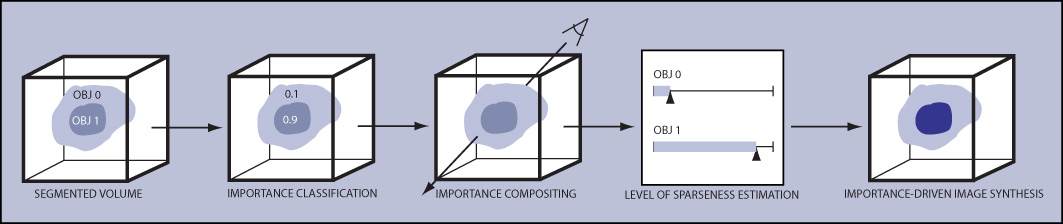
Figure 4:
Stages of the importance-driven volume rendering pipeline in contrast to traditional volume rendering. |
|
Figure 5:
Maximum Importance Projection. Illustrating images of cylindrical and conical MImP. |
|
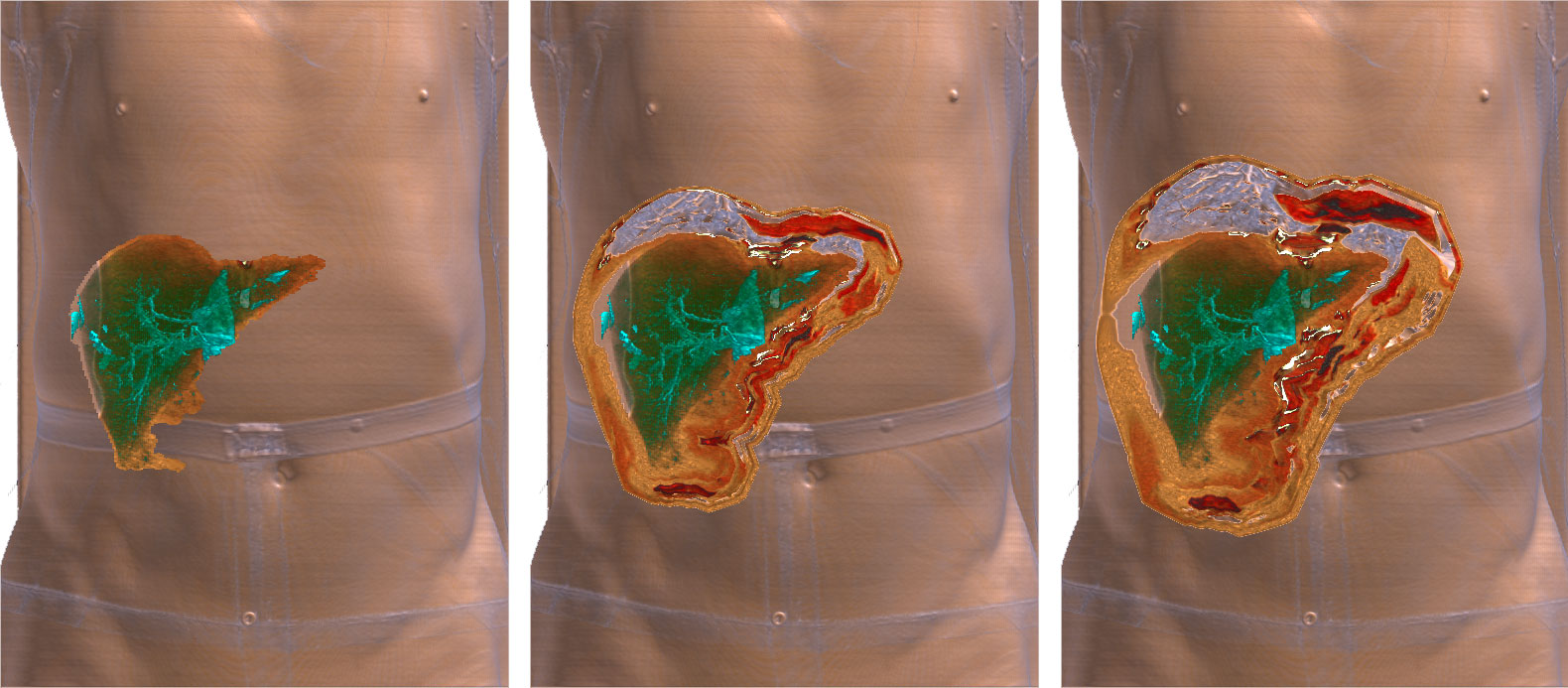
Figure 6:
Maximum Importance Projection. Cylindrical and conical MImP of human liver with different slope factors. |
|
Figure 7:
Average importance compositing: The average compositing is shown in combination with optical properties modulation. |
|
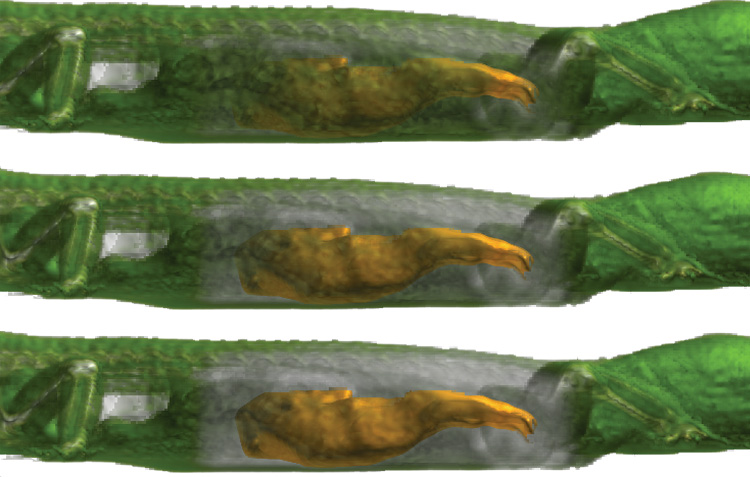
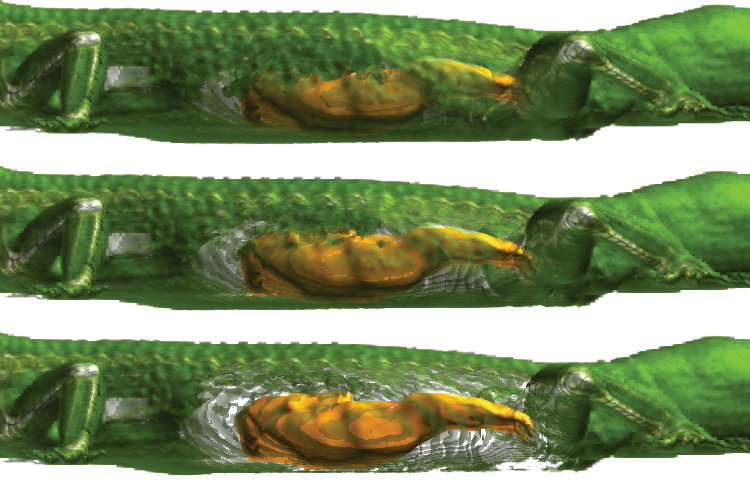
Figure 8 top:
Changing levels of sparseness. Opacity modulation and color saturation modulation. Levels of sparseness with factors 0.75, 0.5, and 0.25. |
|
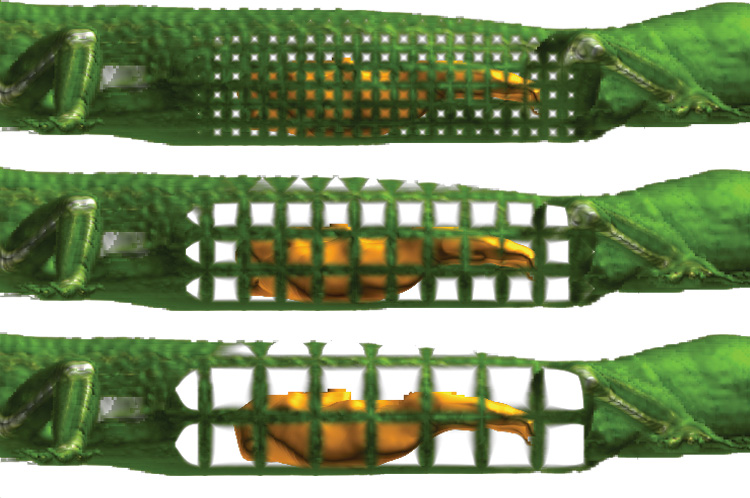
Figure 8 middle:
Changing levels of sparseness. Screen-door transparency. Levels of sparseness with factors 0.75, 0.5, and 0.25. |
|
Figure 8 bottom:
Changing levels of sparseness. Volume thinning.. Levels of sparseness with factors 0.75, 0.5, and 0.25. |
Supplementary videos

|
Video 1:
Leopard Gecko dataset viewed under different viewing angles with dynamically changing level of sparseness. |

|
Video 2:
Leopard Gecko dataset with increasing the importance value of the inner structure. |
|
Video 4:
Conical MImP shown on an application of visualizing liver and its vessel structure. |

|
Video 5:
Conical MImP with varying angle for the countersink geometry. |

|
Video 6:
Conical MImP of the human abdomen. Abdomen organs have the same importance value and the tumor object (yellow color - between the liver and kidney) has the highest importance. |

|
Video 7:
Conical MImP of the hurricane Isabel (multi-modal time-varying dataset). The position of the hurricane eye determines which modality to render (context: cloud information, focus in hurricane eye: precipitation information). |
BibTeX Entry
@InProceedings{vis-viola04,
  author =      {Ivan Viola and Armin Kanitsar and Meister Eduard Gr{\"o}ller},
  title =       {Importance-Driven Volume Rendering},
  booktitle =   {Proceedings of {IEEE} Visualization'04},
  year =        {2004},
  pages =       {139--145},
}