

Maurice Termeer
Comprehensive Visualization of Cardiac MRI Data
Supervisor: Eduard Gröller
Duration: November 2005 — January 2009
[image] [ thesis]
Information
- Publication Type: PhD-Thesis
- Workgroup(s)/Project(s):
- Date: 2009
- Date (Start): November 2005
- Date (End): January 2009
- TU Wien Library:
- Second Supervisor: Marcel Breeuwer
- Rigorosum: 20. January 2009
- First Supervisor: Eduard Gröller
- Keywords: Cardiac MRI Visualization
Abstract
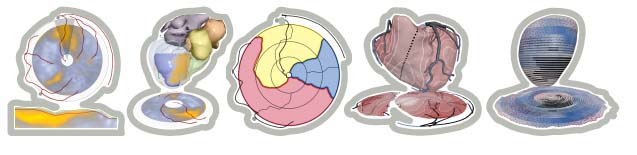
Coronary artery disease is one of the leading causes of death in the western world. The continuous improvements in magnetic resonance imaging technology facilitate more accurate diagnoses by providing increasingly more detailed information on the viability, functioning, perfusion, and anatomy of a patient’s heart. This increasing amount of information creates the need for more efficient and more effective means of processing these data.This thesis presents several novel techniques that facilitate a more comprehensive visualization of a patient’s heart to assist in the diagnosis of coronary artery disease using magnetic resonance imaging (MRI). The volumetric bull’s eye plot is introduced as an extension of an existing visualization technique used in clinical practice---the bull’s eye plot. This novel concept offers a more comprehensive view on the viability of a patient’s heart by providing detailed information on the transmurality of scar while not suffering from discontinuities.
Anatomical context is often lost due to abstract representations of data, or may be scarce due to the nature of the scanning protocol. Several techniques to restore the relation to anatomy are presented. The primary coronary arteries are segmented in a whole heart scan and mapped onto a volumetric bull’s eye plot, adding anatomical context to an abstract representation. Similarly, segmented late enhancement data are rendered along with a three-dimensional segmentation of the patient-specific myocardial and coronary anatomy. Additionally, coronary supply territories are computed from patient-specific data as an improvement over models based on population averages.
Information on the perfusion of the myocardium provided by MRI is typically of fairly low resolution. Using high-resolution anatomical data, an approach to visualize simulated myocardial perfusion is presented, taking full advantage of the detailed information on perfusion. Finally, a truly comprehensive visualization of a cardiac MRI exam is explored by combining whole heart, late enhancement, functional, and perfusion scans in a single visualization. The concepts introduced help to build a more comprehensive view of the patient and the additional information may prove to be beneficial for the diagnostic process.
Additional Files and Images
:thumb64.png)

Weblinks
No further information available.BibTeX
@phdthesis{termeer-2009-cvc,
  title =      "Comprehensive Visualization of Cardiac MRI Data",
  author =     "Maurice Termeer",
  year =       "2009",
  abstract =   "Coronary artery disease is one of the leading causes of
               death in the western world. The continuous improvements in
               magnetic resonance imaging technology facilitate more
               accurate diagnoses by providing increasingly more detailed
               information on the viability, functioning, perfusion, and
               anatomy of a patient’s heart. This increasing amount of
               information creates the need for more efficient and more
               effective means of processing these data.  This thesis
               presents several novel techniques that facilitate a more
               comprehensive visualization of a patient’s heart to assist
               in the diagnosis of coronary artery disease using magnetic
               resonance imaging (MRI). The volumetric bull’s eye plot is
               introduced as an extension of an existing visualization
               technique used in clinical practice---the bull’s eye plot.
               This novel concept offers a more comprehensive view on the
               viability of a patient’s heart by providing detailed
               information on the transmurality of scar while not suffering
               from discontinuities.  Anatomical context is often lost due
               to abstract representations of data, or may be scarce due to
               the nature of the scanning protocol. Several techniques to
               restore the relation to anatomy are presented. The primary
               coronary arteries are segmented in a whole heart scan and
               mapped onto a volumetric bull’s eye plot, adding
               anatomical context to an abstract representation. Similarly,
               segmented late enhancement data are rendered along with a
               three-dimensional segmentation of the patient-specific
               myocardial and coronary anatomy. Additionally, coronary
               supply territories are computed from patient-specific data
               as an improvement over models based on population averages.
               Information on the perfusion of the myocardium provided by
               MRI is typically of fairly low resolution. Using
               high-resolution anatomical data, an approach to visualize
               simulated myocardial perfusion is presented, taking full
               advantage of the detailed information on perfusion. Finally,
               a truly comprehensive visualization of a cardiac MRI exam is
               explored by combining whole heart, late enhancement,
               functional, and perfusion scans in a single visualization.
               The concepts introduced help to build a more comprehensive
               view of the patient and the additional information may prove
               to be beneficial for the diagnostic process.",
  address =    "Favoritenstrasse 9-11/E193-02, A-1040 Vienna, Austria",
  school =     "Institute of Computer Graphics and Algorithms, Vienna
               University of Technology ",
  keywords =   "Cardiac MRI Visualization",
  URL =        "https://www.cg.tuwien.ac.at/research/publications/2009/termeer-2009-cvc/",
}