

Stefan Bruckner , Eduard Gröller
Instant Volume Visualization using Maximum Intensity Difference Accumulation
Computer Graphics Forum, 28(3):775-782, June 2009. [ Paper]
Information
- Publication Type: Journal Paper with Conference Talk
- Workgroup(s)/Project(s):
- Date: June 2009
- Journal: Computer Graphics Forum
- Volume: 28
- Number: 3
- Location: Berlin, Germany
- Lecturer: Stefan Bruckner
- ISSN: 0167-7055
- Event: EuroVis 2009
- Conference date: 10. June 2009 – 12. June 2009
- Pages: 775 – 782
- Keywords: illustrative visualization, maximum intensity projection, direct volume rendering
Abstract
It has long been recognized that transfer function setup for Direct Volume Rendering (DVR) is crucial to its usability. However, the task of finding an appropriate transfer function is complex and time-consuming even for experts. Thus, in many practical applications simpler techniques which do not rely on complex transfer functions are employed. One common example is Maximum Intensity Projection (MIP) which depicts the maximum value along each viewing ray. In this paper, we introduce Maximum Intensity Difference Accumulation (MIDA), a new approach which combines the advantages of DVR and MIP. Like MIP, MIDA exploits common data characteristics and hence does not require complex transfer functions to generate good visualization results. It does, however, feature occlusion and shape cues similar to DVR. Furthermore, we show that MIDA – in addition to being a useful technique in its own right – can be used to smoothly transition between DVR and MIP in an intuitive manner. MIDA can be easily implemented using volume raycasting and achieves real-time performance on current graphics hardware.Additional Files and Images
Additional images and videos
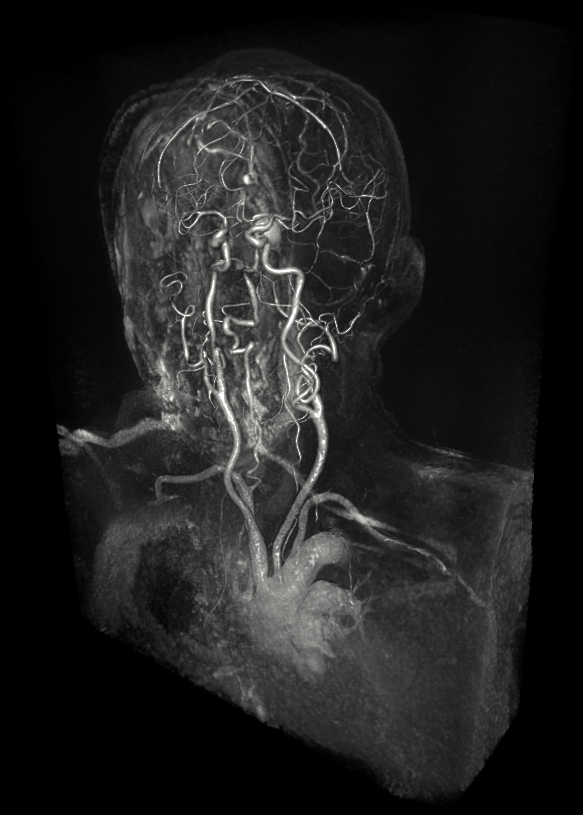
Teaser:
Maximum Intensity Difference Accumulation (MIDA) of an MRI angiography data set
 Video 1:
Animation sequence comparing DVR, MIDA, and MIP applied to a MRI scan
Video 1:
Animation sequence comparing DVR, MIDA, and MIP applied to a MRI scan
 Video 2:
Animation sequence comparing DVR, MIDA, and MIP applied to an Ultramicroscopy scan of a mouse embryo
Video 2:
Animation sequence comparing DVR, MIDA, and MIP applied to an Ultramicroscopy scan of a mouse embryo
 Video 3:
Animation sequence comparing DVR, MIDA, and MIP applied to a CT scan of a backpack
Video 3:
Animation sequence comparing DVR, MIDA, and MIP applied to a CT scan of a backpack
 Video 4:
Animation sequence comparing DVR, MIDA, and MIP applied to a CT scan
Video 4:
Animation sequence comparing DVR, MIDA, and MIP applied to a CT scan
Additional files

Weblinks
BibTeX
@article{bruckner-2009-IVV,
  title =      "Instant Volume Visualization using Maximum Intensity
               Difference Accumulation",
  author =     "Stefan Bruckner and Eduard Gr\"{o}ller",
  year =       "2009",
  abstract =   "It has long been recognized that transfer function setup for
               Direct Volume Rendering (DVR) is crucial to its usability.
               However, the task of finding an appropriate transfer
               function is complex and time-consuming even for experts.
               Thus, in many practical applications simpler techniques
               which do not rely on complex transfer functions are
               employed. One common example is Maximum Intensity Projection
               (MIP) which depicts the maximum value along each viewing
               ray. In this paper, we introduce Maximum Intensity
               Difference Accumulation (MIDA), a new approach which
               combines the advantages of DVR and MIP. Like MIP, MIDA
               exploits common data characteristics and hence does not
               require complex transfer functions to generate good
               visualization results. It does, however, feature occlusion
               and shape cues similar to DVR. Furthermore, we show that
               MIDA – in addition to being a useful technique in its own
               right – can be used to smoothly transition between DVR and
               MIP in an intuitive manner. MIDA can be easily implemented
               using volume raycasting and achieves real-time performance
               on current graphics hardware.",
  month =      jun,
  journal =    "Computer Graphics Forum",
  volume =     "28",
  number =     "3",
  issn =       "0167-7055",
  pages =      "775--782",
  keywords =   "illustrative visualization, maximum intensity projection,
               direct volume rendering",
  URL =        "https://www.cg.tuwien.ac.at/research/publications/2009/bruckner-2009-IVV/",
}