

Ji-Sun Kim, Denis Gracanin, Kresimir Matkovic , Francis Quek
Finger Walking in Place (FWIP): a Traveling Technique in Virtual Environments
In Proceedings of SmartGraphics 2008, Springer LNCS 5166/2008. August 2008.
[]
Information
- Publication Type: Conference Paper
- Workgroup(s)/Project(s):
- Date: August 2008
- ISBN: 978-3-540-85410-4
- Series: LNCS
- Publisher: Springer
- Location: Rennes, France
- Lecturer: Kresimir Matkovic
- ISSN: 0302-9743 (Print) 1611-3349 (Online)
- Booktitle: Proceedings of SmartGraphics 2008, Springer LNCS 5166/2008
- Keywords: Virtual environments, Finger-walking, Navigation, Traveling techniques, Multi-touch device
Abstract
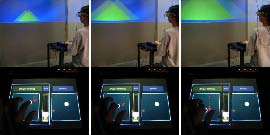
In this paper we present a Finger Walking in Place (FWIP) interaction technique that allows a user to travel in a virtual world as her/his bare ¯ngers slide on a multi-touch sensitive surface. Traveling is basically realized by translating and rotating the user's viewpoint in the virtual world. The user can translate and rotate a viewpoint by mov- ing her/his ¯ngers in place. Currently, our FWIP technique can be used to navigate in a plane but it can be extended to navigate in the third axis, so that the user can move to any direction in a 3D virtual world. Since our FWIP technique only uses bare ¯ngers and a multi-touch de- vice, ¯nger motions are not precisely detected, especially compared with the use of data gloves or similar sensing devices. However, our experi- ments show that FWIP can be used as a novel traveling technique even without accurate motion detection. Our experiment tasks include ¯nding and reaching the target(s) with FWIP, and the participants successfully completed the tasks. The experiments illustrate our e®orts to make the FWIP technique robust as a scaled-down walking-in-place locomotion technique, so that it can be used as a reliable traveling technique.Additional Files and Images

Weblinks
No further information available.BibTeX
@inproceedings{Kim-2008_FWIP,
  title =      "Finger Walking in Place (FWIP): a Traveling Technique in
               Virtual Environments",
  author =     "Ji-Sun Kim and Denis Gracanin and Kresimir Matkovic and
               Francis Quek",
  year =       "2008",
  abstract =   "In this paper we present a Finger Walking in Place (FWIP)
               interaction technique that allows a user to travel in a
               virtual world as her/his bare ¯ngers slide on a multi-touch
               sensitive surface. Traveling is basically realized by
               translating and rotating the user's viewpoint in the virtual
               world. The user can translate and rotate a viewpoint by mov-
               ing her/his ¯ngers in place. Currently, our FWIP technique
               can be used to navigate in a plane but it can be extended to
               navigate in the third axis, so that the user can move to any
               direction in a 3D virtual world. Since our FWIP technique
               only uses bare ¯ngers and a multi-touch de- vice, ¯nger
               motions are not precisely detected, especially compared with
               the use of data gloves or similar sensing devices. However,
               our experi- ments show that FWIP can be used as a novel
               traveling technique even without accurate motion detection.
               Our experiment tasks include ¯nding and reaching the
               target(s) with FWIP, and the participants successfully
               completed the tasks. The experiments illustrate our e®orts
               to make the FWIP technique robust as a scaled-down
               walking-in-place locomotion technique, so that it can be
               used as a reliable traveling technique.",
  month =      aug,
  isbn =       "978-3-540-85410-4",
  series =     "LNCS",
  publisher =  "Springer",
  location =   "Rennes, France",
  issn =       "0302-9743 (Print) 1611-3349 (Online)",
  booktitle =  "Proceedings of SmartGraphics 2008, Springer LNCS  5166/2008",
  keywords =   "Virtual environments, Finger-walking, Navigation, Traveling
               techniques, Multi-touch device",
  URL =        "https://www.cg.tuwien.ac.at/research/publications/2008/Kim-2008_FWIP/",
}