

Andrea Weidlich , Alexander Wilkie
Arbitrarily Layered Micro-Facet Surfaces
In GRAPHITE 2007, pages 171-178. December 2007.
[ paper]
Information
- Publication Type: Conference Paper
- Workgroup(s)/Project(s): not specified
- Date: December 2007
- ISBN: 978-1-59593-912-8
- Publisher: ACM
- Location: Perth, Australia
- Lecturer: Andrea Weidlich
- Booktitle: GRAPHITE 2007
- Pages: 171 – 178
Abstract
In this paper we present a method to combine several micro-facet based surface layers into a single unified, expressive BRDF model that is easy to use. The restriction to micro-facet based layers constitutes no loss of generality, since both perfectly specular and perfectly diffuse surfaces can be seen as limit cases of the micro-facet approach.Such multi-layered surfaces can be used to re-create the appearance of a wide range of different materials, and yield good results without having to perform explicit sub–surface scattering computations. This is achieved through suitable approximations and simplifications of the scattering within the simulated layered surface, while still taking absorption and total internal reflection into account. We also discuss the corresponding probability distribution function that is needed for sampling purposes, and investigate how the flexibility of this new approach is best put to use.
Additional Files and Images
Additional images and videos
image:
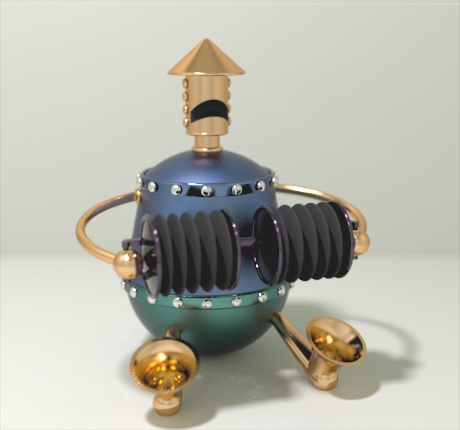
Sample object that uses several of the surface models described in the paper
Additional files
 paper:
Full conference paper
paper:
Full conference paper
Weblinks
No further information available.BibTeX
@inproceedings{weidlich_2007_almfs,
  title =      "Arbitrarily Layered Micro-Facet Surfaces",
  author =     "Andrea Weidlich and Alexander Wilkie",
  year =       "2007",
  abstract =   "In this paper we present a method to combine several
               micro-facet based surface layers into a single unified,
               expressive BRDF model that is easy to use. The restriction
               to micro-facet based layers constitutes no loss of
               generality, since both perfectly specular and perfectly
               diffuse surfaces can be seen as limit cases of the
               micro-facet approach.  Such multi-layered surfaces can be
               used to re-create the appearance of a wide range of
               different materials, and yield good results without having
               to perform explicit sub–surface scattering computations.
               This is achieved through suitable approximations and
               simplifications of the scattering within the simulated
               layered surface, while still taking absorption and total
               internal reflection into account. We also discuss the
               corresponding probability distribution function that is
               needed for sampling purposes, and investigate how the
               flexibility of this new approach is best put to use. ",
  month =      dec,
  isbn =       "978-1-59593-912-8",
  publisher =  "ACM",
  location =   "Perth, Australia",
  booktitle =  "GRAPHITE 2007",
  pages =      "171--178",
  URL =        "https://www.cg.tuwien.ac.at/research/publications/2007/weidlich_2007_almfs/",
}