

Muhammad Muddassir Malik, Torsten Möller, Eduard Gröller
Feature Peeling
In Proceedings of Graphics Interface 2007, pages 273-280. May 2007.
Information
- Publication Type: Conference Paper
- Workgroup(s)/Project(s):
- Date: May 2007
- ISBN: 978-1-56881-337-0
- Publisher: A K Peters Ltd
- Lecturer: Muhammad Muddassir Malik
- Address: Favoritenstrasse 9-11 / E186, A-1040 Wien, Austria
- Booktitle: Proceedings of Graphics Interface 2007
- Pages: 273 – 280
- Keywords: volume visualization, ray analysis, feature peeling
Abstract
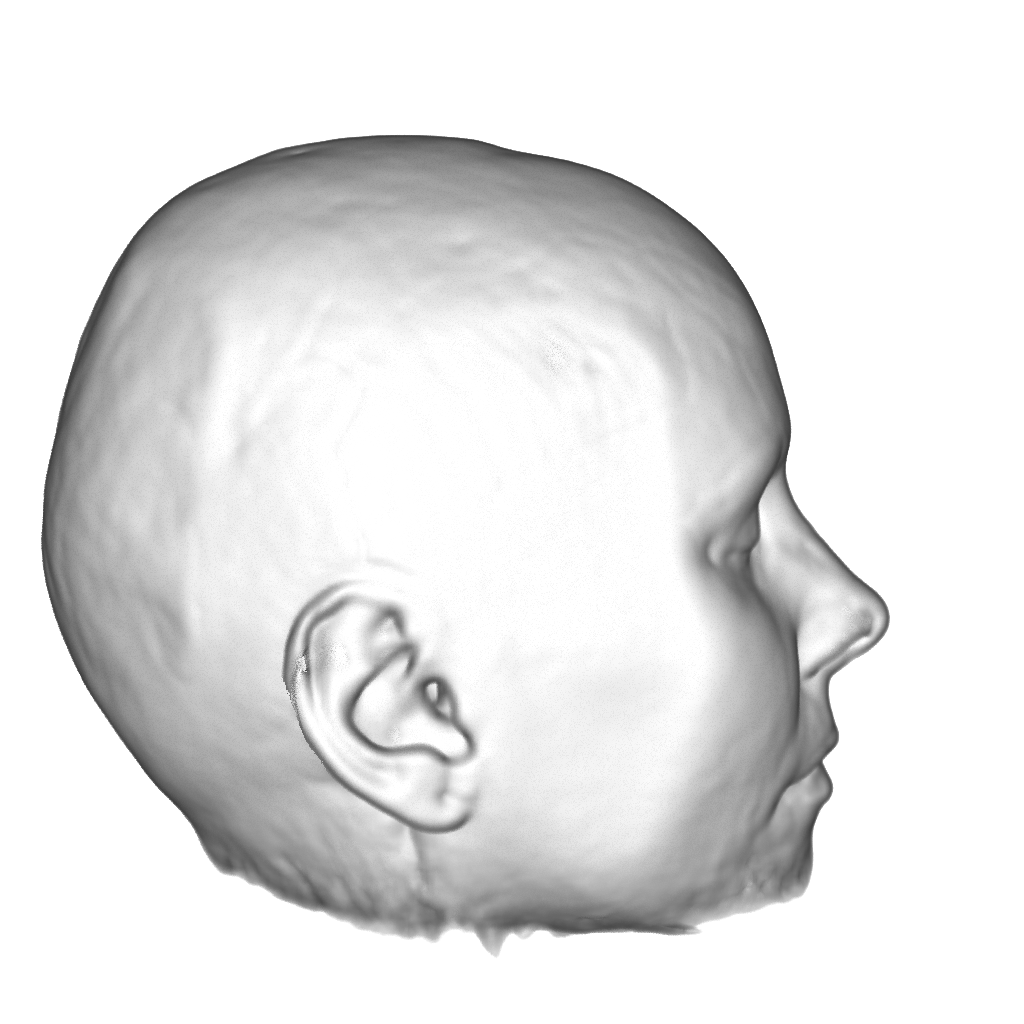
We present a novel rendering algorithm that analyses the ray profiles along the line of sight. The profiles are subdivided according to encountered peaks and valleys at so called transition points. The sensitivity of these transition points is calibrated via two thresholds. The slope threshold is based on the magnitude of a peak following a valley, while the peeling threshold measures the depth of the transition point relative to the neighboring rays. This technique separates the dataset into a number of feature layers. The user can scroll through the layers inspecting various features from the current view position. While our technique has been inspired by opacity peeling approach, we demonstrate that we can reveal detectable features even in the third and fourth layers for both CT and MRI datasets.Additional Files and Images


Weblinks
No further information available.BibTeX
@inproceedings{malik-2007-FP,
  title =      "Feature Peeling",
  author =     "Muhammad Muddassir Malik and Torsten M\"{o}ller and Eduard
               Gr\"{o}ller",
  year =       "2007",
  abstract =   "We present a novel rendering algorithm that analyses the ray
               profiles along the line of sight. The profiles are
               subdivided according to encountered peaks and valleys at so
               called transition points. The sensitivity of these
               transition points is calibrated via two thresholds. The
               slope threshold is based on the magnitude of a peak
               following a valley, while the peeling threshold measures the
               depth of the transition point relative to the neighboring
               rays. This technique separates the dataset into a number of
               feature layers. The user can scroll through the layers
               inspecting various features from the current view position.
               While our technique has been inspired by opacity peeling
               approach, we demonstrate that we can reveal detectable
               features even in the third and fourth layers for both CT and
               MRI datasets.",
  month =      may,
  isbn =       "978-1-56881-337-0",
  publisher =  "A K Peters Ltd",
  address =    "Favoritenstrasse 9-11 / E186, A-1040 Wien, Austria",
  booktitle =  "Proceedings of Graphics Interface 2007",
  pages =      "273--280",
  keywords =   "volume visualization, ray analysis, feature peeling",
  URL =        "https://www.cg.tuwien.ac.at/research/publications/2007/malik-2007-FP/",
}