


Information
- Publication Type: X-Mas Card
- Workgroup(s)/Project(s):
- Date: 2003
Abstract
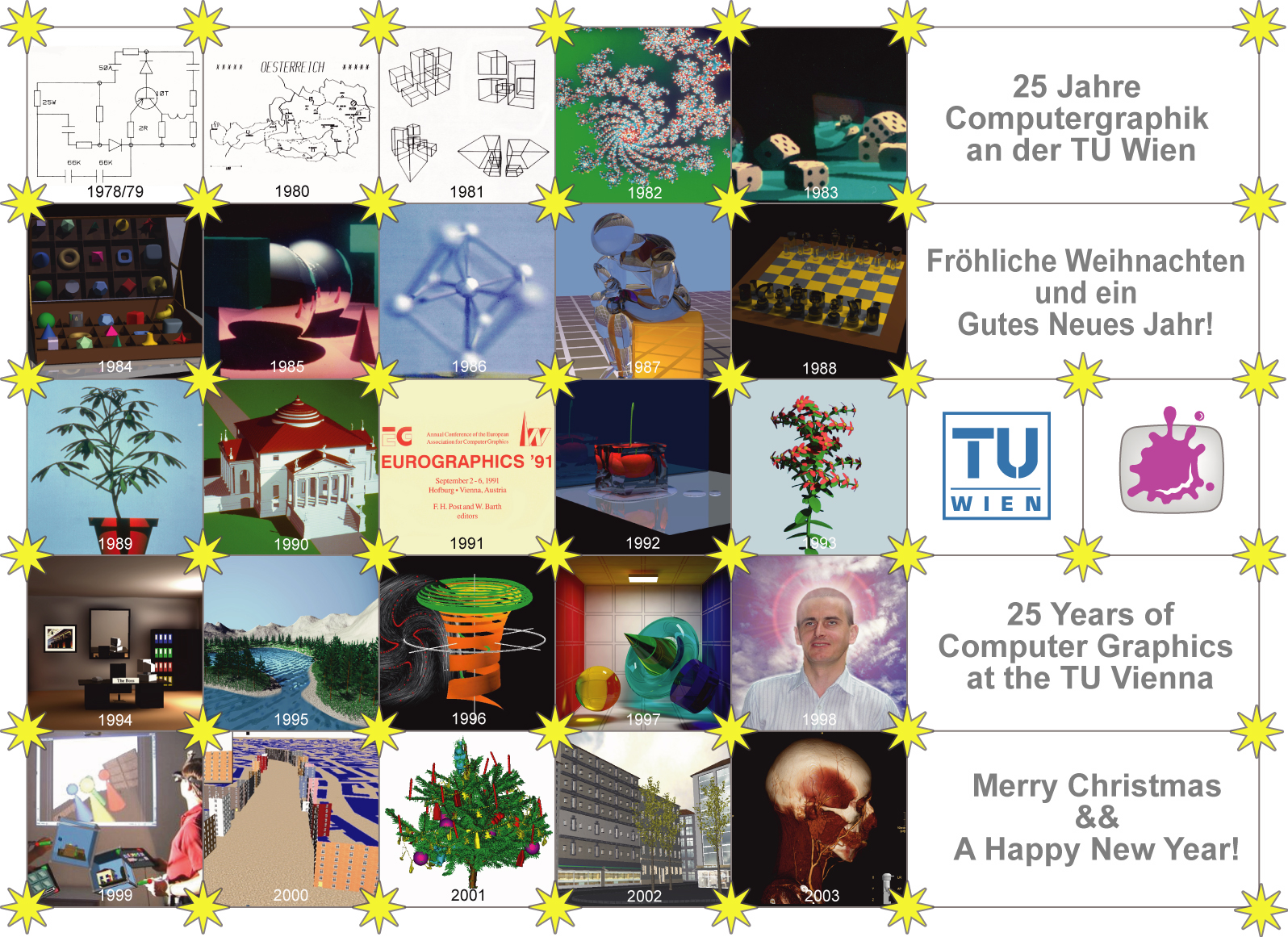
25 Jahre Computergraphik an der TU WienGeschichte ist eng mit Personen verbunden. Die Geschichte der Computergraphik an der Technischen Universität Wien begann unabhängig voneinander an zwei Instituten. In beiden Fällen entstanden die ersten Diplomarbeiten im Jahr 1978. Eine Initiative begann mit Johann Weiß, der sich mit dem Tracken von Lichtstiften beschäftigte, und Georg Stonawski, der eine Diplomarbeit über GKS schrieb. Die zweite Initiative kam von Prof. Wilhelm Barth, der die zwei Diplomanden Emanuel Wenger und Edwin Scherzer die Programmiersprache Pascal um graphische Elemente erweitern ließ. Im Jahr 1980 begann Werner Purgathofer zusammen mit einigen anderen bei Prof. Barth als Assistent und schloss 1984 seine Dissertation ab. Anschließend baute er zusammen mit Michael Gervautz und anderen eine Computergraphik-Arbeitsgruppe auf, die hauptsächlich im Bereich Rendering aktiv war. Als Werner Purgathofer 1988 Professor wurde, stellte er M. Eduard Gröller ein, der die Arbeitsgruppe für Visualisierung gründete. 1990 wurde das Institut in "Institut für Computergraphik" umbenannt, 1991 organisierte die Gruppe die Jahrestagung der Eurographics in der Wiener Hofburg. Bald danach begann Michael Gervautz im Bereich Virtual Reality zu forschen, woraufhin er 1998 die Spinoff-Firma "Imagination" gründete und Dieter Schmalstieg die Leitung der Virtual Reality-Gruppe übernahm. Anfang 2000 gründete das Institut zusammen mit anderen ein Kompetenzzentrum für Virtual Reality und Visualisierung (VRVis), in dem jetzt Georg Stonawski Geschäftsführer und Helwig Hauser wissenschaftlicher Direktor sind. Nach diesen 25 Jahren arbeiten heute in Wien mehr als 100 Personen im Bereich innovativer Computergraphik.
Die Karte wurde unter Verwendung von Adobe Illustrator und Photoshop auf einem Apple iBook produziert. Für die Farbkalibration des bei der Herstellung der physischen Karten verwendeten Druckers wurde die Software ProfileMaker von Gretag Macbeth verwendet.
Idee: Werner Purgathofer Bilder: Der Meister, Emanuel Wenger, Michael Gervautz, Robert F. Tobler, Michael Feda, Christoph Traxler, Michael Wimmer, Alexander Wilkie, Helwig Hauser, Anton L. Fuhrmann und das Kollektiv der Visualisierungsgruppe Herstellung: Alexander Wilkie
25 Years of Computer Graphics at the TU Vienna
History is strongly connected to people. The history of Computer Graphics at the Vienna University of Technology began independently at two institutes. In both cases the first diploma theses were written in 1978. One initiative was started by Johann Weiss, who implemented the tracking of a light pen, and Georg Stonawski, who wrote a thesis about GKS. The second initiative was by Prof. Wilhelm Barth, who worked with the two diploma students Emanuel Wenger and Edwin Scherzer on extending the programming language Pascal with graphical elements. Amongst others, Werner Purgathofer started to work as an assistant of Prof. Barth in 1980, and finished his PhD in 1984. Together with Michael Gervautz and other colleagues, he then built up a Computer Graphics group that was active mainly in the area of Rendering. When Werner Purgathofer became Professor in 1988, he employed M. Eduard Gröller, who in turn founded a Visualisation research group. In 1990 the institute was renamed to "Institute of Computer Graphics", in 1991 the group organized the annual Eurographics conference in the Vienna Hofburg. Soon after that, Michael Gervautz started research in the area of Virtual Reality, which led to the founding of the spin-off company "Imagination" in 1998. Since then, the Virtual Reality group was led by Dieter Schmalstieg. Together with others, the institute created a competence center for Virtual Reality and Visualisation (VRVis) in January 2000, of which Georg Stonawski is the CEO and Helwig Hauser is the scientific director. After these 25 years, there are now more than 100 people in Vienna working in the field of innovative Computer Graphics.
The card was produced using Adobe Illustrator and Photoshop on an Apple iBook. The colour calibration of the printer used for the production of the pysical cards was performed using Gretag Macbeth ProfileMaker software.
Idea: Werner Purgathofer Images by: The Master, Emanuel Wenger, Michael Gervautz, Robert F. Tobler, Michael Feda, Christoph Traxler, Michael Wimmer, Alexander Wilkie, Helwig Hauser, Anton L. Fuhrmann and the collective of the Visualisation group Production: Alexander Wilkie
Additional Files and Images
Weblinks
No further information available.BibTeX
@xmascard{xmas-2003,
  title =      "X-Mas 2003",
  author =     "Werner Purgathofer and Alexander Wilkie",
  year =       "2003",
  abstract =   "25 Jahre Computergraphik an der TU Wien  Geschichte ist eng
               mit Personen verbunden. Die Geschichte der Computergraphik
               an der Technischen Universit\"{a}t Wien begann
               unabh\"{a}ngig voneinander an zwei Instituten. In beiden
               F\"{a}llen entstanden die ersten Diplomarbeiten im Jahr
               1978. Eine Initiative begann mit Johann Wei{\ss}, der sich
               mit dem Tracken von Lichtstiften besch\"{a}ftigte, und Georg
               Stonawski, der eine Diplomarbeit \"{u}ber GKS schrieb. Die
               zweite Initiative kam von Prof. Wilhelm Barth, der die zwei
               Diplomanden Emanuel Wenger und Edwin Scherzer die
               Programmiersprache Pascal um graphische Elemente erweitern
               lie{\ss}. Im Jahr 1980 begann Werner Purgathofer zusammen
               mit einigen anderen bei Prof. Barth als Assistent und
               schloss 1984 seine Dissertation ab. Anschlie{\ss}end baute
               er zusammen mit Michael Gervautz und anderen eine
               Computergraphik-Arbeitsgruppe auf, die haupts\"{a}chlich im
               Bereich Rendering aktiv war. Als Werner Purgathofer 1988
               Professor wurde, stellte er M. Eduard Gr\"{o}ller ein, der
               die Arbeitsgruppe f\"{u}r Visualisierung gr\"{u}ndete. 1990
               wurde das Institut in "Institut f\"{u}r Computergraphik"
               umbenannt, 1991 organisierte die Gruppe die Jahrestagung der
               Eurographics in der Wiener Hofburg. Bald danach begann
               Michael Gervautz im Bereich Virtual Reality zu forschen,
               woraufhin er 1998 die Spinoff-Firma "Imagination"
               gr\"{u}ndete und Dieter Schmalstieg die Leitung der Virtual
               Reality-Gruppe \"{u}bernahm. Anfang 2000 gr\"{u}ndete das
               Institut zusammen mit anderen ein Kompetenzzentrum f\"{u}r
               Virtual Reality und Visualisierung (VRVis), in dem jetzt
               Georg Stonawski Gesch\"{a}ftsf\"{u}hrer und Helwig Hauser
               wissenschaftlicher Direktor sind. Nach diesen 25 Jahren
               arbeiten heute in Wien mehr als 100 Personen im Bereich
               innovativer Computergraphik.  Die Karte wurde unter
               Verwendung von Adobe Illustrator und Photoshop auf einem
               Apple iBook produziert. F\"{u}r die Farbkalibration des bei
               der Herstellung der physischen Karten verwendeten Druckers
               wurde die Software ProfileMaker von Gretag Macbeth
               verwendet.  Idee: Werner Purgathofer Bilder: Der Meister,
               Emanuel Wenger, Michael Gervautz, Robert F. Tobler, Michael
               Feda, Christoph Traxler, Michael Wimmer, Alexander Wilkie,
               Helwig Hauser, Anton L. Fuhrmann und das Kollektiv der
               Visualisierungsgruppe Herstellung: Alexander Wilkie    25
               Years of Computer Graphics at the TU Vienna  History is
               strongly connected to people. The history of Computer
               Graphics at the Vienna University of Technology began
               independently at two institutes. In both cases the first
               diploma theses were written in 1978. One initiative was
               started by Johann Weiss, who implemented the tracking of a
               light pen, and Georg Stonawski, who wrote a thesis about
               GKS. The second initiative was by Prof. Wilhelm Barth, who
               worked with the two diploma students Emanuel Wenger and
               Edwin Scherzer on extending the programming language Pascal
               with graphical elements. Amongst others, Werner Purgathofer
               started to work as an assistant of Prof. Barth in 1980, and
               finished his PhD in 1984. Together with Michael Gervautz and
               other colleagues, he then built up a Computer Graphics group
               that was active mainly in the area of Rendering. When Werner
               Purgathofer became Professor in 1988, he employed M. Eduard
               Gr\"{o}ller, who in turn founded a Visualisation research
               group. In 1990 the institute was renamed to "Institute of
               Computer Graphics", in 1991 the group organized the annual
               Eurographics conference in the Vienna Hofburg. Soon after
               that, Michael Gervautz started research in the area of
               Virtual Reality, which led to the founding of the spin-off
               company "Imagination" in 1998. Since then, the Virtual
               Reality group was led by Dieter Schmalstieg. Together with
               others, the institute created a competence center for
               Virtual Reality and Visualisation (VRVis) in January 2000,
               of which Georg Stonawski is the CEO and Helwig Hauser is the
               scientific director. After these 25 years, there are now
               more than 100 people in Vienna working in the field of
               innovative Computer Graphics.  The card was produced using
               Adobe Illustrator and Photoshop on an Apple iBook. The
               colour calibration of the printer used for the production of
               the pysical cards was performed using Gretag Macbeth
               ProfileMaker software.  Idea: Werner Purgathofer Images by:
               The Master, Emanuel Wenger, Michael Gervautz, Robert F.
               Tobler, Michael Feda, Christoph Traxler, Michael Wimmer,
               Alexander Wilkie, Helwig Hauser, Anton L. Fuhrmann and the
               collective of the Visualisation group Production: Alexander
               Wilkie ",
  URL =        "https://www.cg.tuwien.ac.at/research/publications/2003/xmas-2003/",
}