

Christian-Jürgen Gruber
Visualising the Permutation Space
[ Bachelor thesis]
Information
- Publication Type: Bachelor Thesis
- Workgroup(s)/Project(s):
- Date: November 2025
- Date (Start): 19. April 2025
- Date (End): 11. November 2025
- Matrikelnummer: 00121092
- First Supervisor: Eduard Gröller

Abstract
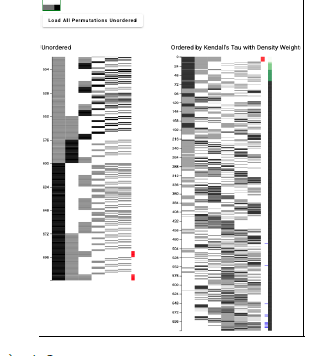
Seriations, i.e. arranging multidimensional data in a list that follows a logical sequence, are part of a technique called Exploratory Data Analysis. They reduce dimensions and give experts a way to assess images and other complex data, enabling them to compare their content and find similarities and differences. But only a few are used at a regular basis, e.g. the historgram seriation. The tool described here tries to add a more wholesome approach by showing all possible seriations in the permutation space. The space grows factorially with the input size, i.e. the number of pixels, and by far not all are meaningful. The goal is to look for patterns in the space, as patterns may indicate further interesting seriations beside the historgram ones. The question is whether one is able to see such patterns when ordering the permutations and/or comparing two ordered spaces. Based on mathematical findings and algorithmic constraints, it will be shown that some patterns can be found even in a simplified setting using images with a size of 3-by-2.Additional Files and Images

Weblinks
No further information available.BibTeX
@bachelorsthesis{gruber-2025-vps,
  title =      "Visualising the Permutation Space",
  author =     "Christian-J\"{u}rgen Gruber",
  year =       "2025",
  abstract =   "Seriations, i.e. arranging multidimensional data in a list
               that follows a logical sequence, are part of a technique
               called Exploratory Data Analysis. They reduce dimensions and
               give experts a way to assess images and other complex data,
               enabling them to compare their content and find similarities
               and differences. But only a few are used at a regular basis,
               e.g. the historgram seriation. The tool described here tries
               to add a more wholesome approach by showing all possible
               seriations in the permutation space. The space grows
               factorially with the input size, i.e. the number of pixels,
               and by far not all are meaningful. The goal is to look for
               patterns in the space, as patterns may indicate further
               interesting seriations beside the historgram ones. The
               question is whether one is able to see such patterns when
               ordering the permutations and/or comparing two ordered
               spaces. Based on mathematical findings and algorithmic
               constraints, it will be shown that some patterns can be
               found even in a simplified setting using images with a size
               of 3-by-2.",
  month =      nov,
  address =    "Favoritenstrasse 9-11/E193-02, A-1040 Vienna, Austria",
  school =     "Research Unit of Computer Graphics, Institute of Visual
               Computing and Human-Centered Technology, Faculty of
               Informatics, TU Wien ",
  URL =        "https://www.cg.tuwien.ac.at/research/publications/2025/gruber-2025-vps/",
}