

Balázs Csébfalvi , Balázs Tóth, Stefan Bruckner, Eduard Gröller
Illumination-Driven Opacity Modulation for Expressive Volume Rendering
In Proceedings of Vision, Modeling & Visualization 2012, pages 103-109. November 2012.
[ Paper]
Information
- Publication Type: Conference Paper
- Workgroup(s)/Project(s):
- Date: November 2012
- Location: Magdeburg, Germany
- Lecturer: Balázs Csébfalvi
- Booktitle: Proceedings of Vision, Modeling & Visualization 2012
- Conference date: 12. November 2012 – 14. November 2012
- Pages: 103 – 109
- Keywords: illustrative visualization, illumination, volume rendering
Abstract
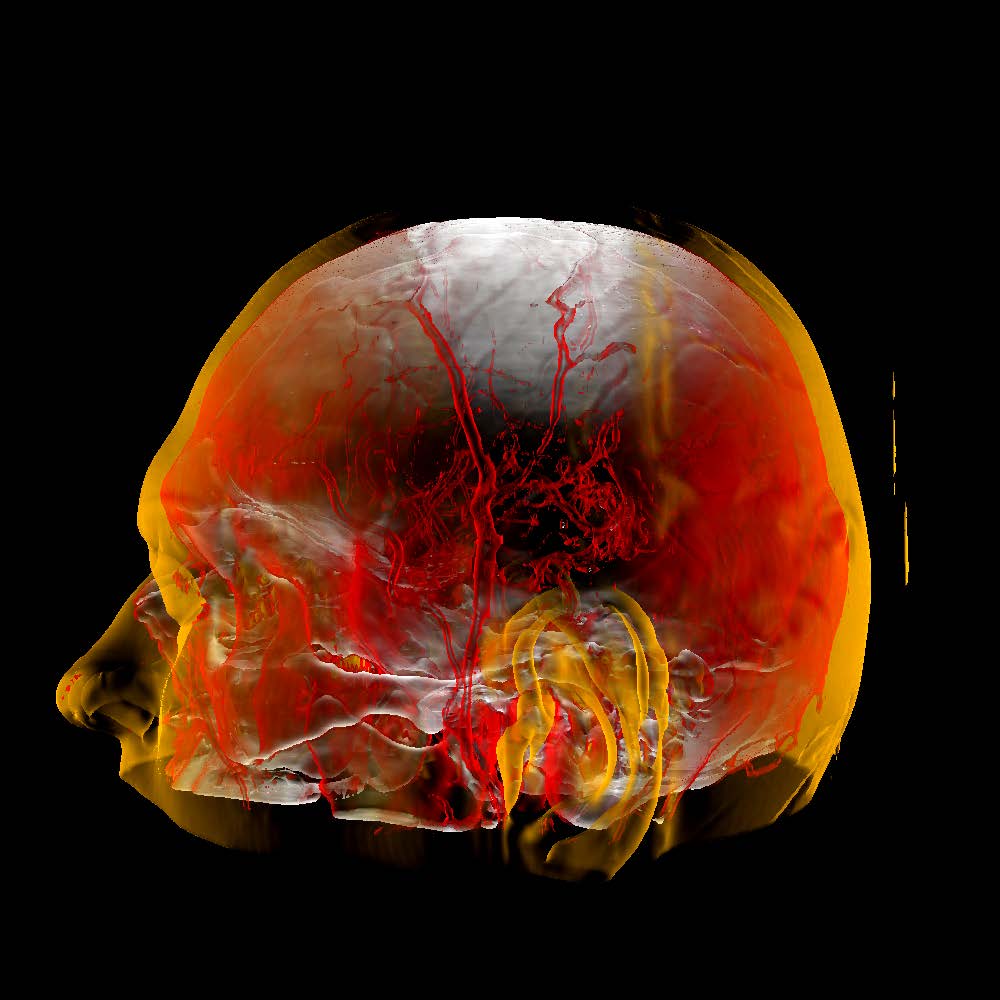
Using classical volume visualization, typically a couple of isosurface layers are rendered semi-transparently to show the internal structures contained in the data. However, the opacity transfer function is often difficult to specify such that all the isosurfaces are of high contrast and sufficiently perceivable. In this paper, we propose a volumerendering technique which ensures that the different layers contribute to fairly different regions of the image space. Since the overlapping between the effected regions is reduced, an outer translucent isosurface does not decrease significantly the contrast of a partially hidden inner isosurface. Therefore, the layers of the data become visually well separated. Traditional transfer functions assign color and opacity values to the voxels depending on the density and the gradient. In contrast, we assign also different illumination directions to different materials, and modulate the opacities view-dependently based on the surface normals and the directions of the light sources, which are fixed to the viewing angle. We will demonstrate that this model allows an expressive visualization of volumetric data.Additional Files and Images
Additional images and videos
Additional files
 Paper:
Illumination-driven opacity modulation in direct volume rendering
Paper:
Illumination-driven opacity modulation in direct volume rendering
Weblinks
No further information available.BibTeX
@inproceedings{Csebfalvi-2012-IOM,
  title =      "Illumination-Driven Opacity Modulation for Expressive Volume
               Rendering",
  author =     "Bal\'{a}zs Cs\'{e}bfalvi and Bal\'{a}zs T\'{o}th and Stefan
               Bruckner and Eduard Gr\"{o}ller",
  year =       "2012",
  abstract =   "Using classical volume visualization, typically a couple of
               isosurface layers are rendered semi-transparently to show
               the internal structures contained in the data. However, the
               opacity transfer function is often difficult to specify such
               that all the isosurfaces are of high contrast and
               sufficiently perceivable. In this paper, we propose a
               volumerendering technique which ensures that the different
               layers contribute to fairly different regions of the image
               space. Since the overlapping between the effected regions is
               reduced, an outer translucent isosurface does not decrease
               significantly the contrast of a partially hidden inner
               isosurface. Therefore, the layers of the data become
               visually well separated. Traditional transfer functions
               assign color and opacity values to the voxels depending on
               the density and the gradient. In contrast, we assign also
               different illumination directions to different materials,
               and modulate the opacities view-dependently based on the
               surface normals and the directions of the light sources,
               which are fixed to the viewing angle. We will demonstrate
               that this model allows an expressive visualization of
               volumetric data.",
  month =      nov,
  location =   "Magdeburg, Germany",
  booktitle =  "Proceedings of Vision, Modeling & Visualization 2012",
  pages =      "103--109",
  keywords =   "illustrative visualization, illumination, volume rendering",
  URL =        "https://www.cg.tuwien.ac.at/research/publications/2012/Csebfalvi-2012-IOM/",
}