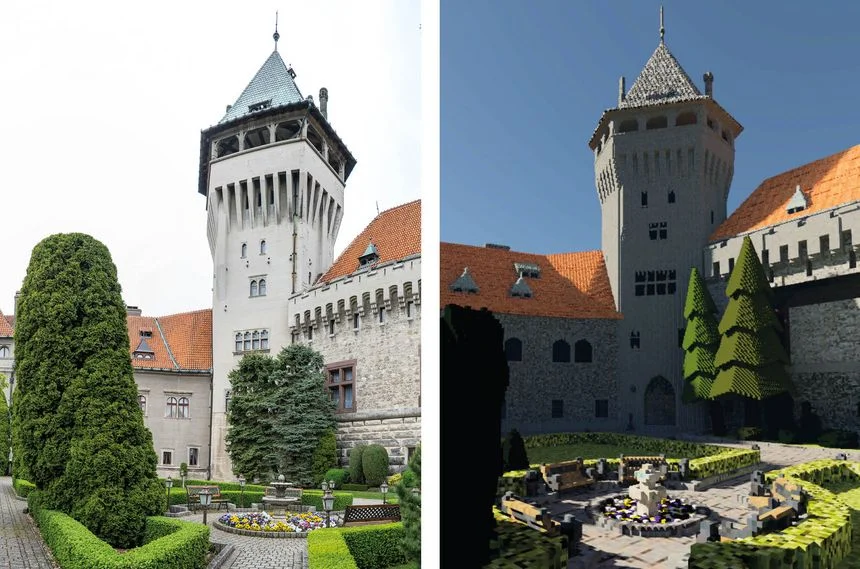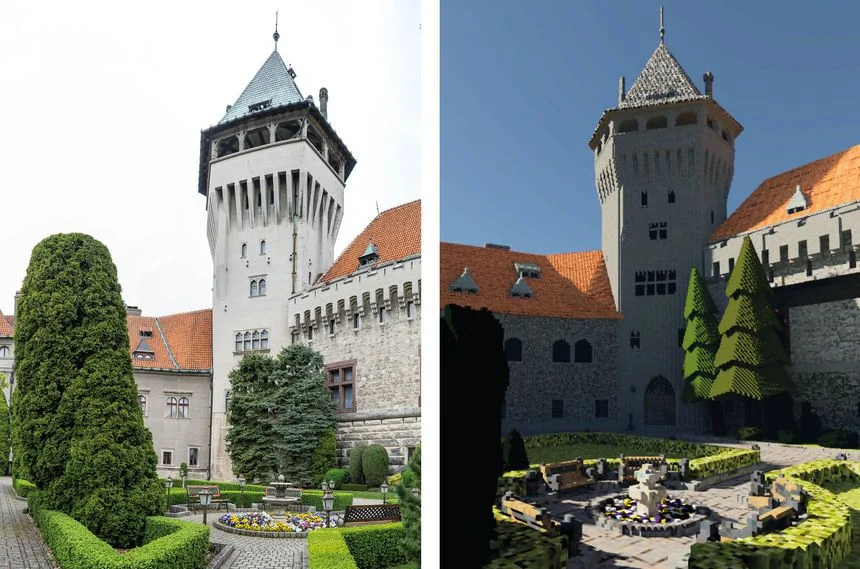

Compelling game worlds don’t just happen by chance. Annalena Ulschmid is researching how computer graphics bring virtual worlds to life and explains why mathematics and physics are just as important in game development as creativity.
When people think of video games, they usually think of exciting stories, impressive graphics, or thrilling competitions. What’s often overlooked is that behind every game lies a complex interplay of computer science, mathematics, physics, and creative design. It is precisely at this intersection that Annalena Ulschmid, a doctoral candidate in the Research Unit Computer Graphics, conducts her research. She is exploring how our real world can be represented in video games as efficiently as possible while remaining authentic.
This involves far more than just beautiful images. Light, shadows, materials, and surfaces must be described mathematically so that they appear realistic on the screen. To achieve this, three-dimensional objects are broken down into countless small triangles, which are then assembled to form entire landscapes, buildings, or characters.
When every millisecond counts
Esports – games in which players compete against each other in real time – are extremely popular. Games like League of Legends (LOL) are played by more than 100 million people each month. For the computer program, this means that every mouse movement and every click must be processed in real time with virtually no delay. “In esports games, even a few milliseconds can make all the difference. Everything has to react immediately,” explains Annalena Ulschmid. Unlike scientific simulations, which also attempt to model the real world, there is no time in a game for complex calculations.
Instead of precisely simulating every physical movement, developers therefore often work with mathematical approximations. The result should look convincing to players, but at the same time be calculable quickly enough. Research at TU Wien focuses precisely on these kinds of challenges. “The more realistic a scene becomes, the more computing power it requires. Our task is to develop intelligent solutions for this,” says Annalena Ulschmid.
Tools for game development
A specific example Ulschmid is working on is a shader for clouds. A shader is a program used in game development to render objects – such as clouds – realistically. This is executed on specialized graphics hardware, known as a GPU. “This involves, for example, the internal representation and storage of the clouds’ volume or the calculation of shadows that make the clouds appear more realistic,” explains Annalena Ulschmid.
The cloud shader is just one example of how research is creating new tools for game development. The knowledge generated at universities is then presented at conferences and shared with other researchers. “Research lives on the exchange of results and the ability of others to build on them,” explains Annalena Ulschmid. As a result, university innovations in computer graphics often find their way into game engines and later into a wide variety of games.
Developing games means teamwork
Game development not only benefits from the exchange between academia and the industry; game development itself requires far more than just programming expertise. Storytelling, level design, animation, sound design, supporting multiple languages, marketing, and much more all come together here. “You can enter the gaming industry from a wide variety of backgrounds,” says Annalena Ulschmid. “That’s exactly what makes this field so exciting.”
In addition, even small teams can develop successful games today. Modern game engines make it possible to implement complex projects without large studios. At the same time, the indie scene thrives on open collaboration. Code is shared, ideas are refined, and new partnerships emerge.
Annalena Ulschmid brings this concept to life at TU Wien as well. Together with Diana Marin from the Research Unit of Virtual and Augmented Reality, she regularly organizes so-called game jams. During these events, around 80 participants develop a playable prototype based on a given theme within 48 hours. For many, this is their first step into game development, and it’s not uncommon for teams to form there that later collaborate on their own projects.
Fostering a passion for computer science
Another of Ulschmid’s aims is to bring computer science to life for a wide audience. That is why, together with colleagues and students from the Research Unit Computer Graphics, she regularly presents their work at events where families and young people in particular can experience games research for the first time. Most recently, the team – comprising 18 student volunteers, Diana Marin and Annalena Ulschmid – was present at the Vienna eSports Festival, opens an external URL in a new window. “Games are a brilliant gateway to computer science,” she says. “They show how many different disciplines come together and just how creative this field can be.” The student projects, opens an external URL in a new window produced each year within the research group also demonstrate just how diverse games can be – not only in their graphics, but also in the laws of nature the fictional world follows.
It is precisely this diversity that makes games an ideal gateway to computer science for Ulschmid. Behind every game that captivates people lies far more than mere entertainment. Mathematical models, intelligent algorithms and the work of many different experts are what make virtual worlds possible in the first place. For Ulschmid, this is precisely what makes her field of research so fascinating – and is perhaps also the best proof of just how versatile computer science can be.
Contact
Annalena Ulschmid
TU Wien
Research Unit Computer Graphics
+43 1 58801 186 46
annalena.ulschmid@tuwien.ac.at
Text: Sarah Link
https://www.tuwien.at/en/tu-wien/news/news-articles/news/die-wissenschaft-hinter-guten-games
https://www.tuwien.at/tu-wien/aktuelles/news/news/die-wissenschaft-hinter-guten-games