

Florian Ladstädter, Andrea K. Steiner, Bettina C. Lackner, Barbara Pirscher, Gottfried Kirchengast, Johannes Kehrer, Helwig Hauser , Philipp Muigg, Helmut Doleisch
Exploration of Climate Data Using Interactive Visualization
Journal of Atmospheric and Oceanic Technology, 27(4):667-679, April 2010.
Information
- Visibility: hidden
- Publication Type: Journal Paper (without talk)
- Workgroup(s)/Project(s): not specified
- Date: April 2010
- Journal: Journal of Atmospheric and Oceanic Technology
- Number: 4
- Volume: 27
- Pages: 667 – 679
Abstract
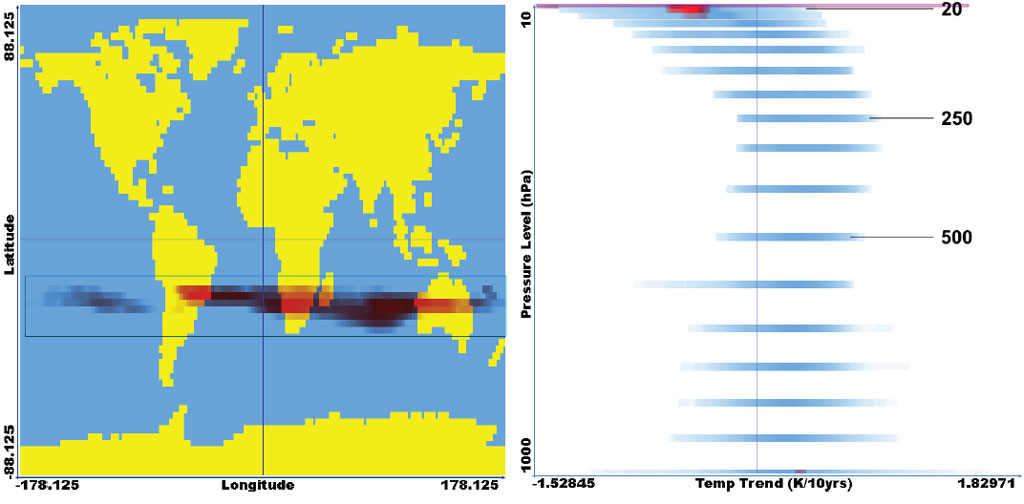
In atmospheric and climate research, the increasing amount of data available from climate models and observations provides new challenges for data analysis. We present interactive visual exploration as an innovative approach to handle large datasets. Visual exploration does not require any previous knowledge about the data as is usually the case with classical statistics. It facilitates iterative and interactive browsing of the parameter space in order to quickly understand the data characteristics, to identify deficiencies, to easily focus on interesting features, and to come up with new hypotheses about the data. These properties extend the common statistical treatment of data, and provide a fundamentally different approach. We demonstrate the potential of this technology by exploring atmospheric climate data from different sources including reanalysis datasets, climate models, and radio occultation satellite data. Results are compared to those from classical statistics revealing the complementary advantages of visual exploration. Combining both, the analytical precision of classical statistics and the holistic power of interactive visual exploration, the usual work flow of studying climate data can be enhanced.Additional Files and Images
Weblinks
BibTeX
@article{Ladstaedter-2010-exp,
  title =      "Exploration of Climate Data Using Interactive Visualization",
  author =     "Florian Ladst\"{a}dter and Andrea K. Steiner and Bettina C.
               Lackner and Barbara Pirscher and Gottfried Kirchengast and
               Johannes Kehrer and Helwig Hauser and Philipp Muigg and
               Helmut Doleisch",
  year =       "2010",
  abstract =   "In atmospheric and climate research, the increasing amount
               of data available from climate models and observations
               provides new challenges for data analysis. We present
               interactive visual exploration as an innovative approach to
               handle large datasets. Visual exploration does not require
               any previous knowledge about the data as is usually the case
               with classical statistics. It facilitates iterative and
               interactive browsing of the parameter space in order to
               quickly understand the data characteristics, to identify
               deficiencies, to easily focus on interesting features, and
               to come up with new hypotheses about the data. These
               properties extend the common statistical treatment of data,
               and provide a fundamentally different approach. We
               demonstrate the potential of this technology by exploring
               atmospheric climate data from different sources including
               reanalysis datasets, climate models, and radio occultation
               satellite data. Results are compared to those from classical
               statistics revealing the complementary advantages of visual
               exploration. Combining both, the analytical precision of
               classical statistics and the holistic power of interactive
               visual exploration, the usual work flow of studying climate
               data can be enhanced.",
  month =      apr,
  journal =    "Journal of Atmospheric and Oceanic Technology",
  number =     "4",
  volume =     "27",
  pages =      "667--679",
  URL =        "https://www.cg.tuwien.ac.at/research/publications/2010/Ladstaedter-2010-exp/",
}