![]() |
Calibration for Augmented RealityProject duration: 1999-2000 Contact: Anton L. Fuhrmann |
|
Augmented Reality overlays computer generated images over the real world. To correctly depict spatial relations between real and virtual objects, these images have to be generated using transformations which correctly project a point in virtual space onto its corresponding point in the real world.
|
|
We present here a simple and fast calibration scheme, which does not require additional instrumentation or complicated procedures. This allows us to calibrate HMDs for specific users. The calibration process is presented to the user as interactively guided initialization step, which enables even inexperienced users to adapt the calibration to their eye distance and head geometry. The calibration is stable - meaning that slight errors made by the user do not result in gross miscalibrations - and applicable for see-through and video-based HMDs. Additionally we show a method for correcting the distortions introduced by the camera lens in real-time using standard OpenGL hardware and for registering tracked objects to their augmentations.
|
|
Anton Fuhrmann, Dieter Schmalstieg and Werner Purgathofer VRST '99, May 1999. |
Why calibration? |
|
|
Since Augmented Reality enhances the real with the virtual world, the position of
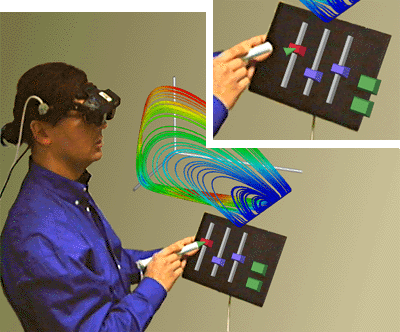
virtual objects has to correspond to a given position in real space. The image below demonstrates how miscalibration can negatively affect interaction in in STUDIERSTUBE, our augmented environment. It depicts a user wearing see-through HMDs and controlling the parameters of a scientific visualization using the Personal Interaction Panel, a tracked board augmented with customary 2D interface elements. |
|
|
|
uncalibrated display The green virtual tip of does not align with the real pen. Neither does the slider geometry align to the black PIP. |
|
calibrated display Everything is where it should be. |
|
| Composite image for illustration purposes only. | |
|
|
|
Calibration of geometric camera parameters
![]()
|
|
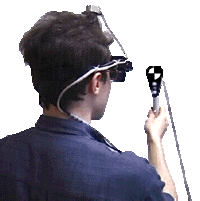
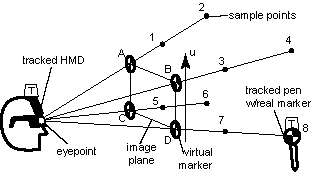
The user clicks on a predefined set of virtual markers.
The resulting data is fed into a two-stage optimization procedure
which calculates the geometric camera parameters like position, orientation and field-of-view.
|
|
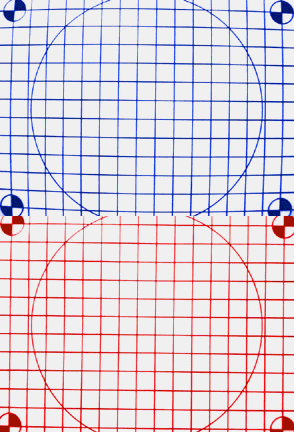
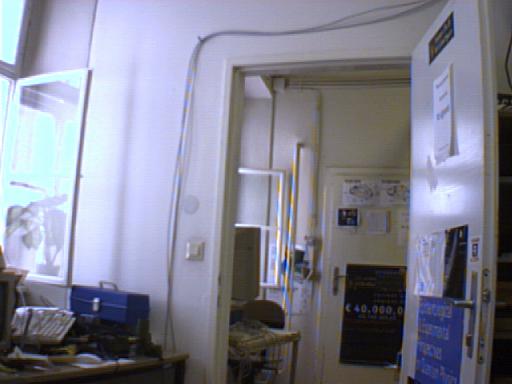
| Most camera lenses distort the images non-linearly (barrel distortion, blue). We compensate this distortions in realtime (red). |
| Related topics: |
Detailed description of calibration method (full paper)
STUDIERSTUBE |