
ENVIRON-HYDRO: Environmental Hydropower
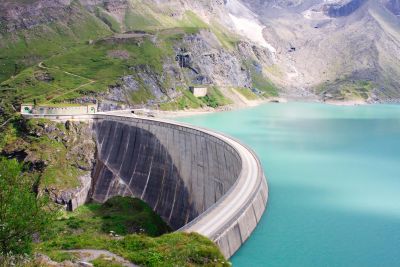
The ENVIRON-HYDRO project addresses the growing challenges faced by hydropower plants due to climate change and evolving regulatory frameworks. Austria generates around 70% of its electricity from hydropower, making it one of the most hydropower-dependent countries in Europe. However, many existing plants are aging and are increasingly vulnerable to hydrological changes, extreme weather events, and environmental pressures. ENVIRON-HYDRO aims to develop a hybrid data-driven model that integrates internal operational data from hydropower plants with external environmental parameters, enabling more accurate diagnostics, performance assessments, and long-term operational forecasts. This will lay the foundation for resilient, climate-adaptive, and ecologically compatible hydropower systems.
At its core, the project focuses on integrating high-frequency sensor data (e.g., vibration, pressure, temperature) with external, typically low-frequency environmental data (e.g., weather patterns, sediment transport, snowmelt). This integrated approach enables the discovery of relationships between plant performance, environmental behavior, and climatic trends - connections that have remained largely unexplored in current practice. ENVIRON-HYDRO thus goes beyond previous research efforts that rely on isolated data streams. At the same time, it tackles key challenges in data fusion, such as differences in resolution, data format, and semantic context.
The project applies methods from cross-domain data fusion and probabilistic modeling (e.g., Bayesian networks) to combine these heterogeneous data sources into a meaningful framework. The result is a virtual, adaptive representation of hydropower operation under real-world environmental conditions. These models will be used to identify the impacts of seasonal and long-term climate changes and provide actionable recommendations for future operations.
Funding
- FFG - Österr. Forschungsförderungs- gesellschaft mbH
Project Partner
- TU Wien - Research Unit of Fluid Flow Machinery
- Salzburg AG für Energie, Verkehr und Telekommunikation
- UBIMET GmbH
- VibroConcept GmbH
Team
Research Areas
 In this research area, our focus lies on novel visual encodings and interaction techniques to explore a large amount of abstract data, often in combination with analytical reasoning.