
Speaker: Elias Füricht
Abstract
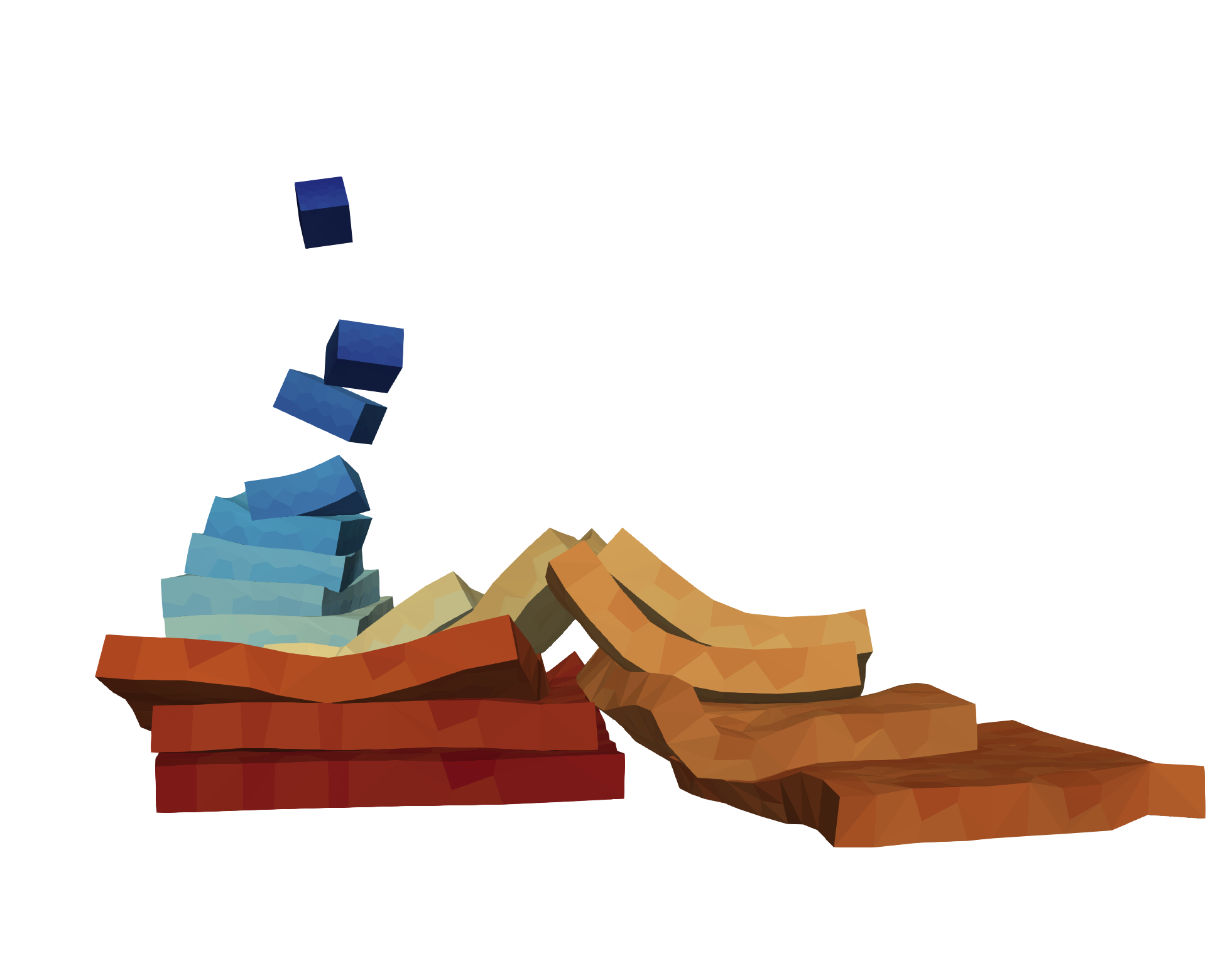
Collision handling for deformable objects is particularly challenging when their volumes are discretized into general polyhedral elements. Unlike standard tetrahedral meshes, these elements have irregular topology, may contain non-planar polygonal faces, and can become non-convex during simulation. This thesis presents a collision handling pipeline for elastic polyhedral meshes that runs entirely on the GPU and extends an existing Virtual Element Method simulation framework.
Our pipeline traverses a Bounding Volume Hierarchy (BVH) to generate candidate pairs of intersecting element Axis-Aligned Bounding Boxes (AABBs). Topological neighborhood information and an active-element classification avoid tests that cannot produce relevant contact. For the remaining pairs, an image-based collision detection method, adapted from previous work, rasterizes a triangulated representation of the polyhedral surfaces using a custom CUDA compute rasterizer. A position-based correction approach is then used to reduce interpenetration between colliding elements and also computes resulting forces to be fed into the subsequent solver iteration.
Our evaluation shows that the detection method is accurate, the detected pairwise overlap is generally reduced over time and active-element and neighborhood filtering avoid many unnecessary collision tests. Among the three collision-handling stages, the image-based narrow phase has the most dominant runtime and memory cost and is therefore the primary target for further optimization. Overall, the implementation provides a practical foundation for GPU-based collision handling on deformable polyhedral meshes and identifies several directions for future work.