

Details
Type
- Bachelor Thesis
- Student Project
- Master Thesis
Persons
Motivation
Human drivers regularly make mistakes when driving a vehicle, especially in a dense city, due to many traffic signs, overcomplex, incomprehensible, or conflicting regulations, and human capacity to consider multiple traffic signs, street markings, other nearby vehicles that can cause stress, and impairments due to tiredness, intoxication, or distractions. Often, small traffic rule violations do not result in consequences such as damage to humans, vehicles, or street furniture, leading to increased tolerance of doing so (if nothing happens 1000 times, the human mind tends to regard it as safe).
Detecting and collecting statistics on which rules tend to be violated, where, and how often can yield valuable information to city officials responsible for safe street design to improve the street infrastructure, and remove redundant or unnecessary markings or signs, or add such items to clarify unclear situations.
Description
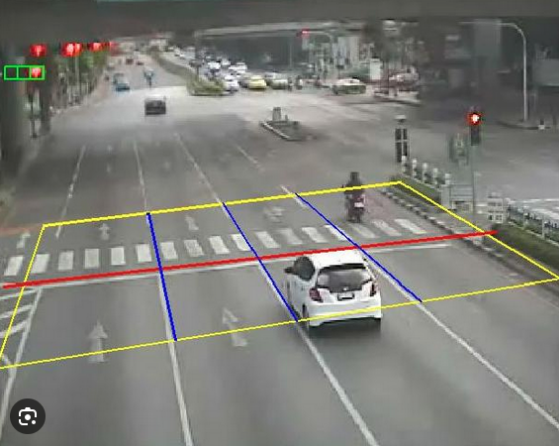
This requires (pre-trained) neural network models to detect entities in the vicinity of the vehicle, including vehicles, traffic signs, and traffic lights, as well as street markings (e.g., lanes) and street boundaries such as curbs. In addition to static detections such as being across a non-cross line, temporal analysis is important to detect red light runs, too close driving (which also depends on speed), and other time-dependent violations of traffic signs.
Preliminary work has been documented in this bachelor's thesis: https://www.cg.tuwien.ac.at/research/publications/2025/mueller-2024-rbt/mueller-2024-rbt-thesis.pdf, and here are some references of the state of the art:
https://link.springer.com/article/10.1007/s44196-024-00427-6
https://arxiv.org/abs/2305.08673
https://ieeexplore.ieee.org/abstract/document/11146662
https://joiv.org/index.php/joiv/article/view/2941/1061
Tasks (depending on PR/BA/DA and number of students)
- Detection of vehicle positions
- Detection of street markings, including lane dividers, pedestrian crossings, restricted zones, and stop lines
- Detection of traffic signs
- Detection of street boundaries, such as curbs, bicycle lanes, sidewalks, and their combinations at crossroads
- Detection of traffic light states
- Static and temporal analysis of traffic states with respect to various rules according to the Austrian traffic law (StVO)
- Evaluation of the quality of detection of the various rule violations based on video
Requirements
- Knowledge of English (source code comments and final report have to be in English)
- Experience in Linux, python, and machine learning is a plus
Environment
A bonus of €500/€1000 if completed to satisfaction within an agreed time-frame of 6/12 months (PR/BA or DA)