About the Project
This project implements an approach to network visualization through node-group separation presented by Suh et.al, leveraging persistent homology to guide force-directed graph layouts. By analyzing the topological features of networks, we can create more meaningful and structured visualizations that reveal underlying community structures and relationships.
Based On
Suh, Ashley & Hajij, Mustafa & Wang, Bei & Scheidegger, Carlos & Rosen, Paul. (2019). Persistent Homology Guided Force-Directed Graph Layouts. IEEE Transactions on Visualization and Computer Graphics, vol. 26, no. 1, pp. 697-707, Jan. 2020 DOI: 10.1109/TVCG.2019.2934802.
Screenshots
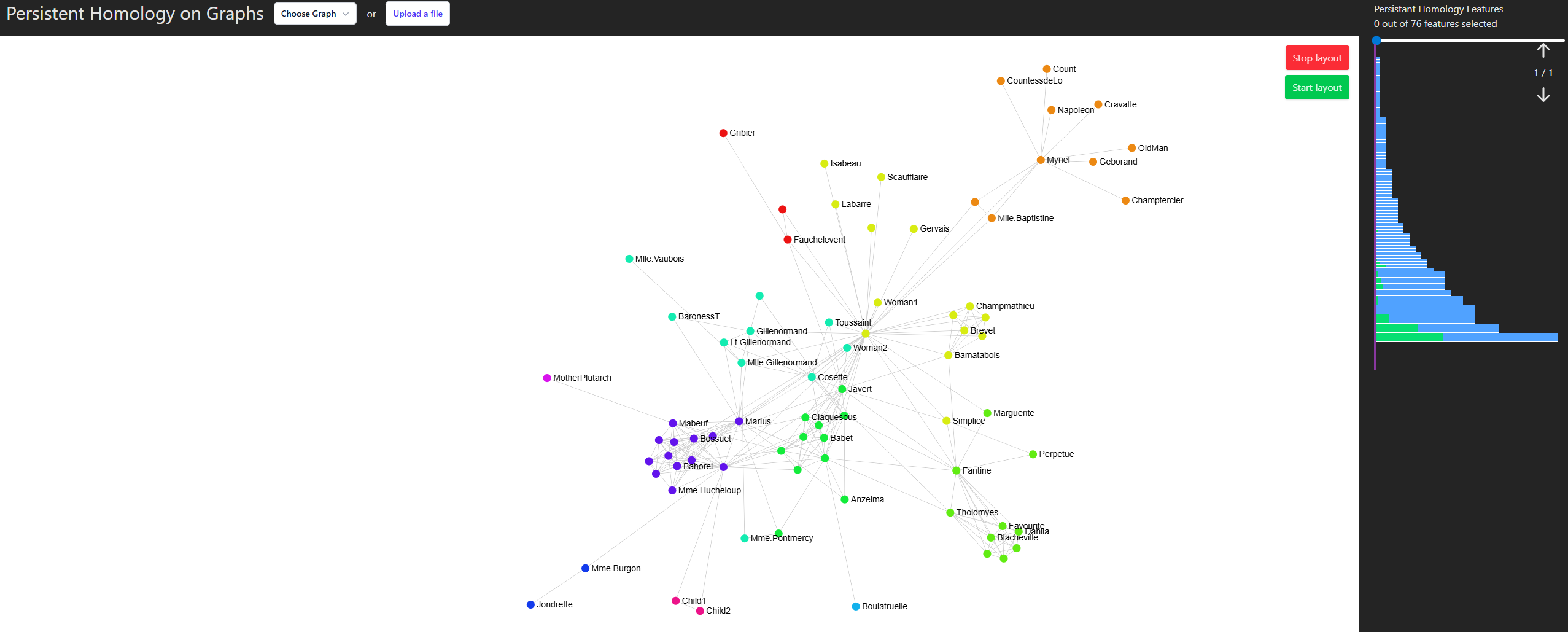
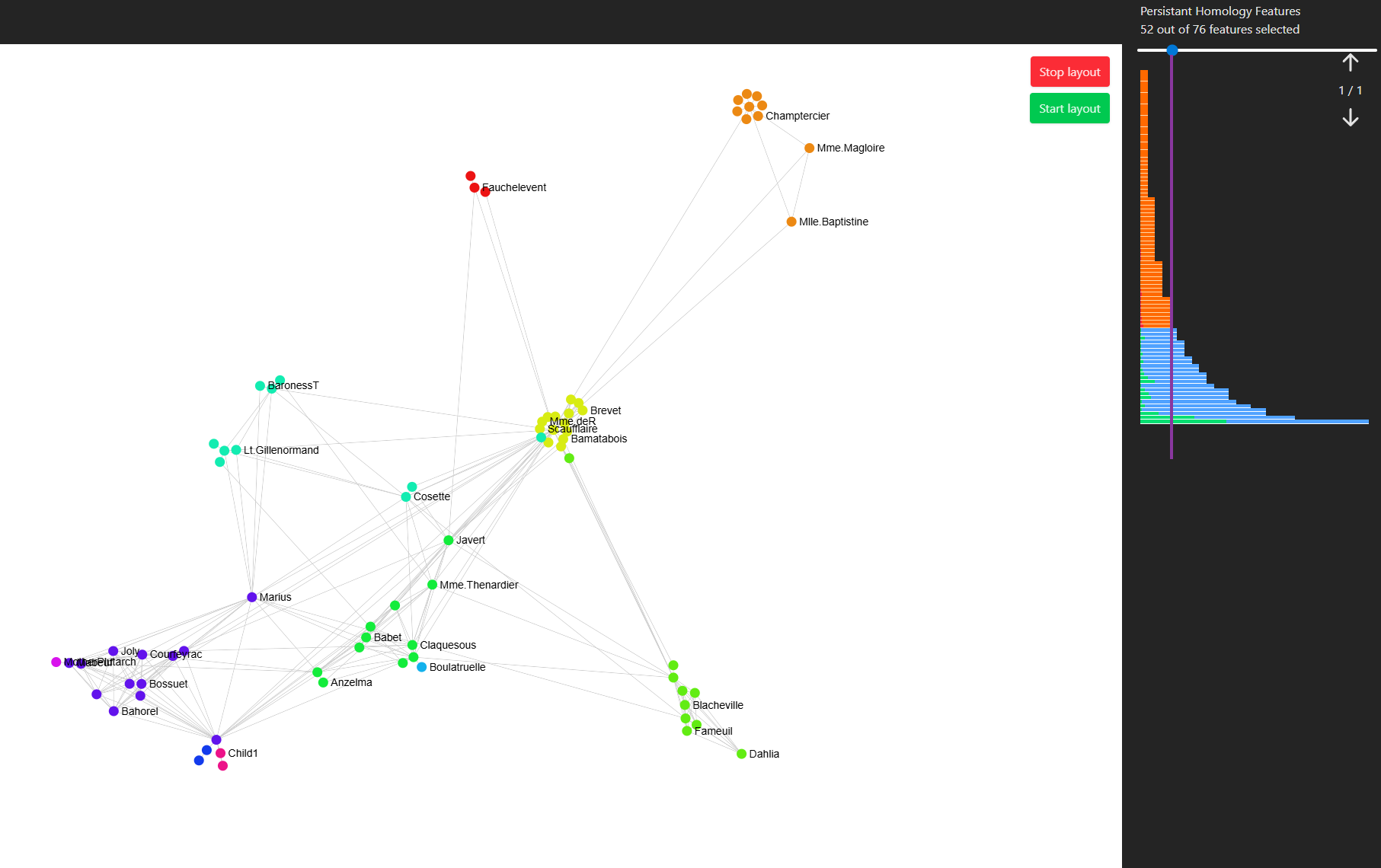
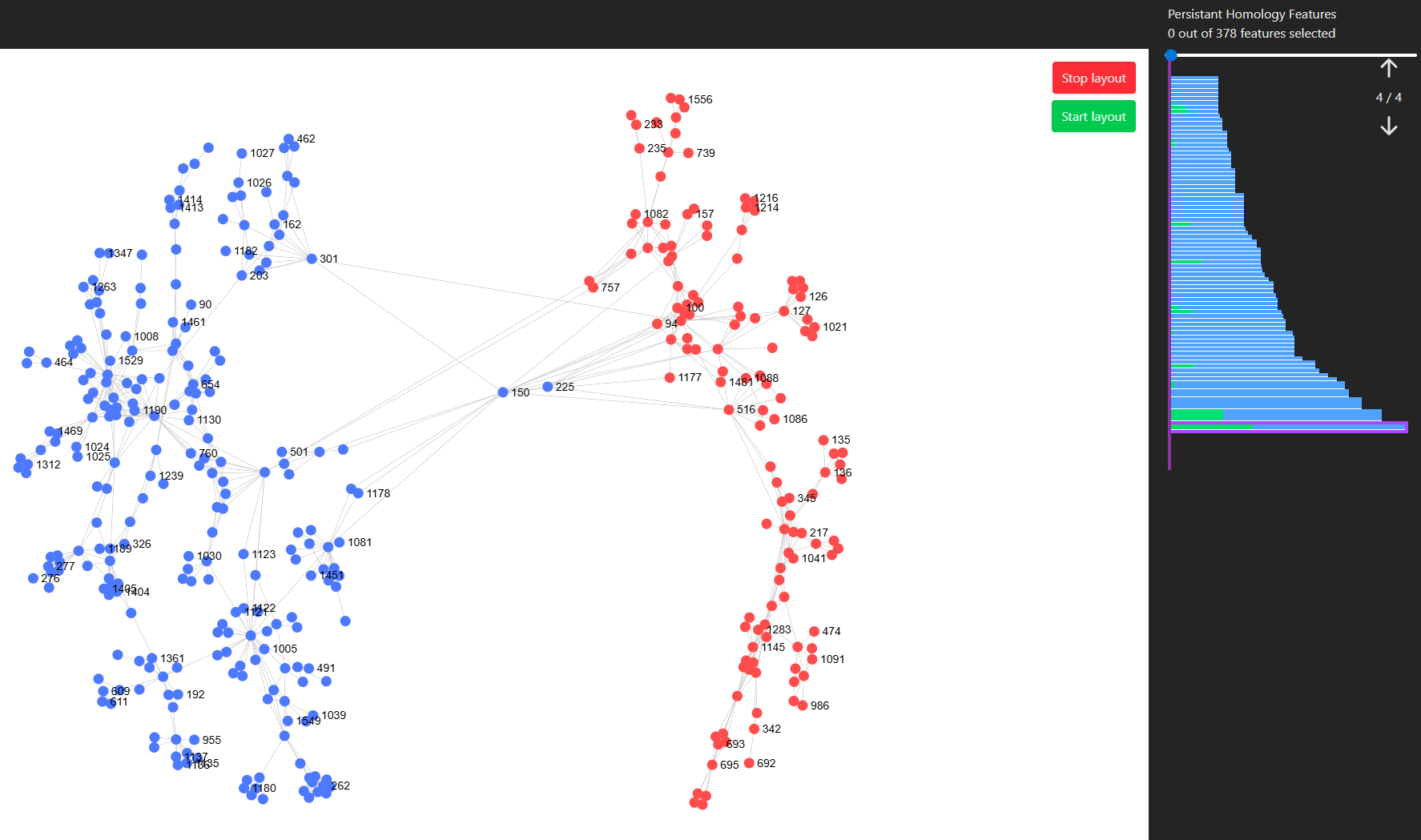
Features
Graph Visualization
Interactive visualization of network graphs using sigma.js and Graphology. The system provides real-time rendering of nodes and edges, allowing users to explore complex network structures with smooth pan, zoom, and interaction capabilities.
Persistent Homology Barcode
Generates barcode diagrams that represent the topological features of the network across different scales. Each bar in the diagram corresponds to a topological feature and shows its persistence. Longer bars indicate more significant structural features, helping identify robust community structures and hierarchical organization in the network.
PH Repulsion
Applies repulsive forces between nodes based on persistent homology analysis. This feature uses topological information to push apart nodes that belong to different communities or clusters, enhancing visual separation between distinct groups.
PH Contraction
Implements attractive forces within topologically identified communities to create tighter, more cohesive clusters. This contraction mechanism pulls together nodes that share strong topological relationships, making community structures more visually apparent.
Technologies
- React: Modern JavaScript library for building interactive user interfaces with component-based architecture
- sigma.js: High-performance graph visualization library optimized for rendering large networks in the browser
- Graphology: Powerful graph data structure library for JavaScript, providing comprehensive graph manipulation and analysis tools
How to Run
- Navigate into the
/sigmadirectory - Run
npm installto install dependencies - Execute
npm run devto start the development server - Open your browser and navigate to the provided localhost URL