Mixed Reality Edutainment Installations
Mixed reality (MR) is currently the cutting-edge technology for edutainment installations, which are typically produced for exhibitions and fairs. Their main characteristics are intuitive interfaces and immersive displays, which allows creating exciting interactive experiences. Edutainment installations are an ideal instrument to arouse the public's interest for historic facts or brand new archaeological discoveries. They make pastime events perceivable in a multi-modal way, thereby also addressing other sense besides vision and hearing.
Another important aspect for any presentation is the interpretation of the historical data. Digital storytelling embeds archaeological or historical facts into an interesting story. It allows different points of view of a historical event and is thus also a meaningful tool for archaeologists and historians as well.
The following three MR edutainment installations have been produced and will be set-up on site for an presentation event planned for spring of 2009. They mediate historical facts related or associated with Leopoldsberg, a famous Viennese location.
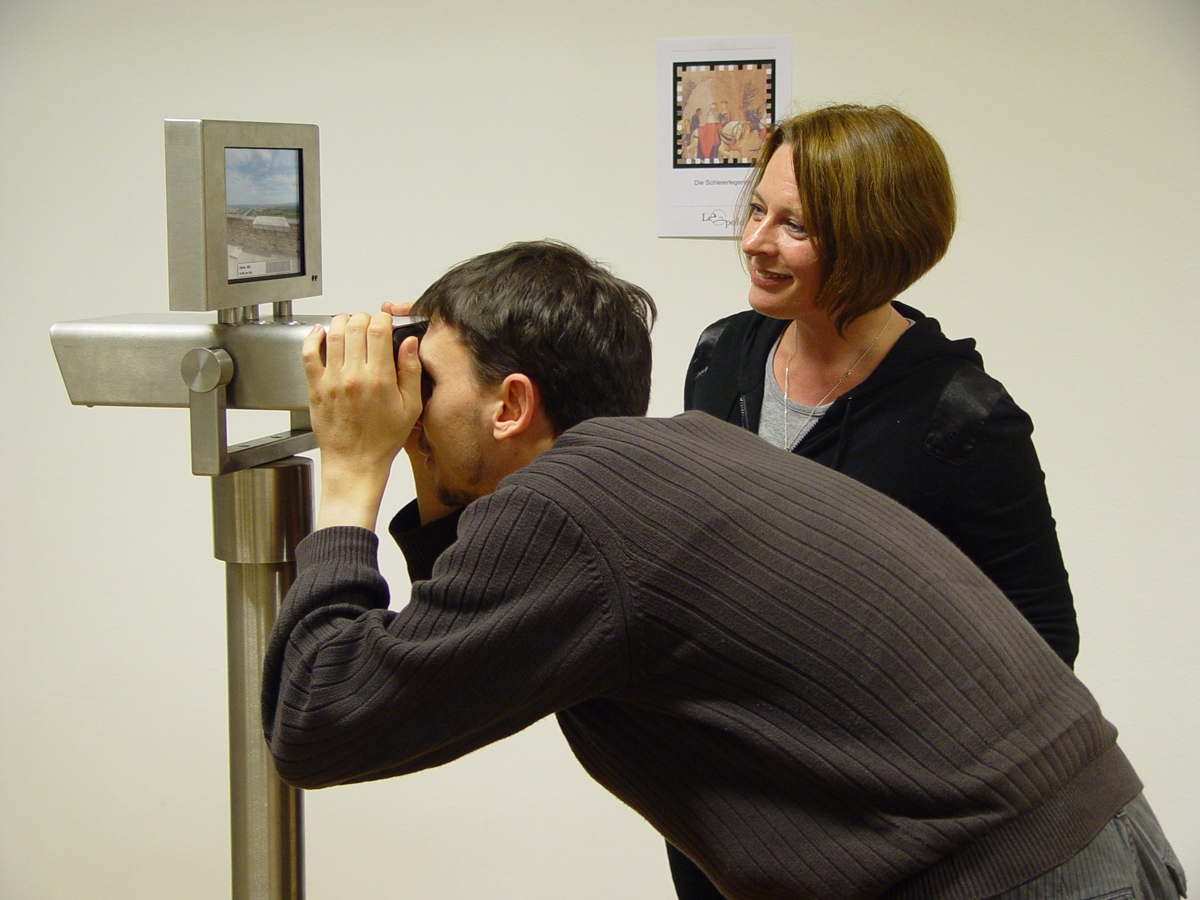
Magic Binoculars
They look like ordinary binoculars mounted on a stand, so that they can be turned around by 360° and tilted up and down. In this way users navigate through a surround panorama. This is achieved by a sensor system and built in displays. Speakers are also integrated to provide sound.The external display mounted on top allows more users to share the experience.
With push buttons user can switch between different historical epochs. For each epoch a surround panorama can be viewed that has embedded hotspots. They can be activated to start a multimedia presentation that tells a story associated with the location marked by the. For example when choosing the Medieval as epoch and looking at the spot of the castle, where the old forge was excavated, a presentation starts that tells the story about the construction of the castle.
In this way visitors can explore the past of Leopoldsberg and Vienna in an exciting and surprising way.
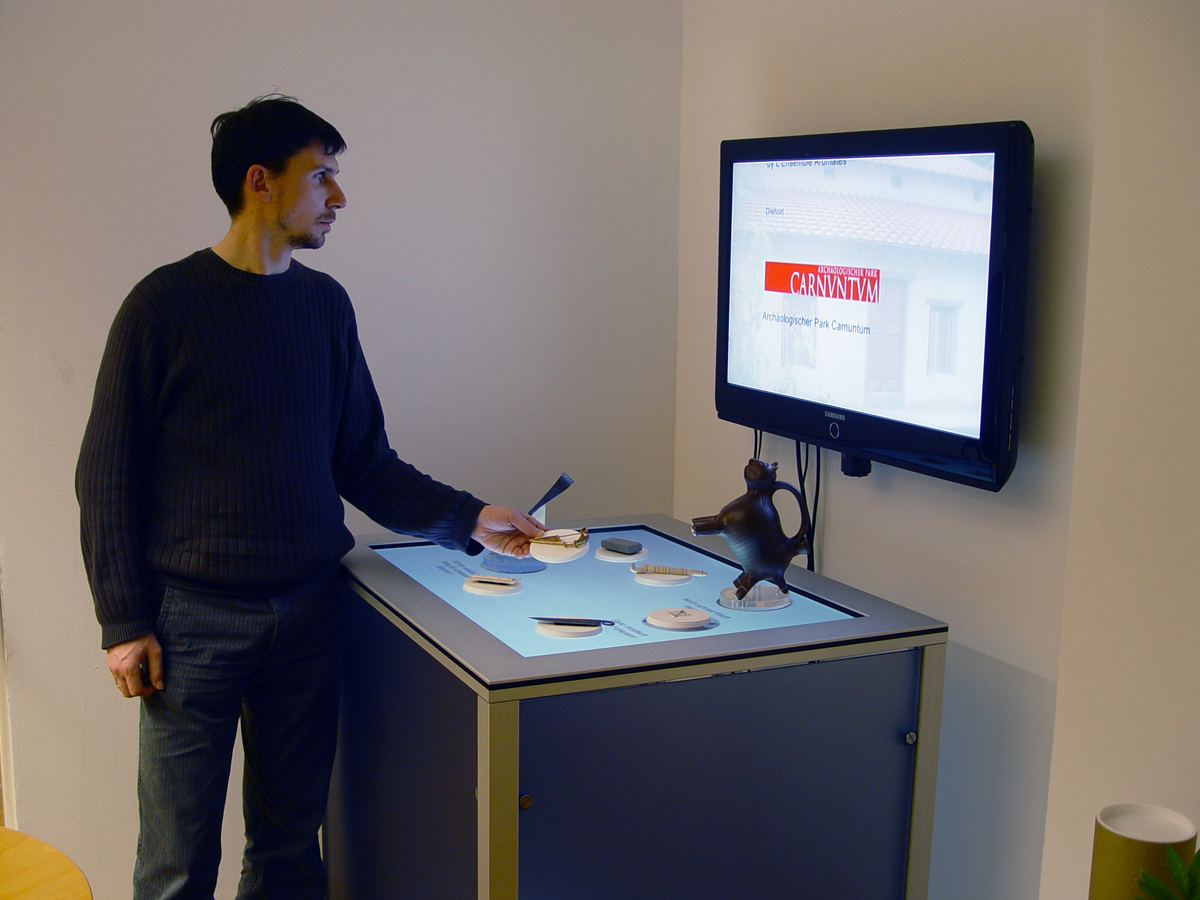
Window to the Past
This installation focuses on the theme of body care for different historical epochs. Replicas of artifacts associated with body care are presented on a table with a flat panel screen. Examples are ancient razors, a comb, an aquamanile and even a device to get rid of fleas used during Baroque times. Since body care differs between the genders there will be an equivalent number of objects associated with women and men.
When a visitor picks up an object the corresponding story is started. This is recognized by attaching markers to the objects and capture them from below through the transparent surface.
Visitors will learn, how and when the item was used by watching a brief video documentary. These documentaries were produced with lay actresses and actors in authentic costumes and at historically relevant locations, like the reconstruction of an Celtic dwelling in Schwarzenbach, a Roman mansion in Carnuntum, castle Forchenstein and the Baroque castle Schloßhof.
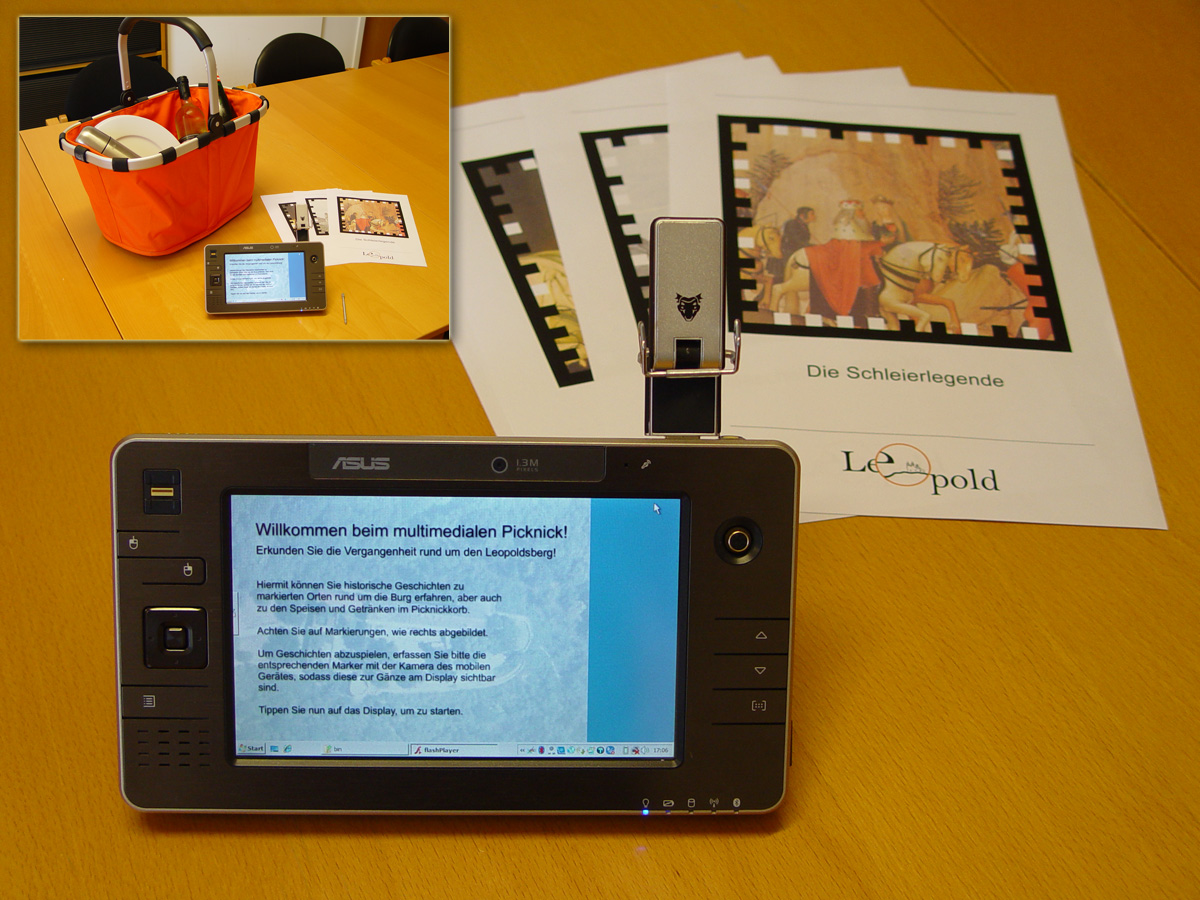
Multimedia Picnic Basket
Leopoldsberg was a favorite place for picnics during the Biedermeier epoch. This edutainment application let visitors experience Biedermeier style picnics. They will get a basket with foods and drinks, which are typical for this epoch. The idea is to encourage visitors to stroll around the castle and the court after they have enjoyed their picnic taking the basket with them.
The picnic basket is equipped with a mobile device. It knows the position of its user and recognizes markers attached to historical spots in the vicinity via its built-in camera. When visitors come near to such a spot the device plays the corresponding story. So visitors can combine a recreational walk with historical experiences embedded in the real environment.
During the picnic the basket also recognizes, which foods and drinks are taken out and tells a related story about it. In this way taste and smell are addressed as well within this culinary installation.